Blog

  • The Couple’s Guide to Wedding Vendor Agreements: Everything You Need to Protect Your Celebration

    The Couple’s Guide to Wedding Vendor Agreements: Everything You Need to Protect Your Celebration

    Wedding Supplier Contracts are the only thing standing between a perfect celebration and a logistical nightmare. When you are planning the biggest day of your life, you aren't just choosing flowers or tasting cakes; you are engaging in high-stakes project management. Most couples treat contracts as a formality, a "click-to-accept" hurdle on the way to the fun stuff. This is a mistake that kills budgets and ruins memories.

    In the wedding industry, vendors typically use their own paper. These agreements are drafted by their lawyers to protect their bottom line, not your peace of mind. To secure your celebration, you must approach every signature as a defensive maneuver. You need to identify the traps, lock in the deliverables, and ensure that "force majeure" isn't used as a get-out-of-jail-free card for poor service.

    The High Cost of Vague Language

    A contract that lacks specificity is a liability. If your agreement with a florist simply says "flowers for the ceremony," you have no recourse if they show up with wilted carnations instead of the premium peonies you discussed. Wedding Supplier Contracts must be granular. If it isn't in writing, it doesn't exist.

    Vague terms like "industry standard" or "reasonable efforts" are red flags. These phrases are designed to give vendors an out when things go wrong. You aren't paying for "reasonable efforts"; you are paying for a specific result. Your contracts should detail every deliverable, from the exact number of hours a photographer will be on-site to the specific brand of gin the bar will serve. For more insights on how to structure your event planning for success, check out our innovation ideas.

    Macro shot of a pen on paper representing detailed Wedding Supplier Contracts to protect the couple.
    Alt: A close-up of a couple reviewing Wedding Supplier Contracts with a focus on fine print.

    Identifying Red Flags in Wedding Supplier Contracts

    To protect the couple, you must learn to spot "poison pill" clauses before you sign. Vendors often hide lopsided terms in the fine print. Here are the most common red flags:

    1. Non-Refundable Everything: While deposits are standard, a contract that declares all payments non-refundable regardless of the circumstances is predatory. There should always be a sliding scale based on how far in advance a cancellation occurs.
    2. The "Substitution" Clause: Many vendors include language allowing them to substitute products or personnel at their "sole discretion." This is a loophole. You should require that substitutions be of "equal or greater value" and require your written approval.
    3. Indemnification Overload: If a vendor asks you to indemnify them for their own negligence, walk away. You should not be held liable for a professional's failure to maintain a safe environment or follow local regulations.
    4. Vague Timelines: "Delivery on the wedding day" is not enough. You need specific load-in and load-out times.

    When you encounter these red flags, do not be afraid to strike them out. A contract is a negotiation, not a decree. If you need inspiration on how to leverage technology to manage these negotiations, visit our development ideas page.

    Locking in Service Delivery: The Performance Shield

    The biggest fear for any couple is the "no-show." To prevent this, your Wedding Supplier Contracts must include performance guarantees. This goes beyond just showing up; it’s about performing the specific duties agreed upon.

    For example, a videographer's contract should specify the "raw footage" delivery date and the number of edit revisions included. Without these specifics, the vendor can hold your memories hostage or deliver a subpar product with no incentive to fix it. We often see couples lose leverage the moment the final payment is made. To keep the power in your hands, structure your payments so a portion is held until final deliverables: like the wedding album or the edited video: are received.

    Magnifying glass over digital documents symbolizing a thorough audit of Wedding Supplier Contracts.
    Alt: A digital dashboard showing the management of Wedding Supplier Contracts to protect the couple.

    Vow Shield: Your Digital Guardian

    At GHW-Digital, we understand that managing a dozen different Wedding Supplier Contracts is a recipe for human error. That is why we emphasize the importance of centralized contract management. We advocate for tools like Vow Shield, a dedicated framework designed to protect the couple from vendor slip-ups.

    Vow Shield isn't just a folder for your PDFs; it’s a proactive defense mechanism. It tracks deadlines, flags inconsistent clauses across different vendors, and ensures that your catering contract doesn't conflict with your venue's rules. It’s about creating a unified legal front for your wedding. Instead of 15 separate agreements, you have one cohesive plan. If you're interested in how we build these kinds of protective systems, explore our latest concepts.

    The "Act of God" Trap

    The pandemic taught the wedding industry a hard lesson about "Force Majeure." Many couples lost thousands because their Wedding Supplier Contracts didn't account for government-mandated shutdowns.

    A modern, couple-focused contract must have a clear "Impossibility of Performance" clause. This should specify what happens if the venue burns down, a global health crisis occurs, or the vendor is incapacitated. It should outline a clear path for rescheduling without additional fees or a full refund if rescheduling is impossible. Do not let "Acts of God" become a way for vendors to keep your money without providing a service. According to legal experts at Cornell Law School, these clauses must be specific to be enforceable in your favor.

    Digital shield protecting a white rose illustrating the Vow Shield for Wedding Supplier Contracts.
    Alt: A protective shield icon over a wedding contract icon, symbolizing Wedding Supplier Contracts protection.

    Ensuring Alignment Across All Vendors

    Your vendors do not work in a vacuum. The DJ needs the venue's power specs; the caterer needs the rental company's kitchen equipment. If their contracts don't align, you are the one who pays the price.

    When reviewing Wedding Supplier Contracts, check for "cross-vendor dependencies." If your venue contract says music must stop at 10:00 PM, but your DJ contract is for service until 11:00 PM, you are wasting an hour of fees. Aligning these documents is crucial for a seamless event. We provide a wealth of resources on aligning complex project requirements on our ideas site.

    Action-Benefit: How to Negotiate Like a Pro

    • Action: Request an itemized list of all fees. Benefit: Eliminates "hidden" service charges and "admin fees" that can bloat your budget by 20%.
    • Action: Add a "Personal Performance" clause for key talent. Benefit: Ensures the specific lead photographer or DJ you hired actually shows up, rather than a junior associate.
    • Action: Define "Deliverables" with dates. Benefit: Prevents the "six-month wait" for wedding photos that many couples face.
    • Action: Require proof of insurance. Benefit: Shifts liability away from you in the event of an accident on-site.

    For more strategic advice on managing high-stakes projects, see our comprehensive ideas list.

    Wedding rings secured under a glass cloche representing protection within Wedding Supplier Contracts.
    Alt: A couple shaking hands with a vendor after successfully negotiating Wedding Supplier Contracts.

    Finalizing the Agreement

    Before you put pen to paper, do one final pass. Ensure that every verbal promise made during the sales pitch is documented. If the venue manager promised you a "free champagne toast," put it in the contract. If the limo driver said they would provide "unlimited stops," put it in the contract.

    Wedding Supplier Contracts are not about lack of trust; they are about clarity. A good vendor will appreciate a detailed contract because it protects them from "scope creep" just as much as it protects you from "service shrink." It establishes a professional boundary that ensures everyone is on the same page. For more tips on maintaining professional boundaries in tech and events, check out this guide by Brides on contract basics.

    The goal is a celebration where you can focus on the moment, not the fine print. By treating your Wedding Supplier Contracts with the seriousness they deserve, you build a fortress around your wedding day.

    Stop letting vendors dictate the terms of your celebration. Secure your investment, lock in your vision, and protect your peace of mind.


    Marblism Legal Shield Footer

    GHW-Digital provides this information for educational purposes only. We are app development experts, not a law firm. While we build tools like Vow Shield to help you organize and manage your digital life, we recommend consulting with a qualified legal professional to review any binding agreements. Our commitment is to transparency, fairness, and the protection of our users' interests through better data management and clear communication.

    Take control of your celebration today. Don't sign a single document until you've verified it against your protection checklist.

    Start building your protective strategy now.

  • Why Your Current Service Agreement is Leaking Profit: The Ultimate Guide to Crucial Protection

    Why Your Current Service Agreement is Leaking Profit: The Ultimate Guide to Crucial Protection

    Why your current service agreement is leaking profit isn’t just a curiosity: it’s a financial emergency. In the world of high-stakes app development and freelance consulting, your contract is either a shield or a sieve. Most business owners treat their service agreements like a one-time administrative hurdle. They sign it, file it, and forget it. Meanwhile, revenue is quietly draining out of the back door through unbilled hours, missed milestones, and the silent killer of all margins: scope creep.

    At GHW-Digital, we see it constantly. A project starts with clear boundaries, but slowly, those boundaries dissolve. A "quick tweak" here, an extra "small feature" there, and suddenly you’re working for half your intended hourly rate. If you don't have a structural defense in place, you are essentially volunteering your time to your clients’ bottom line.

    The Reality of Why Your Current Service Agreement is Leaking Profit

    Profit leakage isn't usually one massive mistake. It’s a thousand tiny papercuts. Research suggests that the average company loses between 9% and 12% of its annual revenue due to contract mismanagement. For a boutique agency or an elite freelancer, that is the difference between scaling your business and just staying afloat.

    The primary reason why your current service agreement is leaking profit is that it’s likely a static document. You’re using a PDF or a Word doc that lives in a folder somewhere, disconnected from your actual workflow. When your contract is disconnected from your delivery, you lose visibility. You forget what you promised, and more importantly, you forget what you didn't promise.

    Digital shield with leaks showing why your current service agreement is leaking profit due to scope creep.
    Alt-text: A digital visualization showing why your current service agreement is leaking profit through gaps in a digital shield.

    Scope Creep: The Invisible Margin Killer

    Scope creep is the most common way profit escapes. It’s a "nice guy" problem. You want to provide value. You want the client to be happy. So, when they ask for a minor adjustment to the app interface, you say "no problem."

    But it is a problem. According to industry insights from Forbes, unplanned work can account for up to 30% of a project's total labor. If that labor isn't tracked against a rigid agreement, you’re hemorrhaging cash. Your agreement needs to be a living boundary, not a dusty piece of paper. It needs to define exactly where the project stops.

    Structural Risks: Why Your Current Service Agreement is Leaking Profit

    If your agreement is vague, you are essentially giving your client a blank check. Most contracts fail because they lack "hard stops." They use soft language like "reasonable revisions" or "timely updates." In a professional environment, "reasonable" is a subjective term that usually favors the person paying the bill.

    1. The PDF Dead-End

    Storing contracts as flat files is a liability. A PDF cannot send you a notification when a milestone is reached. It cannot alert you when a client has requested work that falls outside of Section 4.2. To protect your margins, you need to transition from "documents" to "data." When your contract terms are structured data, they can be monitored and enforced automatically.

    2. Manual Billing Discrepancies

    How many times have you reached the end of a month and realized you forgot to bill for a specific consultation? Or worse, you realize your "introductory rate" should have expired three months ago, but you’ve still been billing at the lower price? This is a fundamental reason why your current service agreement is leaking profit. Manual billing is prone to human error, and human error almost always costs the service provider, not the client.

    3. Missing Obligation Tracking

    Every contract is a list of obligations. You have obligations to deliver; the client has obligations to pay and provide feedback. When these aren't tracked systematically, milestones slip. When milestones slip, project timelines extend. When timelines extend, your overhead increases, but your project fee stays the same. That is the definition of profit leakage.

    Data dashboard tracking why your current service agreement is leaking profit across project milestones.
    Alt-text: A minimalist dashboard showing how why your current service agreement is leaking profit can be identified through data tracking.

    Plugging the Gap: Why Your Current Service Agreement is Leaking Profit Needs a Solution

    You need to stop the bleeding. This isn't about being "difficult" with clients; it’s about respect. You respect their time by delivering high-quality code and design; they must respect your time by adhering to the agreed-upon scope.

    Implement a Scope Guard Mentality

    At GHW-Digital, we believe in the "Digital Architect" persona. An architect doesn't just start building; they have a blueprint. If a homeowner wants to add a second story halfway through the build, the architect doesn't just grab more wood: they revise the blueprint and the budget.

    You need to do the same. Tools like Scope Guard Elite are designed to provide this exact level of protection. By formalizing every change request, you turn a potential profit leak into an upsell opportunity.

    Action-Benefit: Lock in Your Boundaries

    • Define the "No-Fly Zone": Explicitly list what is NOT included in the project. This removes ambiguity and makes it easier to say "that will require a change order."
    • Automate Milestone Alerts: Use systems that notify both you and the client when a billable event occurs. Don't wait for the end of the month to "figure it out."
    • Centralize Communication: Stop taking project requests over Slack or WhatsApp. If it’s not in the project management system, it doesn't exist.

    Action-Benefit: Automate the Defense

    The most effective way to ensure your service agreement holds water is to use automation. As noted in Harvard Business Review studies on contract management, automation can reduce leakage by up to 50%. By utilizing a system like Vow Guard Elite, you ensure that the promises made during the sales process are the exact promises being tracked by the production team.

    Futuristic lock symbolising the solution for why your current service agreement is leaking profit.
    Alt-text: A secure digital lock icon representing the solution to why your current service agreement is leaking profit.

    Moving From Vulnerable to Protected

    If you’re ready to stop the drain, you have to change your relationship with your contracts. They are not just legal "safety nets" for when things go wrong; they are operational manuals for how you make money.

    Stop giving away the "extra 10%."
    That extra 10% of effort you give away for free on every project is your profit margin. If you’re working with a 20% margin and you give away 10% in untracked scope creep, you’ve just cut your take-home pay in half.

    Structure your data.
    Take your existing agreements and break them down. What are the triggers? What are the limits? If you cannot easily see these things at a glance, neither can your team, and neither can your client. Visibility is the first step toward enforcement.

    Use Professional Shielding.
    For those in the app development space, the stakes are even higher. Technical debt often follows scope creep. When you rush to finish an unbilled feature, you write sloppier code. This leads to bugs, which lead to more unbilled "fix-it" time. It’s a downward spiral. Using a tool like Scope Sentry allows you to maintain the integrity of your code and your bank account simultaneously.

    Final Thoughts: Secure Your Competitive Advantage

    The freelance and agency market is more competitive than ever. The winners aren't just the ones who code the fastest or design the best; they are the ones who run the tightest ships. Every dollar you lose to profit leakage is a dollar you can't invest back into your team, your tools, or your growth.

    Why your current service agreement is leaking profit is a problem with a clear solution: transition to structured, automated, and enforced agreements. Protect your time. Protect your expertise. Most importantly, protect your profit.

    Powered by GHW Digital (Company No: 16834250). This document is an automated draft for business organization purposes only. It does not constitute legal advice. GHW Digital accepts no liability for disputes, financial loss, or enforceability. Users must consult a qualified professional in their jurisdiction before signing.

  • Autonomous Digital Assets Explained: Elite Protection and Ultimate Security

    Autonomous Digital Assets Explained: Elite Protection and Ultimate Security

    Meta Description: Discover how Autonomous Digital Assets provide elite protection for your business, replacing expensive consultants with automated professional service contracts and software.

    Autonomous Digital Assets are the final frontier of business security and contract precision. In a world where scope creep kills margins and manual oversight leads to catastrophic leaks, code-driven protection is the only viable defense. You are currently losing money because you rely on the subjective interpretation of human consultants. It is time to replace those expensive, slow-moving parts with the uncompromising logic of autonomous systems.

    Stop the Bleeding: The High Cost of Human Error

    Traditional business agreements are fragile. They rely on the "good faith" of parties and the expensive intervention of legal consultants when things go south. This is a reactive, failed model. Autonomous Digital Assets flip the script by embedding rules directly into the asset or contract itself.

    When you hire a consultant to manage your project scope, you are paying for an opinion. Opinions are variable. They shift with the wind. Code does not. By moving your operational logic into autonomous frameworks, you eliminate the need for the middleman who charges $400 an hour to tell you that your project is over budget. You already know it is over budget. What you need is a system that prevents the overage from happening in the first place.

    Traditional contracts evolving into secure autonomous digital assets for elite business protection.

    Replace Consultants with Elite Software Tools

    The era of the "expert consultant" is sunsetting. Elite software tools now provide a level of precision that no human can match. At GHW-Digital, we focus on creating systems where Professional Service Contracts are no longer static documents gathering dust in a cloud folder. Instead, they become living, breathing scripts that monitor performance and gate access to funds based on real-time data.

    Think about the traditional "Statement of Work." It is often a vague list of aspirations. When you utilize software like Scope Guard Elite or Vow Guard Elite, those aspirations become hard-coded requirements. If the work is not done, the payment does not trigger. If the scope expands without authorization, the system flags it instantly. This is how you protect your time and your profit.

    Securing Margins through Autonomous Digital Assets

    What makes an asset "autonomous"? It is the ability of the asset: be it a contract, a piece of software, or a digital token: to execute its own rules without external permission. This is often achieved through Smart Contracts, which are self-executing programs that run on a blockchain or a secure distributed ledger.

    By integrating these into your workflow, you achieve a state of Elite Protection. You are no longer defending your business through litigation; you are defending it through architecture. You are building a fortress where the gates only open when the correct keys are presented. This is not just a technological upgrade; it is a fundamental shift in how value is guarded in the digital age.

    A minimalist digital vault door representing elite protection for professional service contracts.

    Eliminate Ambiguity : Secure Your Margin

    Ambiguity is the enemy of profit. In every professional service engagement, there is a "gray area" where consultants thrive and clients lose. Autonomous Digital Assets erase this gray area.

    1. Lock in Scope: Use automated tools to define exactly what is being built.
    2. Track Progress: Real-time data integration ensures you always know where your project stands.
    3. Calculate Risk: Software doesn't guess; it calculates the impact of every change.
    4. Protect Liquidity: Funds are only released upon verifiable milestone completion.

    We have seen too many businesses fail because they couldn't control their own digital ideas. This is why we urge our clients to explore our innovative ideas for app development frequently. The faster you move your logic into an autonomous framework, the faster you stop the leak of revenue caused by manual management.

    Professional Service Contracts: From Paper to Power

    A piece of paper cannot stop a developer from going over hours. A piece of paper cannot prevent a vendor from delivering subpar code. However, a Professional Service Contract that is integrated into an autonomous system can.

    When your contract is an Autonomous Digital Asset, it has teeth. It can revoke access to servers, it can freeze payments, and it can notify stakeholders of breaches the millisecond they occur. This is the difference between a "professional service" and an "elite guarded operation."

    Autonomous digital assets serving as an elite guardian for secure professional service agreements.

    The Future of Autonomous Digital Assets and Professional Service Contracts

    The trend is clear: the world is moving toward decentralization. According to research on Decentralized Autonomous Organizations, the shift toward code-based governance is accelerating. Businesses that refuse to adopt these tools will find themselves stuck in the slow, expensive, and litigious world of the past.

    At GHW-Digital, we don't just build apps; we build guardians for your business interests. Whether you are using Scope Sentry to keep your project on track or building entirely new models of engagement, the goal is the same: absolute control.

    Action-Benefit: Why You Need This Now

    • Action: Implement Autonomous Digital Assets today.

    • Benefit: Eliminate the $20,000/month "management fee" for consultants who add no technical value.

    • Action: Use hard-coded Professional Service Contracts.

    • Benefit: Zero scope creep and guaranteed alignment between what was paid for and what was delivered.

    • Action: Deploy Scope Guard Elite.

    • Benefit: A permanent shield around your project budget that humans cannot override.

    A digital shield protecting project margins and scope through elite protection software tools.

    Maintain Control with Elite Protection

    Elite protection isn't about having the best lawyers on speed dial; it's about making those lawyers unnecessary. When your digital assets are autonomous, the rules are the law. There is no negotiation on a Friday afternoon about whether a feature was "included" or "extra." The system knows. The code remembers.

    If you are tired of the "moving goalposts" and the "leaking revenue" that comes with traditional project management, it is time to pivot. You need to leverage the power of GHW-Digital's app development ideas to transform your business from a vulnerable target into a hardened, autonomous entity.

    Fairness, Respect, and Alignment

    We believe in a professional world where boundaries are respected. This isn't about being "difficult" with vendors or consultants. It is about alignment. When everyone knows the rules are enforced by an impartial, autonomous system, the friction of human emotion is removed. You get better work, faster results, and total transparency. This is how high-performing teams operate in 2026.

    Stop pleading for respect from your contractors. Use software to enforce the respect your budget deserves. Lock in your margins. Protect your time.


    Marblism Legal Shield

    Data Integrity Notice: All information provided regarding GHW-Digital services and autonomous frameworks is designed to optimize business logic. We value blunt honesty. Our systems are built on the principle that code is the ultimate arbiter of truth. We do not use "marketing tricks": we use math and logic to ensure your assets remain yours. Your data remains your own, protected by the very autonomous structures we implement.

    Secure your competitive advantage today. Stop the waste. Build with GHW-Digital.

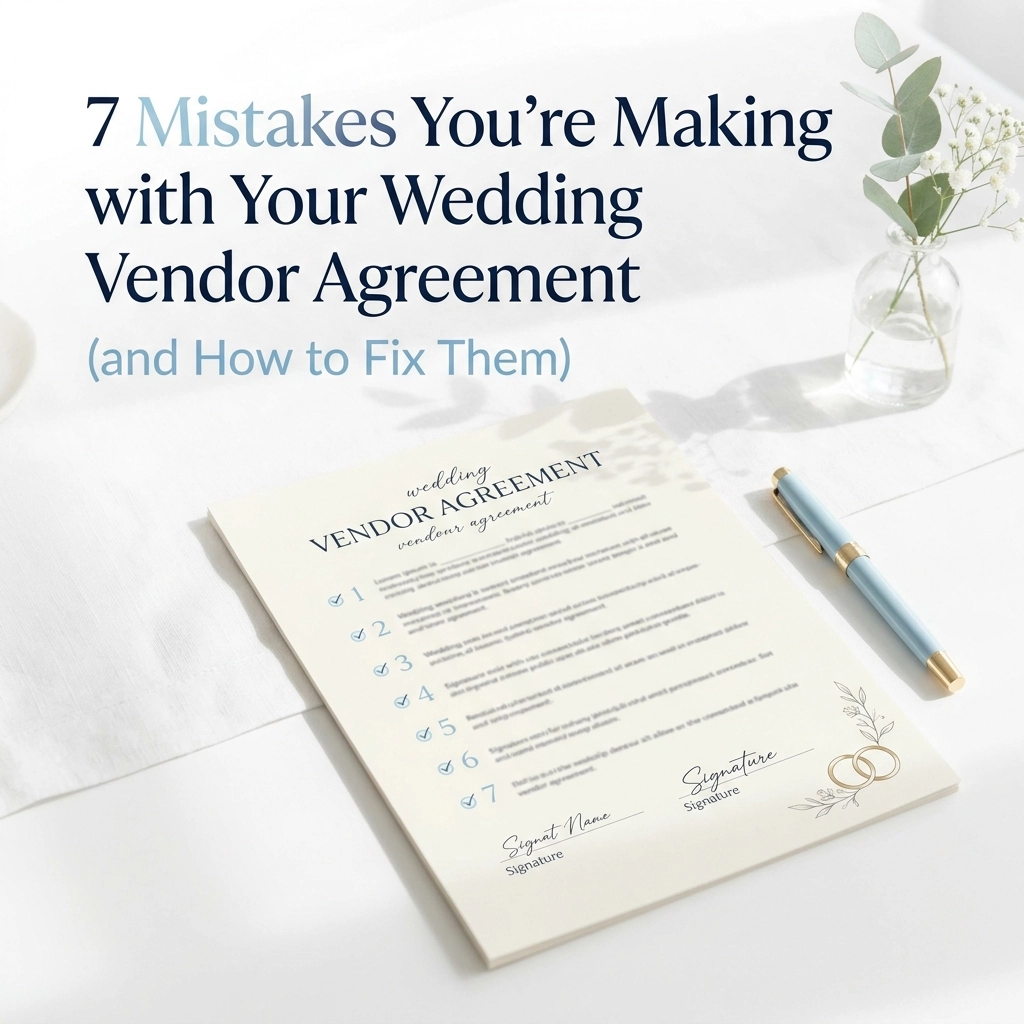
  • 7 Mistakes You’re Making with Your Wedding Vendor Agreement (and How to Fix Them)

    7 Mistakes You’re Making with Your Wedding Vendor Agreement (and How to Fix Them)

    Wedding Supplier Contracts are the only thing standing between you and a logistical nightmare on your big day. When you are planning a wedding, the excitement often overshadows the cold, hard reality of legal documentation. You aren't just buying a cake or a dress; you are entering into a series of high-stakes business partnerships. If those partnerships aren't locked down with a solid agreement, you are the one left holding the bill when things go sideways.

    At GHW-Digital, we see people make the same errors over and over. They trust a "vibe" instead of a clause. They prioritize a friendly smile over a force majeure policy. This is a mistake. To protect the couple, you must treat every vendor interaction with the same scrutiny you’d apply to a corporate merger.

    Here are the seven most common mistakes you’re making with your Wedding Supplier Contracts and exactly how to fix them before you sign your rights away.

    1. Relying on "Handshake" Agreements

    The most dangerous mistake you can make is operating without a formal document. A verbal promise is worth the paper it’s written on. Whether it’s your cousin’s best friend doing the photography or a high-end florist you met at a bridal expo, if the terms aren't in writing, they don't exist.

    The Fix: Every single transaction must be backed by a written agreement. If a vendor hesitates to provide one, it is a massive red flag. A professional vendor uses Wedding Supplier Contracts to protect their business, and a smart couple uses them to ensure service delivery. You can find more strategies on managing these risks at GHW-Digital Ideas.

    2. Accepting Vague Deliverables

    "Floral arrangements for the ceremony" is not a contract term; it’s a suggestion. Vague language is the enemy of accountability. When the contract doesn't specify the types of flowers, the number of bouquets, or the exact dimensions of the centerpieces, you have no recourse if the vendor shows up with half of what you expected.

    The Fix: Demand an itemized list. Your contract should specify quantities, colors, sizes, and even specific flower varieties. Use "Action-Benefit" headers in your mind: Define the Scope : Secure the Vision. If it’s not listed, don’t expect it to appear. For a deeper dive into defining project scopes, check out our resources at https://ghw-digital.com/ideas.html.

    Professional desk with itemized Wedding Supplier Contracts and checkboxes to protect the couple.
    Alt text: Detailed Wedding Supplier Contracts showing itemized lists of services to protect the couple.

    3. Ignoring Arrival and Departure Windows

    Time is the most volatile element of your wedding day. Many couples focus on the "what" and forget the "when." If your caterer’s contract says they will provide "dinner service" but doesn't specify that they must be set up by 5:00 PM, you could be facing hungry guests and a stressed-out coordinator.

    The Fix: Lock in specific timeframes. This includes arrival times, setup completion times, service duration, and teardown windows. Wedding Supplier Contracts must align with your venue’s access hours. If the vendor overstays, who pays the venue’s overtime fee? Ensure the contract states the vendor is responsible for any fines incurred due to their tardiness or slow cleanup.

    4. Missing the "Substitution" Clause

    What happens if your specific photographer gets sick? Or if the peonies you ordered aren't in bloom due to a weather event? Most vendors include a clause that allows them to substitute "equivalent" services or products. The problem is that "equivalent" is subjective.

    The Fix: Define the standard for substitutions. To protect the couple, the contract should state that any substitutions must be approved by you in writing or must meet a pre-defined quality threshold. Don’t let a vendor swap a premium service for a budget alternative without a price adjustment. This is about maintaining the value of your investment. We talk more about value protection over at GHW-Digital Ideas.

    A couple reviewing digital Wedding Supplier Contracts on a tablet to identify red flags.
    Alt text: A couple reviewing Wedding Supplier Contracts for red flags regarding substitution clauses.

    5. Overlooking Hidden Fees and "Standard" Upsells

    The price you see on the brochure is rarely the price you pay. Service charges, gratuities, corkage fees, and "delivery premiums" can bloat your budget by 20-30% if they aren't disclosed in the Wedding Supplier Contracts. These are often buried in the fine print as "variable costs."

    The Fix: Request an "All-In" price. Ask the vendor point-blank: "What other costs could possibly be added to this bill?" Ensure the contract stipulates that no additional charges will be incurred without your express written consent. Total transparency is the only way to prevent budget leakage. For tips on managing complex project budgets, visit https://ghw-digital.com/ideas.html.

    6. Weak Force Majeure and Cancellation Policies

    The last few years have taught us that the unexpected is inevitable. If a vendor’s contract has a "No Refunds Under Any Circumstances" clause, you are in a high-risk position. A fair contract should balance the vendor’s need for security with your need for protection against acts of God or personal emergencies.

    The Fix: Look for a balanced Force Majeure clause. It should cover what happens if the event is postponed versus canceled. Ensure there is a clear schedule for non-refundable deposits and that the vendor's "retained" fees are proportional to the work they have already performed. If you need a more robust solution for tracking these commitments, our Scope Sentry logic applies perfectly here.

    Digital shield protecting a wedding venue icon, representing secure Wedding Supplier Contracts.
    Alt text: Legal documents highlighting red flags in Wedding Supplier Contracts to protect the couple.

    7. Signing Away Your Right to Recourse

    Many vendors include "Liability Waivers" or "Indemnification Clauses" that essentially say you can’t sue them even if they are negligent. Some even include "Non-Disparagement" clauses that prevent you from leaving an honest negative review if they fail to deliver. These are massive red flags.

    The Fix: Never sign a contract that waives your right to hold a vendor accountable for gross negligence. You are the client; the contract should serve you. If a vendor insists on a gag order (non-disparagement clause), ask yourself what they are trying to hide. Real protection comes from transparency, not silence.


    The Ultimate Solution: Vow Shield

    Managing multiple Wedding Supplier Contracts is a full-time job that requires legal precision. This is why we developed Vow Shield (part of our Vow Guard Elite suite). Vow Shield is designed to act as your digital guardian. It scans your agreements, identifies red flags, and ensures that the power stays in your hands.

    Don't leave your wedding day to chance. Use a system that tracks every deliverable and locks in every promise. You can see how we apply this "Shield" mentality to all our development projects by visiting our Apps Page or reading more about our philosophy at https://ghw-digital.com/ideas.html.

    Action-Benefit Summary for Couples

    • Audit Your Agreements: Find the gaps before they find you.
    • Lock in Timelines: Ensure everyone is where they need to be.
    • Eliminate Ambiguity: If it’s not specific, it’s not safe.
    • Deploy Vow Shield: Use elite tools to protect your biggest day.

    Abstract digital security interface for Vow Shield to manage secure Wedding Supplier Contracts.
    Alt text: The Vow Shield logo representing protection for Wedding Supplier Contracts.

    Your wedding is a celebration, but the planning is a business. Treat your Wedding Supplier Contracts with the respect they deserve, and you’ll ensure that the only surprises on your wedding day are the happy ones. For more insights on how to manage complex service agreements and avoid common pitfalls, keep an eye on our daily updates at GHW-Digital Ideas.

    For external guidance on standard contract practices, you can also refer to resources like The Knot's Guide to Contracts or LegalZoom's Service Agreement Basics.


    Marblism Legal Shield
    The information provided in this blog post is for educational and informational purposes only and does not constitute legal advice. While we strive for accuracy, GHW-Digital and Marblism are not law firms. We strongly recommend consulting with a qualified legal professional to review any specific contracts or legal documents related to your wedding or business. Your data and privacy are handled with strict adherence to our Privacy Policy. Use of any tools mentioned is subject to our standard terms and conditions.

  • Professional Service Contracts: The Elite Comparison Between Legal Consultants and Autonomous Systems for Massive Agency Growth

    Professional Service Contracts: The Elite Comparison Between Legal Consultants and Autonomous Systems for Massive Agency Growth

    Professional Service Contracts are the structural integrity of your agency. If the contract is weak, the entire project collapses. For years, the only way to secure these agreements was to hire expensive legal consultants who billed by the hour to tell you what you already knew: scope creep kills margins. But the landscape has shifted. Elite software tools are now replacing traditional consultants, offering a level of precision and speed that human professionals simply cannot match.

    In the fast-paced world of app development, waiting three days for a legal review is a death sentence for a deal. You need protection that moves at the speed of your business. This is the battle between legacy human expertise and the new era of autonomous systems. Which one will safeguard your profit?

    The Consultant Trap: Why Expensive Humans Are Failing You

    For decades, agencies relied on legal consultants to draft and review their Professional Service Contracts. These consultants are thorough, but they are also slow, expensive, and prone to the "billable hour" bias. They profit from complexity, not clarity. When you are trying to innovate, you don't need a 40-page document that hides risks in legalese; you need a shield that locks in your scope and protects your revenue.

    The reality of modern agency life is that project requirements change daily. A consultant cannot keep up with the daily ideas generated in high-growth environments. Every time you pivot a feature or adjust a timeline, you technically need a contract amendment. If you wait for a consultant to draft that, the momentum is gone. You are leaking revenue through the cracks of administrative delay.

    Digital hourglass symbolizing the speed of GHW-Digital autonomous Professional Service Contracts.

    Autonomous Systems: The New Guardian of Professional Service Contracts

    Autonomous systems, like those we develop at GHW-Digital, represent a paradigm shift. These aren't just templates; they are intelligent agents that understand the nuances of software development. They recognize when a client's request deviates from the initial scope and automatically flag it. This isn't just about "writing a contract": it’s about active defense.

    Using an autonomous system to manage your Professional Service Contracts means you have a guardian that never sleeps. While a consultant is offline, the system is analyzing project data against your latest development ideas to ensure total alignment.

    Action-Benefit: Automate Compliance – Lock In Profit

    When you automate the review of your Professional Service Contracts, you remove human error. The system checks every clause against industry standards and your specific agency thresholds. The benefit is immediate: you stop giving away work for free. You stop the "moving goalposts" before they even start to shift.

    Scope Creep Kills Margins: The Shield Approach

    Every agency owner knows the pain of a project that grows in size but stays the same in price. This is where autonomous systems outshine consultants. A consultant looks at a contract once at the beginning. An autonomous system, such as Scope-Guard Elite, monitors the execution of that contract in real-time.

    • Protect: Your time is your inventory. Don't let it be stolen by vague requirements.
    • Track: Use autonomous tools to monitor how many "small changes" are being requested.
    • Calculate: Instantly see the financial impact of scope adjustments.
    • Lock In: Ensure that every new feature is tied to a new payment milestone.

    By integrating these tools, you turn your Professional Service Contracts into living documents that react to the reality of the build. For more strategies on how to stay ahead of the curve, check out our innovation ideas page.

    A protective blue shield signifying machine precision in securing Professional Service Contracts.

    The Cost of Human Error vs. Machine Precision

    Let's talk numbers. A mid-tier legal consultant will charge between $300 and $600 per hour. Reviewing a standard set of Professional Service Contracts for a new app build can take five to ten hours. That’s $3,000 to $6,000 before a single line of code is written.

    In contrast, an autonomous system provides:

    1. Instant Turnaround: No more waiting for "the lawyer to get back to us."
    2. Fixed Costs: Predictable pricing that doesn't scale with complexity.
    3. Consistency: Unlike humans, machines don't have bad days or overlook details because they are tired.

    According to a study by the International Association for Contract & Commercial Management (IACCM), poor contract management can cost companies up to 9% of their bottom line. For an agency, that 9% is often the difference between scaling and stagnating. You can find more insights on how to optimize your agency's output at GHW-Digital Ideas.

    Strategic Alignment: Human Judgment vs. Algorithmic Speed

    We are not saying human judgment is obsolete. In high-stakes litigation or massive mergers, you want a human mind. But for the day-to-day operation of an app development agency, you need speed and precision. Professional Service Contracts in our industry are about managing expectations and protecting boundaries.

    Autonomous systems are built for this. They are programmed with the "us vs. the problem" mentality. They don't care about being "nice" to the client: they care about fairness and alignment. They ensure that if you deliver value, you get paid. This professional stance regarding boundaries is easier to maintain when a system handles the enforcement. It removes the emotional pleading from the negotiation.

    Human hand aligning with digital data for real-time monitoring of Professional Service Contracts.

    Action-Benefit: Real-Time Monitoring – Eliminate Revenue Leaks

    By connecting your project management tools directly to your Professional Service Contracts, you create a closed loop. If a developer logs hours on a feature that isn't in the contract, the system flags it. This is how you stop leaking revenue. This is how you ensure that your newest app ideas are actually profitable.

    Key Features of Elite Autonomous Contract Tools:

    • Vow-Guard Elite: Ensures all parties adhere to the "vows" or promises made in the initial discovery phase. Check it out at Vow-Guard Elite.
    • Scope-Sentry: A digital lookout that monitors for scope creep before it becomes a problem. Details at Scope-Sentry.
    • Sitemap Alignment: Ensures the technical architecture matches the legal obligations. See Sitemap.

    Why Your Agency Needs to Shift Today

    The transition from consultants to autonomous systems isn't just about saving money; it's about gaining a competitive advantage. Agencies that use elite software tools can move faster, close deals quicker, and deliver projects more profitably. While your competitors are waiting for their legal team to approve a change order, you’ve already signed the digital amendment and started coding.

    The frequency of change in the tech world is daily. Your Professional Service Contracts must reflect that. Visit our ideas hub to see how we are constantly evolving our approach to contract automation and agency efficiency.

    Laser alignment of blocks representing elite GHW-Digital scope guarding for service contracts.

    Final Verdict: The Hybrid Future

    For 95% of your agency’s needs, autonomous systems are better, faster, and cheaper than legal consultants. They provide a level of "Scope Guarding" that a human simply cannot sustain over a six-month project. Use consultants for the 5% of "edge cases": the unique, high-risk situations: but let the machines handle the heavy lifting of your Professional Service Contracts.

    Don't let your profit leak through outdated processes. Secure your agency, lock in your scope, and move forward with the precision of an elite autonomous system.


    Marblism Legal Shield

    This content is provided for informational purposes only and does not constitute legal advice. Our systems are designed to provide technical safeguards and administrative efficiency, not to replace the nuanced counsel of a licensed attorney where required by law. At GHW-Digital, we believe in blunt honesty: our tools are powerful defense mechanisms, but they are most effective when used as part of a comprehensive business strategy. Your data and privacy are protected under our rigorous security protocols, ensuring that your agency’s intellectual property remains your own.

    Stop leaking revenue today. Secure your margins by exploring our latest strategies at GHW-Digital Ideas.

  • The Ultimate Guide to Wedding Vendor Agreements: Everything You Need to Protect Your Big Day

    The Ultimate Guide to Wedding Vendor Agreements: Everything You Need to Protect Your Big Day

    Wedding Supplier Contracts are the only line of defense between your dream celebration and a logistical nightmare. In the high-stakes world of wedding planning, hope is not a strategy. You are managing a massive budget, dozens of moving parts, and a once-in-a-lifetime event where there are no "do-overs." If your paperwork is weak, your protection is non-existent.

    At GHW-Digital, we understand that whether you are developing a complex application architecture or planning a tiered reception, the principles of scope and delivery remain the same. You need to lock in your vision with precision. This guide is designed to shift the power back to you, the couple, ensuring your vendors deliver exactly what they promised: or face the consequences.

    Audit the Paperwork: Guarantee Service Excellence

    Most couples approach Wedding Supplier Contracts with an emotional mindset. Vendors, however, approach them with a business mindset. To protect your investment, you must treat every agreement as a technical specification. If a service isn't written down in granular detail, it doesn't exist.

    Vague language is the enemy of a successful wedding. Phrases like "professional lighting" or "adequate staffing" are subjective and dangerous. They allow for "scope sag," where the quality of service drops as the vendor tries to maximize their profit margin. You need to define the "What, When, and How" of every deliverable. If you are looking for more innovative ideas on how to manage complex projects, applying these rigid standards is the first step.

    Detailed wedding supplier contracts and a pen on a desk for auditing vendor agreements.

    Identify the Red Flags: Eliminate Financial Risk

    The most dangerous Wedding Supplier Contracts are those that provide an "exit ramp" for the vendor but trap the couple in a corner. You are the client; the contract should serve your interests, not just the vendor's bottom line.

    Keep a sharp eye out for these deal-breakers:

    • Vague Deliverables: If a photographer’s contract doesn’t specify the exact number of hours, the number of edited photos, and the delivery deadline, they are leaving the door open for delays.
    • The "Substitution" Clause: Beware of clauses that allow a vendor to send a "qualified replacement" without your prior approval. You hired a specific artist, not a temp agency.
    • One-Sided Cancellation Policies: If the vendor can cancel for "any reason" but you lose your entire deposit if you reschedule due to an emergency, the alignment is broken.
    • Missing Liability Insurance: Professional vendors must carry their own liability insurance. If they don't, you could be held responsible for accidents occurring on-site.

    Protecting yourself means being willing to walk away from a vendor who refuses to clarify these points. For a deeper look at how to structure professional agreements, check out our latest insights.

    Deploy Vow Shield: Armor Your Big Day

    In the app development world, we use "Scope Guards" to prevent projects from spiraling out of control. In the wedding world, you need Vow Shield. Vow Shield is your guardian against the "moving goalposts" of event planning. It acts as a verification layer for your Wedding Supplier Contracts, ensuring that what you signed for is exactly what arrives on the day.

    When you use a system like Vow Shield, you are documenting every milestone. It’s about building a digital paper trail that prevents vendors from claiming they "didn't realize" a certain service was required. This level of precision is exactly how we handle app development ideas at GHW-Digital: by creating a shield of data and clear expectations around every project.

    A blue shield protecting rings, representing security in wedding supplier contracts.

    Secure the Delivery: Lock In the Timeline

    Service delivery is the heartbeat of your wedding. If the caterer is late, the schedule collapses. If the florist brings the wrong palette, the aesthetic is ruined. Your Wedding Supplier Contracts must include a hard timeline.

    Don't just agree on a date. You need to specify:

    1. Arrival Time: When exactly will the vendor be on-site?
    2. Setup Completion: When must the "stage" be ready for guests?
    3. Breakdown Responsibility: Who clears the trash? Who handles the teardown?
    4. Penalty Clauses: What happens if they are late? Financial credits are a powerful motivator for punctuality.

    By treating your wedding timeline as a product roadmap, you ensure that every participant knows their role and the stakes of failure.

    Force Majeure and The "What If" Scenarios

    The last few years have taught the industry that the unthinkable can happen. Your Wedding Supplier Contracts must have a robust Force Majeure clause. This protects you if an "Act of God": like a hurricane, a pandemic, or a sudden venue closure: makes the event impossible to hold.

    A fair clause allows for the rescheduling of services without the forfeiture of deposits. If a vendor's contract doesn't include protection for the couple in these scenarios, it is a predatory document. According to The Knot, understanding these legal basics is critical for any modern couple. Similarly, Brides.com emphasizes that the fine print is where your wedding is either saved or lost.

    A minimalist clock symbolizing the importance of timelines in wedding supplier contracts.

    Negotiate Like a Pro: Secure Fair Alignment

    Negotiating Wedding Supplier Contracts isn't about being "difficult"; it's about being diligent. Vendors expect professional clients to ask questions. If you encounter resistance when asking for a clause to be clarified, take it as a sign of future communication issues.

    Focus your negotiations on:

    • Payment Schedules: Avoid paying 100% upfront. Keep a meaningful "final payment" for after the service is delivered. This is your leverage.
    • Usage Rights: Ensure you own the rights to your wedding photos and videos for personal use without having to pay extra for "digital releases."
    • Exclusivity: Ensure your venue isn't hosting another event that will bleed noise or foot traffic into your space.

    For more strategies on high-level negotiation and strategic planning, GHW-Digital provides the frameworks you need to succeed in any high-stakes environment.

    Protective dome over a venue model representing safety in wedding supplier contracts.

    Final Verification: The Professional Checklist

    Before you put pen to paper (or digital signature to PDF), run your Wedding Supplier Contracts through this no-nonsense checklist:

    • Does the contract list the specific name of the person performing the service?
    • Is the total price inclusive of all taxes, travel fees, and gratuities?
    • Is there a clear, dated timeline for deliverables (e.g., "Photos delivered within 45 days")?
    • Are the cancellation and rescheduling terms fair to both parties?
    • Does the contract mention Vow Shield or a similar verification system for service delivery?

    Protecting your big day is about more than just picking the right flowers; it's about building an airtight legal and logical framework. At GHW-Digital, we apply this same rigor to every app idea we bring to life. Your wedding deserves nothing less than professional-grade protection.

    Stop letting vendors dictate the terms of your happiness. Lock in your contracts, deploy your shields, and secure your big day with the authority it deserves.


    Marblism Legal Shield

    GHW-Digital and the Marblism Legal Shield initiative are committed to data integrity and consumer protection. All information provided in this guide is for educational purposes and does not constitute formal legal advice. We believe in blunt honesty: your data is yours, and your contracts should be transparent. We do not use "marketing tricks" or hidden trackers. Our goal is to build trust through alignment and professional excellence.

  • The Anatomy of a High-Value Digital Asset: Beyond the Static Template

    The Anatomy of a High-Value Digital Asset: Beyond the Static Template

    High-Value Digital Asset construction is the only way to stop the silent revenue bleed in your business. Static templates are dead. They are empty containers that offer no defense, no intelligence, and no scalability. If you are still relying on a "fill-in-the-blanks" PDF or a basic Word document to manage your core business operations, you aren't building a legacy; you are building a liability.

    A High-Value Digital Asset is a living, breathing piece of software infrastructure. It doesn’t just sit there; it works. It protects your time, secures your intellectual property, and ensures that every interaction your client has with your brand is governed by logic, not luck. As a Digital Architect, my job is to show you that the "anatomy" of these assets is what separates the industry leaders from those who are constantly chasing their tails.

    Kill the Static Template: Eliminate Passive Risks

    Static templates are a trap. They feel safe because they are familiar, but they are the primary source of scope creep. When you hand a client a static document, you are handing them a weapon they can use to move the goalposts. A static template cannot enforce boundaries. It cannot calculate risk in real-time. It cannot adapt to the complexity of a modern project.

    To build a High-Value Digital Asset, you must shift your mindset from "documentation" to "instrumentation." You aren't just writing things down; you are building a tool that monitors the health of the engagement. This is where tools like Scope Sentry come into play. They replace the passive agreement with an active guardian.

    A high-value digital asset replacing static paper templates with intelligent software instrumentation.

    Embed Intelligence: Automate Decision Logic

    The first anatomical requirement of a High-Value Digital Asset is intelligence. A high-value asset knows its own rules. It understands its metadata and its taxonomy. It knows who is allowed to touch it, what they can change, and what the consequences of those changes are.

    When we move beyond the static, we introduce "if-then" logic into the asset itself.

    • Self-Correction: If a project parameter changes, the asset should automatically recalculate the resource requirements.
    • Automated Governance: Access control should be hard-coded into the asset's lifecycle, ensuring only authorized eyes see sensitive data.
    • Predictive Alerting: The asset should flag potential disputes before they happen, acting as a shield for your profit margins.

    According to research on digital asset management foundations, the ability to process information automatically is what transforms a simple file into a strategic powerhouse.

    Harden the Infrastructure: Protect Your Intellectual Property

    A High-Value Digital Asset is a vault. In a world where digital content is easily replicated and stolen, your assets must be self-protecting. This isn't just about passwords; it's about the fundamental architecture of the software.

    • Cryptographic Security: Every high-value asset should have a unique digital signature. This ensures that the version you sent is the version they signed.
    • Immutable Logs: You need a transparent audit trail. If a dispute arises, the asset provides the proof. No "he-said, she-said." Just data.
    • Rights Management: The asset should carry its own usage rights. It should know its own value and enforce its own limits.

    This level of protection is why we developed Vow Guard Elite. It takes the concept of a promise and hardens it into a digital structure that cannot be ignored or easily broken.

    Securing a high-value digital asset within a modern digital vault for cryptographic protection.

    Enforce Boundaries: Stop the Moving Goalposts

    The most dangerous thing in any service-based business is the "moving goalpost." It happens slowly, then all at once. A small request here, a minor change there, and suddenly your profit is gone. A High-Value Digital Asset acts as an architectural boundary.

    By using intelligent software like Scope Guard Elite, you create a barrier between your time and the client’s whims. The anatomy of the asset includes a "lock-in" mechanism. Once the parameters are set, they are guarded. Any deviation triggers a protocol, not a conversation. This removes the emotional weight of saying "no" and replaces it with the objective reality of the digital agreement.

    Integrate the Core: Create a Single Source of Truth

    A High-Value Digital Asset does not live in isolation. It is connected to your entire ecosystem. Static templates create silos; intelligent assets create bridges.

    When your digital assets are built correctly, they function as the "central source of truth" for your organization.

    1. Sync Across Channels: Update a parameter in one place, and it propagates everywhere.
    2. Eliminate Redundancy: No more searching for the "final_final_v2" version of a document.
    3. Real-Time Transparency: Both you and your client see the same data, at the same time, with the same level of authority.

    This is the standard we set at GHW-Digital. We don't just build apps; we build asset frameworks that enable businesses to scale without losing control.

    A high-value digital asset framework acting as a single source of truth for business scalability.

    Adopt the Architect Persona: Protect Your Legacy

    To succeed in 2026, you cannot just be a business owner. You must be a Digital Architect. You must look at every part of your workflow and ask: "Is this a static liability or a High-Value Digital Asset?"

    The shift to high-value assets is a defensive move that leads to offensive growth. When you don't have to spend your time defending your scope or searching for files, you can spend your time building new value. You become the guardian of your own time.

    Digital assets, particularly those involving blockchain or decentralized ledgers as noted by PwC, are becoming the new gold standard for business value. If your business isn't tokenizing its processes into these high-value formats, you are falling behind.

    Execute the Shift: From Templates to Tools

    The transition is simple but requires a no-nonsense approach.

    • Audit your current "templates." If it's a PDF, it's a risk.
    • Define your rules. What are the "if-then" scenarios for your service?
    • Build the shield. Use software to enforce those rules.

    Don't wait for a dispute to realize your templates are failing you. The anatomy of a High-Value Digital Asset is designed for those who value precision over guesswork and profit over "pleasantries." Secure your advantage today.

    Stop the bleed. Lock in your scope. Build assets that actually work. Visit our apps page to see the tools that make this possible.

    Powered by GHW Digital (Company No: 16834250). This document is an automated draft for business organization purposes only. It does not constitute legal advice. GHW Digital accepts no liability for disputes, financial loss, or enforceability. Users must consult a qualified professional in their jurisdiction before signing.

  • How to Create Your Professional Protection Protocol in 5 Minutes

    How to Create Your Professional Protection Protocol in 5 Minutes

    Professional Protection Protocol implementation is the single most important action you can take to stop the invisible bleeding in your service business. Every day, small-to-medium agencies and freelance professionals lose thousands of dollars because of vague agreements and shifting expectations. Scope creep is not a minor inconvenience; it is a direct theft of your time and profit. If you are not shielding your business with elite software tools, you are leaving your gates wide open for revenue leakage.

    Traditional consulting firms will tell you that establishing a robust legal and operational framework takes months and cost tens of thousands in billable hours. They are wrong. In the modern app development landscape, code has replaced the consultant. At GHW-Digital, we believe in efficiency over bureaucracy. You don’t need a law degree or a boardroom full of suits to protect your margins. You need a protocol that works as hard as you do.

    The Professional Protection Protocol: Why Manual Contracts are Failing You

    The old way of handling Professional Service Contracts is broken. Relying on manually drafted PDFs and "gentleman's agreements" is a recipe for disaster. When a client asks for "just one more small change," and you don't have a rigid system to track and bill that change, you are effectively working for free. This is why a Professional Protection Protocol is mandatory, not optional.

    Most business owners avoid complex contracts because they fear the friction. They think that "elite" protection requires a massive legal department. However, elite software tools now offer the same, if not better, security than traditional methods. By automating your boundary-setting, you remove the emotional labor of saying "no" to a client. The system says it for you. You can find dozens of ways to implement these systems by browsing our latest development ideas.

    Digital dashboard showing a Professional Protection Protocol for automated contract monitoring.
    Alt: A professional dashboard showing automated contract monitoring and risk assessment.

    Step 1: Identify Your Perimeter and Map the Risks

    You cannot protect what you haven't defined. The first minute of your Professional Protection Protocol involves a brutal assessment of where you are losing money. Are you over-delivering on features? Are you failing to charge for "quick" consultation calls? Or is the lack of a clear Scope Guard allowing clients to move the goalposts mid-project?

    Identify the three biggest threats to your profitability today. Usually, these are:

    1. Unstructured Communication: Clients texting or calling at odd hours without a log.
    2. Feature Creep: Adding "minor" additions that collectively consume days of dev time.
    3. Delayed Sign-offs: Projects stalling because there is no automated "accept or reject" trigger.

    Once you name these risks, you can automate the defense. We provide daily updates on how to tackle these specific risks at https://ghw-digital.com/ideas.html.

    Step 2: Implement Elite Software Tools Over Expensive Consultants

    Why pay a consultant $300 an hour to tell you that your contracts are weak when you can use a Vow Guard Elite system to enforce them automatically? The second minute of your protocol is about choosing your weapons. Software doesn't get tired, it doesn't "forget" to mention a clause, and it doesn't feel awkward when enforcing a late fee.

    Using elite software tools allows you to scale your Professional Service Contracts without scaling your overhead. These tools act as a digital sentry, monitoring the state of your agreements in real-time. If a project deviates from the agreed-upon path, the protocol triggers an alert. This level of precision is impossible with paper-based systems. For a full list of how software is eating the legal consulting world, check our apps section.

    Elite software tools replacing manual Professional Service Contracts for business efficiency.
    Alt: Comparison between manual legal consulting costs and automated software protection efficiency.

    Step 3: Standardize Your Professional Protection Protocol Language

    Your protocol needs a "source of truth." This is where you define exactly what happens when a boundary is crossed. This isn't about being "mean" to clients; it's about being fair to your business. A Professional Protection Protocol ensures that both parties are aligned. If the scope changes, the price changes. It is a simple, logical progression that elite tools like Scope Sentry handle with ease.

    Standardization means you stop reinventing the wheel for every new client. You should have a core set of "Protection Modules" that apply to every project. This creates a repeatable, scalable environment where your team knows exactly where the lines are drawn. If you need inspiration for your own internal standards, our ideas page is updated daily with industry-leading protocols.

    Step 4: Automate the Enforcement Loop

    A contract that isn't enforced is just a piece of paper. The fourth minute is about closing the loop. You must link your Professional Service Contracts directly to your project management and billing software. This is the "Protection" part of the Professional Protection Protocol.

    When a developer logs time against a task that isn't in the original scope, the system should flag it immediately. According to research on contract management best practices, businesses that automate their enforcement see a 15-20% increase in realized revenue. Don't wait for a month-end audit to realize you've been overworking. Your protocol should give you a live view of your "contractual health."

    Automated enforcement loop ensuring real-time revenue protection and project scope tracking.
    Alt: An automated enforcement loop showing real-time revenue protection and scope tracking.

    Step 5: Establish a Daily Review Frequency

    The world of app development moves fast. A protocol you set a year ago might be obsolete today. The final minute of your setup is committing to a frequency of review. We recommend a "Daily Pulse" check. Elite tools can provide a 60-second summary of all active contracts and any potential breaches.

    By keeping a daily eye on your Professional Protection Protocol, you catch "scope leaks" while they are small droplets, before they become a flood that drowns your project. This proactive stance is what separates professional outfits from amateurs. If you want to stay ahead of the curve, we publish daily insights on maintaining these protocols at https://ghw-digital.com/ideas.html.

    Stop The Bleeding and Secure Your Advantage

    Revenue leakage is a choice. You can choose to continue paying for expensive, slow consultants who give you static advice, or you can choose to implement a Professional Protection Protocol powered by elite software. The latter gives you control, precision, and, most importantly, your time back.

    At GHW-Digital, we specialize in building the tools that act as your digital guardian. Whether it's through Scope Guard Elite or custom development solutions, our mission is to ensure your "Professional Service Contracts" are ironclad and automated.

    Don't let another day go by where your margins are at the mercy of a client's "quick request." Lock in your profit. Protect your team. Implement your protocol today.

    Successful project completion using a Professional Protection Protocol and elite software tools.
    Alt: A professional service provider successfully closing a project on time and within scope using elite tools.

    For more strategies on how to optimize your business operations and stay protected in the digital age, visit our main site or dive into our latest ideas.


    Marblism Legal Shield
    This content is provided for informational purposes only and does not constitute legal advice. GHW-Digital provides software solutions to assist in business management. We take your privacy seriously; for more information, please visit our Privacy Policy. All data processed through our elite tools is handled with the highest standards of security and transparency.

  • Wedding Supplier Contracts: The Crucial and Ultimate Guide for a Watertight Template

    Wedding Supplier Contracts: The Crucial and Ultimate Guide for a Watertight Template

    Wedding supplier contracts are the only line of defense between your perfect day and a logistical nightmare. In the high-stakes world of wedding planning, hope is not a strategy. Most couples sign agreements without realizing those documents are heavily weighted to protect the vendor, not the client. At GHW-Digital, we believe in radical transparency and ironclad boundaries. Whether you are building an app or building a wedding, the principles of Scope Guard Elite apply: if it isn’t in writing, it doesn’t exist.

    This guide is designed to flip the script. We are moving away from "handshake deals" and vague promises toward a framework that ensures you get exactly what you pay for. If you want to dive deeper into how we apply these rigorous standards to digital projects, check out our ideas page.

    The Power Imbalance in Wedding Supplier Contracts

    When you receive a contract from a photographer, caterer, or venue, it is usually a standard form drafted by their legal team to limit their liability. These agreements often contain "gray areas" that allow vendors to swap out staff, change materials, or cancel with minimal repercussions.

    To protect the couple, you must treat every agreement like a professional service level agreement (SLA). You are the project manager of your wedding. Your vendors are your contractors. Using a watertight template ensures that the "moving goalposts" of event planning stay firmly in place. You can find more about managing project expectations on our ideas page.

    Identify Red Flags Before You Sign

    Before you commit your hard-earned money, you need to scan for these high-stakes red flags. If a vendor refuses to modify these clauses, walk away. Your peace of mind is worth more than any specific aesthetic.

    • Unilateral Change Clauses: This allows the vendor to change the service or products provided without your prior consent.
    • Vague Deliverables: If a photographer promises "coverage" but doesn't specify the number of hours or the final photo count, you are at risk.
    • The "Substitution" Trap: Many floral or catering contracts allow for "substitutions of equal value." Without defining what "equal value" means, you might end up with carnations instead of peonies.
    • Missing Liability Insurance: Never work with a vendor who cannot provide a COI (Certificate of Insurance).

    Reviewing wedding supplier contracts at a minimalist desk with a pen and professional glasses.

    Crucial Clauses to Protect the Couple

    To turn a standard agreement into a protective shield, you need to insert specific language that prioritizes your interests. Here are the non-negotiables for your wedding supplier contracts:

    1. The Specificity Mandate

    Don't settle for "Catering for 100 guests." Your contract should read: "Plated three-course meal for 100 guests, including Filet Mignon and Sea Bass options, served by a minimum of 10 waitstaff between 7:00 PM and 9:00 PM." Precise details eliminate the "leaking revenue" of hidden costs later on. For more on how we define project scopes precisely, visit our apps page.

    2. The "No-Substitution" Notification

    If a substitution is necessary (e.g., a specific flower is out of season), the contract must mandate that the vendor notifies you within 48 hours and provides a choice of alternatives. You are the final authority, not them.

    3. Service Delivery Deadlines

    Many couples wait months for wedding videos. Your contract must include a "Delivery Schedule" with financial penalties for late delivery. If the video isn't delivered within 90 days, a 10% refund per week of delay should be triggered. This is a standard practice we advocate for in Scope Sentry.

    Ensuring Service Delivery with Vow Shield

    At GHW-Digital, we’ve developed tools like Vow Guard Elite to help people manage complex commitments. When applied to weddings, we call this the "Vow Shield" mentality. It’s about creating a defensive perimeter around your event.

    Wedding supplier contracts should not just be about what happens if things go right; they must explicitly detail what happens when things go wrong.

    • Force Majeure: Ensure this clause covers you, not just the vendor. If the venue burns down, you get a full refund.
    • Dispute Resolution: Specify that any disputes will be handled via mediation in your local jurisdiction.
    • Staffing Guarantees: If you hired a specific "Lead Photographer," the contract should state that they: and no one else: will be the primary shooter on the day.

    Protective shield over wedding rings symbolizing secure and watertight wedding supplier contracts.

    The Watertight Template Checklist

    When you are reviewing your wedding supplier contracts, use this checklist to ensure you are fully protected. For more strategic planning tips, head over to https://ghw-digital.com/ideas.html.

    • Full Itemization: Every fork, every light bulb, and every hour of labor is listed.
    • Payment Schedule: Clear milestones tied to dates, not "vague feelings."
    • Refund Policy: A tiered refund structure based on how far in advance a cancellation occurs.
    • Indemnification: The vendor agrees to hold you harmless for any injuries or damages caused by their negligence.
    • Point of Contact: A designated lead person for the day of the event.

    Why "Fairness" Requires a Stern Stance

    Some vendors might suggest that a "watertight" contract is too aggressive. They might say, "We’ve been in business for 20 years; you can trust us."

    Trust is earned through transparency, not through avoiding paperwork. A professional vendor will respect a client who understands their boundaries. Alignment between your vision and their delivery is only possible when the rules of engagement are clear. We talk about this philosophy of "Respect through Alignment" extensively on our ideas page.

    Organized wedding reception blueprint illustrating clear terms in wedding supplier contracts.

    Finalizing the Agreement

    Before the ink is dry, do one final pass. Compare the contract against your original inquiry and any email threads. If they promised a "bonus" in an email but it isn't in the contract, it doesn't exist. Stop the "moving goalposts" before the game even starts.

    If you are looking for more ways to secure your projects, events, or digital assets, GHW-Digital offers a suite of tools designed to protect your time and profit. Explore our full range of solutions at https://ghw-digital.com/index.html.

    Securing every vendor with a watertight wedding supplier contracts template is not about being "difficult." It is about being a steward of your own resources. Don't let your wedding day be a lesson in poor contract management. Lock in your vendors, track your deliverables, and protect your peace of mind.

    For more inspiration on building robust systems: whether they are for a wedding or a global app: visit our ideas section daily.


    Marblism Legal Shield:
    The information provided in this blog post is for educational and informational purposes only and does not constitute legal advice. GHW-Digital and its affiliates are not law firms. While we provide tools like Vow Shield and Vow Guard Elite to help manage event expectations and project scopes, you should always consult with a qualified attorney in your jurisdiction to review any binding legal agreements before signing.

    Secure your future today. Stop the scope creep. Protect your vision. Explore GHW-Digital Solutions.

  • Flawless Primary Function

    Flawless Primary Function

    Flawless Primary Function is the cornerstone of every single line of code we write at GHW-Digital. We believe that the modern digital landscape has become an exhausting minefield of notifications, subscriptions, and unnecessary complexity. When you open an app, you aren’t looking for a new lifestyle; you are looking for an answer. You have a specific problem that needs a specific solution. Our commitment is to provide that solution with absolute precision and then get out of your way.

    The software industry has fallen into a dangerous trap called "feature bloat." Companies feel pressured to add endless bells and whistles to justify recurring monthly fees. This results in "Swiss Army Knife" software, tools that try to do everything but excel at nothing. At GHW-Digital, we take the opposite approach. We identify the core mission of a tool and refine it until it is perfect.

    Why Flawless Primary Function Matters in a Bloated World

    In a world where digital tools are often designed to capture as much of your attention as possible, a Flawless Primary Function is an act of rebellion. Most apps today are built with "dark patterns", psychological tricks designed to keep you scrolling or clicking. They want you to stay inside their ecosystem so they can harvest your data or upsell you on a "Pro" tier you don't need.

    We refuse to play that game. We view software as a utility, like a hammer or a light switch. You don't want to spend an hour admiring your light switch; you want the lights to come on so you can get to work. By focusing on a Flawless Primary Function, we ensure that our users spend the absolute minimum amount of time on their screens. This isn't just a design choice; it’s a respect for your life outside the digital realm.

    Whether you are a freelancer trying to navigate a complex client situation or an individual managing a significant life milestone, you deserve tools that work the first time, every time. You shouldn't have to watch a thirty-minute tutorial to understand how to get a result. If a tool requires a manual for its basic operation, it has already failed its primary mission.

    A single blue button on a clean white surface representing a Flawless Primary Function away from software bloat.
    Alt: A clean and minimalist digital interface demonstrating a Flawless Primary Function.

    The Engineering Philosophy of Simplicity

    Building something complex is easy. Shoving a hundred features into a dashboard is a matter of time and budget. However, building something simple is incredibly difficult. It requires the discipline to say "no." It requires a deep understanding of the user’s pain points and the courage to strip away everything that doesn't directly alleviate that pain.

    This is what we call "Security Through Simplicity." When an application focuses on a Flawless Primary Function, it naturally becomes more secure. Every extra feature, every unnecessary data field, and every third-party integration is a potential vulnerability. By keeping our tools lean and focused, we drastically reduce the "attack surface" for bad actors. We don't want your data. We don't want to know your birthday, your mother's maiden name, or your browsing history. We want to give you a result and forget you were ever here.

    This philosophy is heavily influenced by the Unix Philosophy, which suggests that software should do one thing and do it well. In the context of modern web applications, this means lightning-fast load times and zero friction. Our tools are built to be lightweight, respecting your device's battery and your data limits. We believe that world-class quality is rooted in this type of engineering empathy.

    How Flawless Primary Function Respects Your Time

    Time is the only truly non-renewable resource we have. When a piece of software wastes your time with "loading" animations, complex account creation screens, or forced updates, it is effectively stealing from you. Our "In-and-Out" philosophy is designed to combat this digital theft.

    A Flawless Primary Function means that the path from "Problem" to "Solution" is a straight line. We eliminate the baggage. In many of our tools, you don't even need to create an account. Why should you have to manage another password just to get a quick answer? You should be able to walk up to the digital tool, use it, grab your information, and walk away. No data held hostage. No exporting required. Just immediate clarity.

    This approach is particularly vital for people who are tired, overwhelmed, and fatigued by the modern digital landscape. Whether you’re at your desk or using your phone at home, you’re likely dealing with enough noise. We don’t want to be another notification on your lock screen. We want to be the quiet, reliable tool in your pocket that works exactly when you need it to, without requiring any babysitting.

    A minimalist digital interface showing a Flawless Primary Function for a fast and frictionless user experience.
    Alt: An illustration of a user quickly achieving a goal through a Flawless Primary Function app.

    Radical Fairness and the Death of the Subscription

    You might wonder why other companies don't follow this path. The answer is simple: the subscription model doesn't allow it. When a company charges you "monthly rent" for digital access, they are incentivized to make the software feel "big." They need to justify that $19.99 a month by constantly adding "new" features, even if those features actually make the tool harder to use.

    At GHW-Digital, we believe software should be a tool, not a tax. We price our products based on the permanent problems they solve, not the number of days you've had an account open. This allows us to focus entirely on the Flawless Primary Function. We don't have to worry about "engagement metrics" or "user retention." If the tool solved your problem today, we’ve done our job. If you don’t need us again for six months, that’s perfectly fine. We’ll be here, exactly as you left us, ready to work.

    This is part of our commitment to User Experience (UX) Simplicity, where the goal is to reduce cognitive load. A user should never have to think about how to use the software; they should only think about the task at hand. By removing the ongoing drain on your bank account and the ongoing drain on your mental energy, we provide a premium result at a radically fair price.

    Your Voice in Creating a Flawless Primary Function

    We are a British-based company that prides itself on delivering elite, globally competitive products. But we don't build in a vacuum. We build for humans. We build for the small agency owner who is tired of being pushed around. We build for the couple trying to navigate a complex wedding contract without losing their minds. We build for you.

    Because our focus is on solving real-world problems with a Flawless Primary Function, we are always looking for the next "one thing" that needs fixing. We aren't interested in building the next social media clone or a bloated project management suite. We want to build the surgical tools of the digital world, small, sharp, and incredibly effective.

    Do you have a digital headache that hasn't been cured? Is there a task in your business or personal life that feels unnecessarily complicated? We want to hear about it. We have a dedicated area on our site where we gather ideas for what to build next.

    A clean minimalist workspace where developers build applications with a Flawless Primary Function.
    Alt: A collaborative workspace where developers focus on a Flawless Primary Function.

    We are genuinely here to help. While we are a business, our primary motivation is to reduce the collective stress caused by bad technology. We want to replace anxiety with clarity and confusion with peace of mind. Every tool we release is a step toward a more honest, more efficient digital world.

    If you have a suggestion for a tool that could benefit from our "In-and-Out" philosophy, please let us know.

    We can't guarantee we'll build it but we guarantee we'll read it!

    The GHW-Digital Guarantee

    Reliability is not an "extra": it is a feature. When we promise a Flawless Primary Function, we are promising that our tools will work exactly when you need them. No dark patterns, no hidden fees, and no jargon. We speak in plain English because we focus entirely on the relief and clarity our tools provide to your daily life and your bottom line.

    Technology should be an equalizer. It should take the high-end capabilities usually reserved for giant corporations and hand them directly to everyday people and SMEs. By stripping away the bloat and focusing on the core value, we make elite digital power accessible to everyone.

    We are GHW-Digital. We build tools that actually fix problems. No fleeting trends, just solid, reliable help. Use the app, get your result, and get back to your life. That is the power of a Flawless Primary Function.


    Powered by GHW Digital (Company No: 16834250). This document is an automated draft for business organization purposes only. It does not constitute legal advice. GHW Digital accepts no liability for disputes, financial loss, or enforceability. Users must consult a qualified professional in their jurisdiction before signing.