Blog

  • Wedding Supplier Contracts Mistakes: Crucial Pitfalls You Must Avoid for Ultimate Protection

    Wedding Supplier Contracts Mistakes: Crucial Pitfalls You Must Avoid for Ultimate Protection

    Wedding Supplier Contracts are the only barrier between your dream wedding and a logistical nightmare. In the high-stakes world of event planning, your signatures carry more weight than your vows when it comes to protecting your financial and emotional investment. At GHW-Digital, we understand that scope creep isn't just a term for app development; it’s a reality that drains budgets and ruins timelines when vendor agreements are left to chance.

    If you treat these documents as "standard paperwork," you are leaving yourself exposed. You wouldn't launch a million-dollar app without a rigorous Scope Guard, so why would you sign a five-figure venue contract without the same level of scrutiny? Protecting the couple is our priority. You need to identify red flags before they become expensive regrets.

    1. Eliminate The Handshake Trap: Secure Written Terms

    The most dangerous mistake you can make is relying on a "simple agreement" or a verbal promise. A handshake is not a safety net; it is an open invitation for disaster. Whether it’s a DM on Instagram or a casual email thread, these are not legally binding safeguards for your big day.

    Lock In Accountability: Every single interaction with a vendor must be codified. If it isn’t in the contract, it doesn’t exist. Your Wedding Supplier Contracts must explicitly name the legal business entities involved, the specific date, and the exact location. If a vendor pushes back on signing a formal document, walk away immediately. That isn't "casual business": it’s a red flag indicating a lack of professional infrastructure.

    Silver pen on a stack of professional papers representing a secure wedding supplier contract agreement.

    2. Define The Scope: Stop Vague Service Descriptions

    Vague language is the enemy of service delivery. When a contract simply lists "Photography Services" or "Catering," you have effectively handed the supplier a blank check to do the bare minimum. Ambiguity always favors the person who wrote the contract, which in most cases, is the vendor.

    Specify Deliverables: You must define exactly what you are paying for. For photographers, this means specifying the number of shooters, the hours of coverage, and the delivery timeline for edited images. For caterers, it means exact menu items and staff-to-guest ratios. If you are looking for ways to structure these requirements, check out our insights at https://ghw-digital.com/ideas.html for more on managing complex projects. Without specificity, you have no recourse when the "DJ services" turn out to be a guy with a Spotify playlist and a single speaker.

    3. Rebalance The Risk: Avoid Front-Loaded Payment Schedules

    Many vendors attempt to mitigate their own risk by demanding 75% to 100% of the total fee months before the event. This leaves the couple with zero leverage. If the vendor goes out of business or fails to show up, your money is gone, and your ability to hire a replacement is crippled.

    Negotiate Fair Terms: Demand a balanced payment schedule. A professional business should be comfortable with a 20-30% retainer to book the date, followed by interim payments, with the final balance due shortly before or even after the service is rendered. This keeps the vendor motivated and protects your liquidity. Always use traceable payment methods like bank transfers or credit cards to ensure you have a paper trail for dispute resolution.

    Balanced scales symbolizing fair payment terms and financial protection in a wedding supplier contract.

    4. Shield Your Budget: Audit Cancellation and Force Majeure Clauses

    Most couples skim past the "Acts of God" section, assuming it’s just legalese. This is where the most significant financial damage occurs. If you need to reschedule, or if a global event makes your wedding illegal or impossible, an unfair contract will force you to forfeit every penny.

    Demand Shared Risk: Your Wedding Supplier Contracts should not place all the risk on you. Look for clauses that allow for rescheduling without massive penalties if notice is given within a reasonable timeframe. Ensure the "Force Majeure" clause is reciprocal. If the vendor cannot perform their duties due to an emergency, they should be contractually obligated to return all monies paid and assist in sourcing a comparable replacement. For more strategic advice on handling unforeseen project shifts, browse https://ghw-digital.com/ideas.html.

    5. Defend Your Assets: Manage Liability and Insurance Gaps

    A common red flag in vendor agreements is an extreme liability waiver. Some contracts attempt to make the couple responsible for any injury or damage that occurs during the event, even if caused by the vendor’s own negligence. This is unacceptable.

    Verify Coverage: You are not a shield for the vendor's mistakes. Ensure the contract includes a "Limit of Liability" that is fair: typically capped at the total fee paid: but does not excuse gross negligence. Furthermore, insist on seeing a Certificate of Insurance (COI). If a DJ’s equipment sparks a fire at your venue, you do not want to be the one footed with the bill because your supplier wasn't covered.

    Protective glass dome illustrating liability coverage and asset protection for wedding supplier contracts.

    6. Ensure Service Delivery: Mandate Backup and Contingency Plans

    "Don't worry, we've got a backup" is a verbal assurance that carries zero weight when the lead singer gets laryngitis or the florist's van breaks down. If a contingency plan is not written into the contract, the vendor has no legal obligation to provide a solution.

    Lock In Logistics: Your Wedding Supplier Contracts must outline exactly what happens in the event of an emergency. Who is the designated backup photographer? What equipment is kept on-site in case of a hardware failure? By forcing the vendor to put these plans in writing, you ensure they have actually thought through the logistics. This level of precision is exactly what we provide with Vow Guard Elite, ensuring that every variable is accounted for before the first guest arrives.

    7. Secure Peace Of Mind: Use Vow Shield for Professional Review

    The final mistake is signing out of pressure or exhaustion. Wedding planning is a marathon, and by the time the final contracts arrive, many couples just want to be "done." This is when critical errors are ignored. You are not a contract lawyer, and you shouldn't have to be.

    Implement Vow Shield: To truly protect the couple, you need an authoritative review process. Our Vow Shield initiative is designed to scan for red flags, predatory payment terms, and vague service descriptions that vendors use to hide their lack of preparation. Never sign a high-value contract without a professional eye. It is the difference between a secure event and a legal battle. For more tips on securing your commitments, visit https://ghw-digital.com/ideas.html daily for updated strategies.

    Twin camera lenses representing required contingency and backup plans within a wedding supplier contract.

    The Pre-Signing Defense Checklist

    Before you put pen to paper, run your Wedding Supplier Contracts through this no-nonsense gauntlet:

    • Written Confirmation: Is every verbal promise now a written clause?
    • Specific Deliverables: Does the contract define "what," "where," "when," and "how many"?
    • Payment Balance: Are you retaining enough cash to maintain leverage?
    • Cancellation Rights: Is the risk shared equally between you and the vendor?
    • Insurance Proof: Have you seen the COI?
    • Contingency Detail: Is the backup plan explicitly named?

    A scanning light over legal papers symbolizing the review of a wedding supplier contract for red flags.

    Stop Losing Sleep Over Fine Print

    The goal of your wedding is to celebrate a union, not to spend the next two years in small claims court. By treating your Wedding Supplier Contracts with the same rigor we use in high-level app development, you ensure that your boundaries are respected and your investment is safe. Don't let a vendor's "standard agreement" dictate your peace of mind. Take control, identify the red flags, and use Vow Shield to lock in your protection.


    Marblism Legal Shield Footer
    GHW-Digital provides administrative and project management tools. We are not a law firm and do not provide legal advice. All contract templates and review suggestions should be finalized by a qualified legal professional in your jurisdiction to ensure compliance with local regulations. Your data is protected under our strict privacy protocols; we never sell your contract details to third-party vendors.

    Stop being a victim of "standard" agreements. Secure your competitive advantage and protect your wedding budget today.

  • How to Handle the ‘Quick Question’ Without Losing Your Margin

    How to Handle the ‘Quick Question’ Without Losing Your Margin

    Handle the Quick Question. It sounds innocent. It sounds like a five-minute interruption. But in the world of high-stakes app development and digital architecture, there is no such thing as a "quick question." There is only unpaid consulting, scope creep, and margin erosion.

    At GHW-Digital, we view every "quick question" as a potential breach in your project’s defensive perimeter. If you don't have a protocol to manage these micro-requests, you aren't just being helpful; you are leaking revenue. Every time you pivot your focus to answer a "quick" Slack message or an "easy" email, you pay a context-switching tax that drains your mental energy and your company’s bottom line.

    To survive as a Digital Architect, you must learn to handle the quick question with surgical precision and uncompromising boundaries.

    The High Cost of the Micro-Interruption

    Scope creep doesn’t always arrive as a massive new feature request. Often, it enters through the back door in the form of a "quick check-in" or a "simple clarification."

    Research shows that it takes an average of 23 minutes to regain full focus after an interruption. If a client asks three "quick questions" a day, you’ve lost over an hour of deep work. In a high-margin business, that hour represents a significant loss.

    When you fail to handle the quick question properly, you teach your clients that your time is a free resource. You move the goalposts on your own profitability. You must view your time as a ledger. Every minute spent on an unlogged "quick question" is a withdrawal from your margin.

    A leaking hourglass representing margin loss when you handle the quick question without proper time management.
    Alt: Handle the Quick Question by visualizing the impact of interruptions on profit margins.

    Establish Triage – Filter the Noise

    The first step to protect your margin is to establish a triage protocol. Not all questions are created equal. Some are legitimate bugs that fall under support; others are hidden feature requests.

    1. Categorize the Inquiry: Is this a technical blocker, a request for information, or a request for a new capability?
    2. Assess the Impact: Does this stop the project from moving forward? If not, it waits.
    3. Define the Channel: Stop answering business-critical questions in casual chat apps. Move the conversation to a formal ticketing or project management system.

    By forcing "quick questions" through a formal channel, you create a paper trail. This documentation is your shield when it comes time to review the scope of work. You can find more about managing these boundaries at our Scope-Sentry resource page.

    Deploy Templates – Automate Defense

    Efficiency is the enemy of margin loss. If you find yourself answering the same "quick question" more than twice, you are wasting time. You need a library of standardized responses.

    Handle the Quick Question by sending a link, not a custom essay.

    • The FAQ Link: "That’s a great question. We’ve actually documented the answer in detail here [Link]."
    • The Scope Reminder: "I can certainly look into that for you. Since this falls outside our current sprint, would you like me to draft a Change Order or add it to the backlog for Phase 2?"
    • The Deep Dive Offer: "This requires a bit more technical analysis than a quick message allows. Let’s schedule a 15-minute consultation to cover this. You can book that here [Booking Link]."

    Standardization removes the emotional labor of saying "no." It positions you as a professional with a process, rather than a freelancer at the beck and call of a client’s whims.

    Monetize Knowledge – Stop Free Consulting

    Many "quick questions" are actually requests for high-level strategy. Clients ask "What do you think about X technology?" or "Should we change the user flow to Y?"

    These aren't questions; they are consulting sessions.

    To handle the quick question without losing your margin, you must distinguish between support and strategy. Support is "How do I log in?" Strategy is "How should we scale the database?" Strategy is billable.

    If a question requires more than two minutes of thought, it is a consultation. Be blunt. Be professional. State that the inquiry requires a dedicated discovery session. Protecting your expertise is the only way to maintain an elite status in the industry.

    A protected crystal symbolizing the expert knowledge needed to handle the quick question and keep margins high.
    Alt: Use elite strategies to Handle the Quick Question and protect your professional expertise.

    Implement Scope-Guard – Lock the Door

    At GHW-Digital, we advocate for using specialized tools to enforce the boundaries of a project. If you are struggling with clients who constantly overstep, you need a system like Scope-Guard Elite.

    This isn't about being difficult; it's about being fair. It is unfair to your team to work for free. It is unfair to your other clients to have their projects delayed by "quick questions" from someone else.

    Using a tool to track scope ensures that every request is measured against the original agreement. When a client sees that their "quick question" is being logged as a line item, they naturally become more intentional with your time. They start grouping their questions. They start respecting your expertise.

    The Fairness Factor – Aligning Expectations

    A minimalist approach to communication doesn't mean being rude. It means being clear.

    Vague boundaries lead to resentment. When you answer a "quick question" at 9 PM on a Sunday, you aren't being a "hero." You are setting a precedent that will eventually lead to a dispute.

    Establish your "Communication Protocol" at the start of every engagement.

    • Response Times: Define when you are available.
    • Approved Channels: Define where questions should be asked.
    • Billing Rules: Define when a question becomes a billable event.

    This alignment ensures that both parties are playing by the same rules. It creates a professional atmosphere where the focus remains on the product, not on the personality of the architect. For legal clarity in your agreements, consider reviewing our Vow-Guard Elite protocols.

    Parallel monoliths illustrating the structured communication protocols used to handle the quick question.
    Alt: Effective communication protocols help you Handle the Quick Question while maintaining alignment.

    Quantify Complexity – Lock In Profits

    Every "quick question" that leads to a "quick change" in the code base is a risk. In app development, there is no such thing as a simple change. A change in the UI can break the API. A change in the database schema can tank performance.

    When you handle the quick question, you must quantify the complexity.

    "It's just one button" is a lie. That button needs a design, a hover state, a mobile responsive view, an event listener, a backend endpoint, and a unit test.

    Stop underestimating the work. If a client pushes for a "quick fix," provide them with a "Complexity Audit." Show them the dependencies. When they see the web of connections, they will understand why you charge for your time. Your margin is built on the foundation of your specialized knowledge: don't give it away for free.

    Utilize Professional Defense Mechanisms

    As a Digital Architect, your primary job is to protect the integrity of the system. This includes the business system.

    If you are constantly interrupted, the quality of your code will suffer. If the quality suffers, the client is unhappy. Therefore, protecting your time from "quick questions" is actually a service to the client.

    • Batch Your Replies: Check communication channels only twice a day.
    • Use "Office Hours": Tell clients you are available for "quick questions" only between 2 PM and 3 PM.
    • Leverage Documentation: If a client asks a question, point them to the project wiki. If the answer isn't there, write it there once and never answer it again.

    This is the minimalist way. Maximum impact with minimum wasted motion. You can see how we apply these lean principles across our entire app development suite.

    Streamlined spheres showing minimalist communication strategies used to handle the quick question efficiently.
    Alt: Minimalist communication strategies allow you to Handle the Quick Question efficiently.

    Secure Your Advantage

    The "quick question" is the silent killer of profitability. It feels like a small thing, but a thousand small things will sink a ship.

    To handle the quick question, you must be assertive. You must be systematic. You must be protective of your margin. Stop treating your time like an infinite resource. Treat it like the high-value asset it is.

    Implement a triage system. Use templates. Move discussions to billable sessions. Use tools like Scope-Guard Elite to keep everyone honest.

    When you control the flow of information, you control the project. When you control the project, you protect your margin.

    Start today. The next time a "quick question" pops up in your inbox, don't just answer it. Process it. Triage it. Protect your time.

    Secure your advantage and keep your focus where it belongs: on building elite digital products.


    Powered by GHW Digital (Company No: 16834250). This document is an automated draft for business organization purposes only. It does not constitute legal advice. GHW Digital accepts no liability for disputes, financial loss, or enforceability. Users must consult a qualified professional in their jurisdiction before signing.

  • Independent Contractor Agreement: The Ultimate Elite Battle of Systems Vs Consultants

    Independent Contractor Agreement: The Ultimate Elite Battle of Systems Vs Consultants

    Independent Contractor Agreement structures are the bedrock of any professional services engagement. At GHW-Digital, we see the same pattern repeat across the industry: companies hemorrhaging cash on high-priced consultants to draft, manage, and "oversee" these agreements when they could be using elite automated systems to do the heavy lifting. The choice between a human consultant and a software-driven system isn't just about cost: it’s about control, precision, and the survival of your margins.

    In the fast-moving world of app development and professional service contracts, ambiguity is the enemy. Consultants often bring a "bespoke" approach that sounds prestigious but actually introduces human variability and "moving goalposts." Conversely, a robust system: like the ones we explore at https://ghw-digital.com/ideas.html: standardizes excellence.

    Independent Contractor Agreement: Systems Offer Absolute Precision

    When you rely on a consultant to manage your Independent Contractor Agreement, you are paying for their time, their coffee breaks, and their subjective interpretation of "fairness." Systems don't take breaks. They don't have "off days." A system-driven approach to an Independent Contractor Agreement ensures that every clause is optimized for protection and clarity, leaving zero room for the scope creep that kills professional service contracts.

    Elite software tools now replace the need for expensive legal consultants in the initial stages of contract drafting and scope definition. By using a system, you lock in your requirements. You create a digital shield around your project. If you are looking for new ways to implement these digital safeguards, check out our latest concepts at https://ghw-digital.com/ideas.html.

    Automate Compliance: Protect Your Revenue

    The most dangerous part of any professional service contract is the "gray area." Consultants thrive in gray areas because it creates a need for more consulting. Systems, however, are binary. They track, they calculate, and they enforce.

    1. Lock in Scopes: Define exactly what is being built. No more "vague intentions" that lead to budget overruns.
    2. Track Deliverables: Systems provide real-time updates. You aren't waiting for a consultant’s weekly report to know you’re behind.
    3. Secure IP Ownership: An elite system ensures that intellectual property transfers are triggered automatically upon payment, a feature often missed in manual processes.

    Elite digital system managing a professional independent contractor agreement with precision.
    Alt: An elite system managing an Independent Contractor Agreement with professional service contracts logic.

    The High Cost of Human Consulting

    Consultants are often seen as a safety net, but in reality, they can be a leak in your revenue bucket. They are incentivized to keep the engagement going. A software system is incentivized to finish the job efficiently. When you draft an Independent Contractor Agreement through a system, you are utilizing a framework that has been battle-tested across thousands of iterations, not just one person's experience.

    At GHW-Digital, we prioritize "Action-Benefit" logic. If a consultant provides advice, the benefit is theoretical. If a system provides a framework, the benefit is immediate and measurable. You can see how we apply this logic to various app development sectors at https://ghw-digital.com/ideas.html.

    Eliminate Expensive Human Error

    Humans make mistakes. They forget clauses. They misinterpret local regulations. An elite system integrated with your Independent Contractor Agreement uses logic gates to ensure every legal requirement is met before a single line of code is written. This is the "us vs. the problem" mentality. The problem is manual inefficiency; the solution is systemic automation.

    Systems as the Guardian of Professional Service Contracts

    Your professional service contracts shouldn't be static documents gathering dust in a PDF folder. They should be living, breathing data points within your project management ecosystem. Systems like Scope Guard Elite and Scope Sentry act as guardians. They don't just "store" your Independent Contractor Agreement; they enforce it.

    Track Performance: Ensure Absolute Precision

    • Real-time Auditing: Systems audit progress against the contract daily.
    • Automated Notifications: Get alerted the moment a contractor deviates from the agreed-upon path.
    • Data-Driven Decisions: Use hard data from your systems to decide whether to renew an agreement, rather than relying on a consultant's "gut feeling."

    A protective software shield securing terms within an independent contractor agreement.
    Alt: Professional service contracts being guarded by an elite software shield.

    Why GHW-Digital Favors Systems Over Consultants

    We are in the business of building high-performance apps. This requires a level of precision that human consultants simply cannot match at scale. Every Independent Contractor Agreement we facilitate is designed to be a defense mechanism for our clients. We believe in "fairness through alignment." When the system dictates the rules, everyone knows where they stand. There are no emotional pleadings or mid-project negotiations because the system has already locked in the terms.

    For more inspiration on how to automate your business logic, visit https://ghw-digital.com/ideas.html. We update this repository of ideas to help you stay ahead of the curve in a competitive landscape.

    Secure Your Competitive Advantage

    In a world where margins are thin, the company with the best systems wins. Relying on a consultant for your Independent Contractor Agreement is like using a horse and carriage on a highway. It might get you there, but you’ll be late, exhausted, and broke. Transitioning to a system-based approach for your professional service contracts isn't just a "good idea": it’s a survival tactic.

    Advanced data dashboard monitoring status of professional service contracts and agreements.
    Alt: A modern dashboard showing an Independent Contractor Agreement status and professional service contracts data.

    The Role of Marblism in Modern Agreements

    Marblism represents the pinnacle of this "system over consultant" philosophy. By providing a framework that handles the complexities of development and legal alignment, it acts as a silent partner in your success. When your Independent Contractor Agreement is backed by high-tier technology, you aren't just hiring a contractor; you are deploying a resource into a controlled environment.

    You can explore more about how we integrate these elite concepts into our workflow at https://ghw-digital.com/ideas.html. Whether you are looking for Vow Guard Elite protections or simply a better way to manage your roadmap, systems are the answer.

    Actionable Steps to Systemize Your Agreements

    1. Audit Your Current Process: How much are you spending on legal consultants for standard agreements?
    2. Define Your Logic: What are the "if/then" scenarios in your professional service contracts?
    3. Deploy a System: Replace manual drafting with automated templates that sync with your project management tools.
    4. Monitor via Dashboard: Stop reading emails and start reading data.

    Strategic data-driven approach for drafting a secure independent contractor agreement.
    Alt: A data-driven approach to an Independent Contractor Agreement for elite professionals.

    Final Verdict: Systems Win

    The evidence is overwhelming. For an Independent Contractor Agreement that actually protects your bottom line, systems beat consultants every time. Systems provide the transparency, speed, and rigidity required to scale in the 2020s. Consultants provide expensive conversations.

    If you're ready to stop leaking revenue and start locking in your profits, it’s time to move toward a systemized approach for all your professional service contracts. The "moving goalposts" end here. The "leaking revenue" stops now.

    Visit https://ghw-digital.com/ideas.html to see how elite systems can transform your business strategy today.


    Marblism Legal Shield Footer
    This document and the systems described herein are designed to provide robust frameworks for business operations. While we strive for absolute precision, these tools do not constitute legal advice. We recommend a final review by your legal counsel to ensure compliance with local jurisdictions. Your data is your fortress; we provide the walls. GHW-Digital is committed to ethical data use and transparent contractual logic.

    Stop the drain on your resources. Secure your competitive advantage by implementing elite systems today.

  • 7 Mistakes You’re Making with Your Wedding Vendor Agreement (and How to Fix Them)

    7 Mistakes You’re Making with Your Wedding Vendor Agreement (and How to Fix Them)

    Wedding Supplier Contracts are the only thing standing between your dream day and a logistical nightmare. Most couples approach their wedding planning with a sense of wonder, but they treat the legal paperwork as a mere formality. This is a massive error. In the world of high-stakes events, an agreement is not a gesture of goodwill; it is a defensive shield designed to protect your investment.

    At GHW-Digital, we understand that moving goalposts kill progress. Whether you are developing an app or planning a $50,000 ceremony, the principle remains the same: clarity is king. If your vendor agreements are vague, you are essentially handing over your checkbook and hoping for the best.

    Here are the seven crucial mistakes you are making with your Wedding Supplier Contracts and the elite strategies to fix them before they cost you your sanity.

    1. Operating on a "Handshake" Mentality

    The biggest red flag in any professional engagement is the absence of a comprehensive contract. If a vendor tells you, "Don't worry, we'll take care of you," they are usually the ones you need to worry about most. A one-page "agreement" that simply states they will show up is not a contract; it is a recipe for disaster.

    The Fix: Every single vendor must provide a detailed document. If they refuse, walk away immediately. Your Wedding Supplier Contracts must include the vendor’s full legal business name, the exact date and location, and a granular breakdown of every service provided. Do not let "trust" replace "terms."

    2. Accepting Vague "Standard" Deliverables

    "Full photography coverage" or "Standard floral package" means absolutely nothing in a legal context. These vague terms allow vendors to cut corners when they feel squeezed. You might expect a 10-hour day, but their "standard" might only be six. This lack of specificity is how service delivery fails.

    The Fix: You must demand a line-item breakdown. For a photographer, this means specifying the number of shooters, the exact hours of coverage, the minimum number of edited photos, and the delivery timeline. For a florist, it means listing every bouquet, centerpiece, and boutonniere. Use these strategic planning ideas to map out every detail before you sign.

    Camera lens and orchid symbolizing precise service details in Wedding Supplier Contracts.

    3. Ignoring the "Force Majeure" Trap

    Most couples skim over the "Acts of God" clause, assuming it only applies to once-in-a-century floods. However, these clauses are often written by vendors to protect the vendor, not you. If the contract says they are excused from performance due to "unforeseen circumstances" without offering a refund or a reschedule, you are the one left holding the bill.

    The Fix: Rewrite the narrative. Ensure your Wedding Supplier Contracts state that if the vendor cannot perform: for any reason: you are entitled to a full or pro-rated refund. Protect the couple, not the business. If they can’t show up, they shouldn’t keep your money.

    4. Failing to Define the Payment "Stop-Loss"

    Surprise fees are the silent killers of wedding budgets. Many contracts leave the door open for "travel expenses," "overtime charges," or "service fees" that aren't calculated until the final invoice. This is a leak in your revenue that you cannot afford.

    The Fix: Lock in a total "all-in" price. Demand that any potential additional costs are listed with their exact rates. If there is an overtime fee, it must be pre-approved by you in writing on the day of the event. Never sign an agreement that allows for unilateral price increases. You can find more budget-protection ideas here to keep your costs under control.

    5. Overlooking the Setup and Teardown Logistics

    Service delivery isn't just about the main event; it’s about the hours leading up to it. If your contract doesn't specify who is responsible for placing the name cards or moving the ceremony flowers to the reception, those tasks will simply go undone.

    The Fix: Your Wedding Supplier Contracts should include a "Scope of Work" that outlines arrival times, setup duration, and teardown responsibilities. If the vendor is responsible for cleanup, it needs to be in writing. Don't assume the venue staff will pick up the slack for a lazy florist or DJ.

    Stopwatch icon representing setup and logistics timing to ensure wedding service delivery.

    6. Accepting One-Sided Liability Clauses

    Many vendors include "indemnification" clauses that make you responsible for their mistakes. If a caterer’s equipment starts a fire or a photographer trips a guest with a tripod, a bad contract might try to shift that legal burden onto you. This is an unacceptable risk.

    The Fix: Check for liability insurance. Every professional vendor must carry general liability insurance. Demand a certificate of insurance (COI) and ensure the contract includes a mutual indemnification clause. This ensures that each party is responsible for their own negligence. For more on risk mitigation and legal safety, stay informed on our latest industry insights.

    7. Relying on Paper in a Digital World

    In 2026, relying on a PDF tucked away in an email thread is a mistake. When you are in the heat of the wedding day, you need immediate access to your terms and the ability to hold vendors accountable in real-time. Paper is easily ignored; data is not.

    The Fix: This is where Vow Shield comes into play. Just as we use Scope Guard Elite to protect our development projects, you should use specialized software to manage your Wedding Supplier Contracts. Vow Shield acts as a digital guardian, tracking deliverables, alerting you to red flags, and ensuring that what you paid for is exactly what you get.

    Protective digital shield over wedding rings highlighting how to protect the couple with Vow Shield.

    Why Vow Shield is Non-Negotiable

    We built Vow Guard Elite and Vow Shield because we saw too many couples getting bullied by one-sided agreements. Our technology treats your wedding like a high-stakes corporate project. It locks in terms, tracks service delivery, and provides the documentation you need if a vendor fails to meet their obligations.

    Vow Shield Features:

    • Red Flag Detection: Automatically scans Wedding Supplier Contracts for predatory language.
    • Deliverable Tracking: Real-time checklists for your wedding day logistics.
    • Evidence Vault: Stores all communications and verbal promises in one legally-binding location.
    • Payment Guard: Calculates exactly what is due and when, preventing "hidden fee" creep.

    The Professional Standard

    Planning a wedding is a business transaction. Treat it like one. The vendors are experts in their craft, but you must be the expert in your own protection. By fixing these seven mistakes, you transition from a vulnerable consumer to an empowered client.

    Stop letting "moving goalposts" ruin your experience. Secure your agreements, verify your vendors, and use technology like Vow Shield to ensure your wedding day is as flawless as the plan you’ve built. For more innovative ideas on how to manage complex projects and agreements, keep following GHW-Digital.


    Marblism Legal Shield

    GHW-Digital and its products, including Vow Shield and Vow Guard Elite, provide management tools and informational resources. We are not a law firm and do not provide legal advice. All contracts and legal documents should be reviewed by a qualified legal professional in your jurisdiction to ensure full compliance with local laws. We track data to protect your interests, but ultimate responsibility for contract signing rests with the user.

    Stop the stress. Secure your big day now. Explore our Apps and take control of your vendor relationships today.

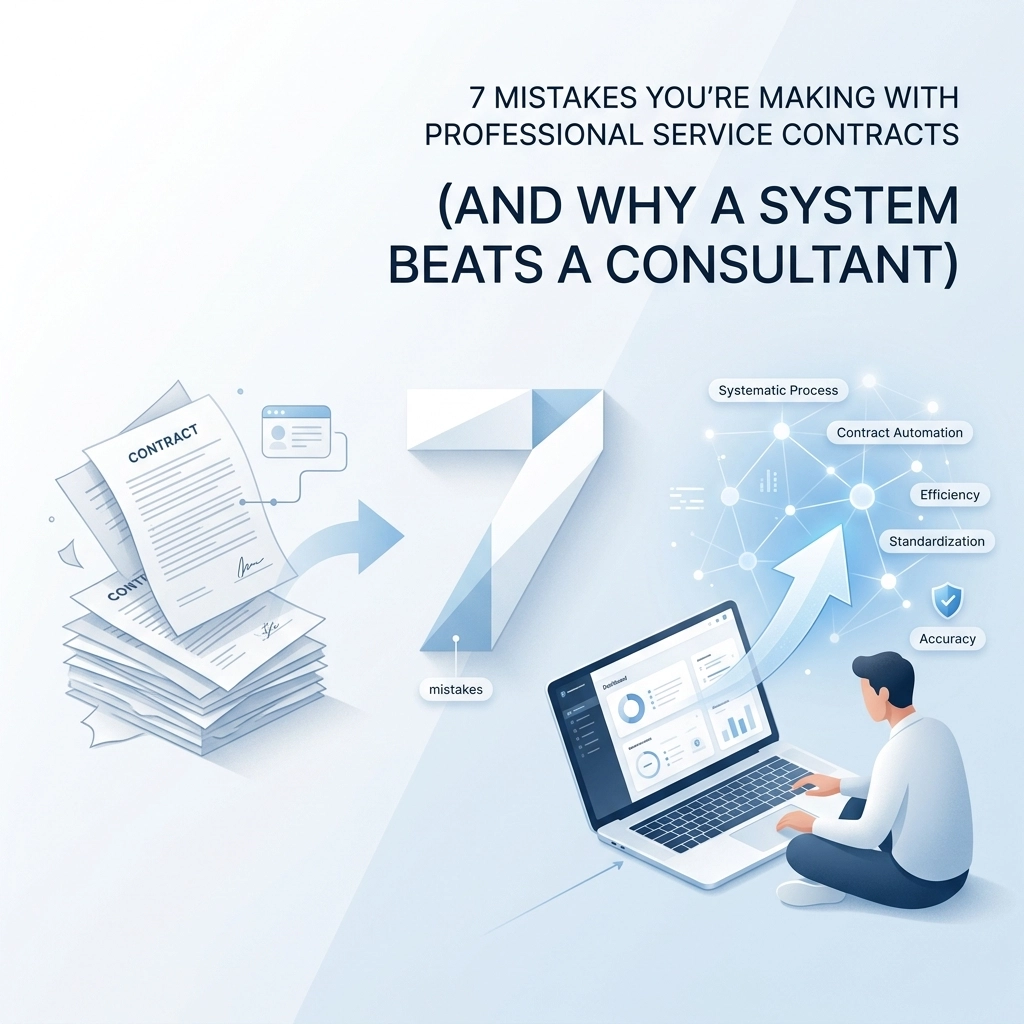
  • 7 Mistakes You’re Making with Professional Service Contracts (and Why a System Beats a Consultant)

    7 Mistakes You’re Making with Professional Service Contracts (and Why a System Beats a Consultant)

    Professional Service Contracts are the structural integrity of your business revenue. If the contract is weak, the entire project, and your profit margin, is at risk of total collapse. Most agency owners and project managers treat these documents as a "set and forget" formality, often relying on a dusty template or an expensive consultant who hasn't looked at their workflow in eighteen months. This is a recipe for massive revenue leakage.

    At GHW-Digital, we’ve seen how poorly managed agreements turn promising partnerships into legal and financial nightmares. If you are still managing your professional service contracts through a combination of manual oversight and occasional consultant advice, you are leaving your business exposed.

    Here are the seven critical mistakes currently draining your resources, and why it is time to move beyond the consultant model toward an elite, automated system.

    1. Defining Boundaries, Stop Scope Creep Immediately

    The most common mistake in Professional Service Contracts is ambiguity in the "Statement of Work." When a deliverable isn't defined with surgical precision, the "moving goalposts" phenomenon begins. A client asks for a "minor tweak" that turns into a three-day overhaul. Without a system to track these deviations against the original agreement, you lose.

    Scope creep kills margins. It is a silent profit killer that thrives in the grey areas of a contract. Consultants can tell you that scope creep is bad, but they aren't there at 2:00 PM on a Tuesday when a client pushes for a free feature. You need a shield. Our Scope Guard Elite tool is designed to be that guardian, ensuring that every hour worked is an hour billed.

    A digital shield protecting a project structure from scope creep in Professional Service Contracts.

    2. Standardize Payment, Ensure Predictable Cash Flow

    If your payment terms are "Net 30" but your tracking is "Whenever we remember to invoice," you are failing. Professional service contracts must dictate exactly when money moves, what triggers a payment, and the penalties for delays.

    Many businesses make the mistake of using generic payment clauses that don't account for milestone-based delivery or fluctuating resource costs. Relying on a consultant to audit your invoices once a quarter is like checking for a leak after the basement is flooded. You need real-time enforcement of your financial boundaries. Explore more ways to tighten your operations at ghw-digital.com/ideas.html.

    3. Update Templates, Mitigate Massive Legal Risks

    Using a boilerplate contract you found online or inherited five years ago is a massive liability. Legislation changes, technology evolves, and the risks associated with data privacy and intellectual property are far higher today than they were even two years ago.

    Professional Service Contracts must be living documents. A consultant will charge you thousands for a "one-time update," but as soon as they leave, the document starts aging again. Elite software tools, like those mentioned on our apps page, provide a framework that evolves with the industry.

    4. Automate Renewals, Capture Every Revenue Opportunity

    The "Silent Exit" happens when a contract expires without a renewal or extension in place. Work continues, but the legal protection and price locking disappear. This is a crucial mistake that often results in "zombie projects", work that is being done without a valid contract, leaving you with zero leverage if a payment dispute arises.

    A system never forgets a date. While a consultant might miss a calendar notification, a dedicated Scope Sentry system ensures that you are alerted 60, 30, and 15 days before a contract lapses. This allows you to renegotiate terms or lock in renewals before you lose your competitive advantage.

    Digital calendar highlighting automated renewal dates for Professional Service Contracts to prevent lapses.

    5. Allocate Liability, Shift Risk Away From Your Core

    Are you absorbing the risk of your vendors' failures? Many professional service contracts fail to properly address indemnification and risk transfer. If a third-party API goes down and your project stalls, who pays for the idle time? If you haven't explicitly defined risk allocation, the answer is usually you.

    Consultants often focus on the "big picture" of a deal, but the devil is in the indemnification clauses. You need a systematic way to vet every contract for these hidden traps. Precision in language isn't just about sounding professional; it's about building a defensive perimeter around your company's assets. Check our latest insights for more on risk mitigation.

    6. Centralize Control, Eliminate Fragmentation

    Where is your latest contract? Is it in a PDF on a salesperson’s laptop? Is it a signed hard copy in a filing cabinet? Or is it a DocuSign link buried in an archive? Fragmentation is the enemy of enforcement. When Professional Service Contracts are scattered across different platforms and people, compliance becomes impossible.

    A system provides a "single source of truth." By centralizing your agreements through Vow Guard Elite, you ensure that every team member, from sales to engineering, is working from the same set of rules. This eliminates the "I didn't know we promised that" excuse that leads to internal friction and client dissatisfaction.

    7. Track Deliverables, Prove Value with Absolute Precision

    The final mistake is failing to link the contract directly to the output. If your contract says you will deliver "Phase 1," but your internal project management tool calls it "Initial Sprint," you are creating a disconnect that clients can exploit during a dispute.

    Your professional service contracts should be the blueprint for your project management. A system beats a consultant here because it integrates the two. It tracks what was promised versus what was delivered, providing an undeniable audit trail of value. For more strategies on aligning delivery with your agreements, visit ghw-digital.com/ideas.html.

    Precise assembly of digital blocks representing deliverables aligned with Professional Service Contracts.


    Why a System Beats a Consultant

    The traditional model of hiring a legal or business consultant to review your Professional Service Contracts is fundamentally flawed for the modern app development world.

    • Consultants are Static; Systems are Dynamic: A consultant gives you advice for today. A system protects you every day.
    • Consultants are Expensive; Systems are Scalable: You pay a consultant by the hour, which disincentivizes them from being efficient. A software system is a fixed-cost investment that grows with your project volume.
    • Consultants are Fallible; Systems are Precise: Human error is the leading cause of contract disputes. A system doesn't "forget" to check a clause or miss a typo in a payment term.
    • Consultants Lack Visibility: A consultant isn't inside your daily workflow. They don't see the scope creep as it happens. An elite tool like Scope Guard Elite lives where the work happens.

    In the fast-paced world of app development, you don't need more meetings; you need better mechanics. You need a system that acts as a sentry, watching over your margins while you focus on building great products.

    Stop making these seven mistakes. Stop relying on outdated manual processes. It’s time to secure your business with the precision and authority it deserves. Learn how to transform your contract management at ghw-digital.com/ideas.html.


    Marblism Legal Shield

    This blog post is provided by GHW-Digital for informational purposes only. While we specialize in high-performance app development and workflow systems, this content does not constitute legal advice. Professional service contracts are complex legal documents; we recommend pairing our elite automation tools with qualified legal counsel. GHW-Digital is committed to your privacy and data security. For more information, please review our Privacy Policy.

  • The Ultimate Guide to the Wedding Couple’s Shield: Securing Your Vendors Without the Stress

    The Ultimate Guide to the Wedding Couple’s Shield: Securing Your Vendors Without the Stress

    Wedding Supplier Contracts are often the last thing on a couple's mind when they are busy choosing cake flavors or floral arrangements. However, ignoring the fine print is the fastest way to turn your dream day into a financial nightmare. Most vendor agreements are written by the vendor’s lawyers to protect the vendor: not you. At GHW-Digital, we believe in flipping the script. You aren't just a client; you are the project manager of the most important event of your life. You need a shield, not just a handshake.

    In this guide, we will break down how to secure your vendors, identify dangerous red flags, and use tools like Vow Shield to ensure your wedding day remains untouchable. If you are looking for more innovative ways to manage your big day, check out our wedding tech ideas.

    The Vendor Bias: Why You Need a Shield

    The wedding industry is a multi-billion dollar machine, and most standard contracts are designed to keep that machine running at your expense. When you sign a contract, you are often signing away your rights to refunds, accountability, and specific performance. This is where the concept of the "Wedding Couple’s Shield" comes in. It is a defensive mindset backed by iron-clad documentation.

    Many couples realize too late that their contracts are "leaking revenue." A vague clause here and an undefined "service fee" there can add thousands to your final bill. To prevent this, you need to treat your wedding like a high-stakes business merger. You wouldn't merge companies based on a "vibe," and you shouldn't hire a venue that way either. Explore our latest app ideas to see how we are digitizing this protection.

    Transparent shield guarding a bridal bouquet, symbolizing wedding supplier contracts protection.

    Red Flags in Wedding Supplier Contracts

    Identifying red flags before you sign is the most effective way to protect your interests. If a vendor pushes back on clarifying these points, consider it a sign to walk away.

    1. The "Force Majeure" Loophole
    While "Acts of God" clauses are standard, many vendors use them as a get-out-of-jail-free card. Ensure the contract specifies what happens to your deposit if the event is cancelled due to circumstances outside your control. If they keep the money without a reschedule date, the contract is biased.

    2. Vague Deliverables
    If your photographer's contract says "photography services for 8 hours" without specifying the number of edited photos or the delivery timeline, you are at risk. You are paying for a product, not just their time. We advocate for "Scope Guard" principles: define every pixel and every minute. Check out our strategy ideas for more on scoping.

    3. Non-Refundable "Everything"
    A deposit should be reasonable. If a contract demands a 50% non-refundable retainer a year in advance with no sliding scale for cancellation, they are offloading all the risk onto you. A fair shield-ready contract uses a tiered refund system based on how close the cancellation is to the date.

    4. The "Discretionary" Clause
    Watch out for phrases like "at the vendor's discretion." This gives them the power to swap your premium florist for a junior assistant or change your menu without notice. Demand "Right of Approval" for any major changes.

    Lock In Service Delivery: The Vow Shield Approach

    At GHW-Digital, we developed the Vow Shield philosophy to ensure that what you pay for is exactly what you get. It isn’t about being "difficult"; it’s about alignment and respect. When expectations are clear, stress disappears.

    Track Every Milestone
    Don't wait until the wedding morning to see if the vendor is ready. Use a digital tracking system to confirm milestones. Has the florist secured the specific peonies you wanted? Has the DJ received the "Do Not Play" list? High-impact management requires proactive check-ins. You can find more digital tracking ideas here.

    Calculate the True Cost
    Hidden fees are the "moving goalposts" of the wedding world. Gratuities, "corkage" fees, and setup charges should all be itemized in the initial Wedding Supplier Contracts. If it isn't on paper, it doesn't exist. We recommend using our budgeting tools to map out these hidden expenses before they hit your credit card.

    Digital timeline with milestones to track wedding vendor service delivery and contract compliance.

    Action-Benefit: How to Negotiate Like a Pro

    Negotiation isn't about lowering the price; it's about increasing the value and the protection.

    • Action: Request an "Itemized Fulfillment List."
    • Benefit: Protect your vision by ensuring every specific request is legally tied to the payment.
    • Action: Insert a "Substitution Clause."
    • Benefit: Prevent the vendor from swapping high-end materials for cheaper alternatives without a price reduction.
    • Action: Demand a "Communication SLA" (Service Level Agreement).
    • Benefit: Stop the "ghosting" phenomenon. Ensure vendors respond within 48 hours during the final month of planning.

    If you need more tips on how to handle these negotiations, our resource hub is updated daily with fresh insights.

    Protecting the Couple: The Legal Defense

    Standard wedding insurance is great, but it’s a reactive measure. Wedding Supplier Contracts are your proactive defense. A well-structured contract acts as a guardian for your time and profit. If a vendor fails to deliver, the contract should dictate the exact penalty or refund amount, skipping the need for emotional pleading or expensive litigation.

    We often see couples lose money because they "trusted" a vendor they met at a bridal fair. Trust is earned through performance, but it is secured through legal language. Think of your contract as a Vow Guard Elite system for your bank account.

    Modern vault door representing the security of the wedding couple's shield and vendor agreements.

    Why Service Delivery Fails

    Service delivery usually fails because of "scope creep" in reverse: the vendor begins to trim the edges of their service to save on their own margins. They might bring one fewer server than promised or use a cheaper sound system. Without a "Wedding Couple’s Shield" (a detailed contract and a tracking app), you won't even notice until it’s too late.

    To prevent this, we suggest a "Final Confirmation Audit" 14 days before the event. This audit should cross-reference your original contract with the vendor's current status. It’s a precision-based approach that leaves no room for error. Learn more about automation for weddings to make this process seamless.

    Securing a Competitive Advantage

    In the 2026 wedding market, the best venues and vendors are booked years in advance. This gives them the leverage. However, by coming to the table with a professional, "shield-first" mindset, you signal that you are a high-value client who expects professional standards. This often leads to better service because the vendor knows you are tracking their performance.

    Don't be afraid to ask for what you need. Fairness and alignment are the pillars of a successful wedding partnership. For more innovative app development ideas that can help you stay ahead, browse our full catalog.

    Magnifying glass auditing wedding items to verify wedding supplier contracts in a final checklist.

    Final Checklist for Your Shield

    Before you sign any Wedding Supplier Contracts, run through this no-nonsense checklist:

    • Is the Focus Keyword of your vision (e.g., "Outdoor Sunset Ceremony") explicitly protected if it rains?
    • Are there specific penalties for late arrival?
    • Is the "Marblism Legal Shield" or a similar legal review framework applied?
    • Does the contract link to a specific Scope Sentry or tracking document?
    • Have you checked the latest industry ideas for potential pitfalls?

    Your wedding is a massive investment of time, emotion, and money. Protect it like the elite asset it is. Stop letting vendors dictate the terms of your happiness. Secure your shield today.


    Marblism Legal Shield Footer

    GHW-Digital and the Vow Shield initiative are committed to transparency and data integrity. All contract templates and advice provided are for informational purposes and should be reviewed by a qualified legal professional in your jurisdiction. We believe in blunt honesty: no software can replace a lawyer, but our tools can ensure your lawyer has the best data to work with. Your privacy and the security of your event data are our primary mission. No marketing tricks, just iron-clad protection.

    Secure your wedding's future. Stop the stress and lock in your vendors now.

  • Stop Selling Hours, Start Selling Certainty: The Ultimate Professional Pivot for Crucial Growth

    Stop Selling Hours, Start Selling Certainty: The Ultimate Professional Pivot for Crucial Growth

    SEO Meta Description: Stop Selling Hours, Start Selling Certainty to protect your margins and build a sustainable agency. Learn how to transition from time-based billing to outcome-based success with GHW-Digital.

    URL Slug: stop-selling-hours-start-selling-certainty

    Stop Selling Hours, Start Selling Certainty

    Stop Selling Hours, Start Selling Certainty. This is the fundamental shift required for any professional who wants to move from being a digital laborer to a Digital Architect. If you are still billing by the hour, you are penalizing your own efficiency and inviting your clients to micromanage your calendar. You are selling a commodity, time, which is the most limited resource you possess.

    In the world of app development and high-level consulting, time is an unreliable metric for value. A senior architect can solve in ten minutes a problem that takes a junior developer ten hours. By billing for the ten minutes, the senior expert is financially punished for their mastery. It is a broken system. To thrive in 2026, you must pivot. You must protect your profit and your sanity by offering the one thing every client actually wants: the elimination of risk.

    The High Stakes of the Hourly Trap

    When you sell hours, you create an adversarial relationship. The client wants fewer hours to save money; you want more hours to sustain your business. This misalignment breeds friction. Every invoice becomes a negotiation. Every meeting becomes a "quick check-in" that leaks revenue because you don't feel comfortable billing for fifteen minutes of "just talking."

    Scope creep is the silent killer here. Without a hard line between what is being built and the time it takes to build it, boundaries dissolve. The Modern Independent Professional understands that the "moving goalpost" syndrome is a direct result of selling time instead of defined outcomes. If the goal is "certainty," then any deviation from the plan has a clear, logical cost.

    Minimalist workspace with app infrastructure plans to stop selling hours, start selling certainty.
    Alt text: A Digital Architect analyzing project blueprints to Stop Selling Hours, Start Selling Certainty.

    Why You Must Stop Selling Hours, Start Selling Certainty Today

    Certainty is the premium product of the digital age. We live in an era of volatility. Projects fail, budgets explode, and deadlines vanish. When you offer certainty, you are offering a shield. You are telling the client: "I know the path, I have the tools to stay on it, and I am responsible for the result, not just the effort."

    Selling certainty requires a structural change in how you present your business. At GHW-Digital, we view ourselves as architects of systems. We don't just "write code"; we build assets that solve specific business problems. This perspective allows us to price based on the impact of the solution rather than the ticking of a clock.

    The Psychographic of the Modern Independent Professional

    The professionals who succeed today share a specific psychographic profile. They are protective of their focus. They are minimalist in their communication but maximalist in their execution. They don't look for "more work"; they look for "better alignment."

    They understand that economic certainty is what allows a client to sleep at night. A client doesn't care if you worked forty hours or four hours; they care that the app works, the data is secure, and the launch is on time. When you Stop Selling Hours, Start Selling Certainty, you align your incentives with the client’s success.

    The Strategy to Stop Selling Hours, Start Selling Certainty

    To make this transition, you need more than a change in mindset; you need a change in infrastructure. You need a way to lock in the scope and defend the perimeter of your project. This is where the concept of the "Digital Architect" comes into play. You aren't just a builder; you are a guardian of the project’s integrity.

    1. Define the Perimeter Early

    Certainty begins with a hard boundary. You cannot guarantee a result if the requirements are a moving target. Use tools like Scope Guard Elite to ensure that every feature is documented, agreed upon, and guarded against unauthorized expansion.

    2. Focus on Outcomes, Not Inputs

    Instead of listing "10 hours of backend development" on a proposal, list "Scalable User Authentication System." The former is a cost to be minimized; the latter is an asset to be acquired. This shift moves the conversation from your "rate" to your "result."

    Digital interface with hexagonal nodes for milestones to stop selling hours, start selling certainty.
    Alt text: Digital interface showing project milestones to Stop Selling Hours, Start Selling Certainty.

    3. Build a Defense Mechanism

    Protection is a core value of the modern professional. You must protect your time to maintain the quality of your work. By using systems like Scope Sentry, you create a transparent environment where the client sees exactly what is being delivered. This transparency builds the trust necessary to sell certainty.

    Action-Benefit: Locking in Your Value

    Protect Your Margins: By selling a fixed outcome, you capture the "efficiency premium." If you find a faster way to deliver a high-quality result, that extra margin belongs to you, not the client. This incentivizes you to innovate and use better tools.

    Calculate the Risk: Selling certainty means you must be excellent at risk assessment. You are taking on the risk of delivery, so your pricing must reflect that responsibility. This is not about being "expensive"; it's about being "valuable."

    Secure the Relationship: Clients stay with professionals who make their lives easier. When you Stop Selling Hours, Start Selling Certainty, you remove the stress of fluctuating invoices. The client knows exactly what they are paying and exactly what they are getting. This is the foundation of a long-term partnership.

    A professional handshake over software blueprints to stop selling hours, start selling certainty.
    Alt text: A professional handshake over a digital blueprint representing the decision to Stop Selling Hours, Start Selling Certainty.

    The Minimalist Approach to Project Management

    Complexity is the enemy of certainty. The more moving parts a project has, the higher the chance of failure. As a Digital Architect, your job is to simplify.

    • Lock in the Vow: Use Vow Guard Elite to ensure that commitments made at the start of the project are honored by all parties.
    • Track the Deviations: Any change in scope must be treated as a new project. No "favors," no "quick additions."
    • Automate the Guardrails: Use software to do the heavy lifting of monitoring boundaries so you can focus on the architecture.

    This minimalist, protective stance is what differentiates an elite developer from a freelancer on a bidding site. You are not competing on price; you are competing on the reliability of your word.

    Stop Selling Hours, Start Selling Certainty: The Financial Logic

    From a business organization perspective, selling hours is a linear growth model. To make more money, you must work more hours or hire more people (who then work more hours). It is hard to scale and even harder to sell.

    A business built on certainty is an asset. It is a system that produces results. When you develop apps with a focus on outcome-based pricing, you are building a scalable engine. You are selling a solution that has a market value independent of the time it took to create.

    Ascending white pillars representing scalable growth to stop selling hours, start selling certainty.
    Alt text: Financial graph showing growth after choosing to Stop Selling Hours, Start Selling Certainty.

    Conclusion: Take the Architect’s Stance

    The transition is not easy. It requires saying "no" to clients who demand an hourly breakdown. It requires the courage to stand behind your results. But the alternative is a slow decline into commoditization.

    Stop Selling Hours, Start Selling Certainty. Protect your craft. Guard your time. Build something that lasts. If you are ready to stop the leak of revenue and start building with precision, it’s time to change how you work.

    Powered by GHW Digital (Company No: 16834250). This document is an automated draft for business organization purposes only. It does not constitute legal advice. GHW Digital accepts no liability for disputes, financial loss, or enforceability. Users must consult a qualified professional in their jurisdiction before signing.

  • Professional Service Contracts Explained in Under 3 Minutes: Why Systems Beat Hourly Fees

    Professional Service Contracts Explained in Under 3 Minutes: Why Systems Beat Hourly Fees

    Professional Service Contracts are the only thing standing between a profitable app development project and a financial disaster. In the high-stakes world of software creation, the traditional model of trading hours for dollars is a relic. It is an inefficient, outdated method that incentivizes slow work and creates friction between client and creator. At GHW-Digital, we have seen how "moving goalposts" can sink a project faster than a bad line of code.

    The reality is simple: Hourly fees are a gamble. Systems are a strategy. When you transition from counting minutes to managing outcomes through robust Professional Service Contracts, you shift the focus from activity to value. This isn't just about legal protection; it’s about aligning incentives so that everyone wins when the project is completed efficiently.

    The Fatal Flaw of the Hourly Fee Model

    Hourly billing is a conflict of interest masquerading as a business model. If an agency works faster, they make less money. If they work slower or encounter "unexpected" hurdles, the bill goes up. This creates a baseline of distrust that no amount of weekly reporting can fix.

    For the client, hourly fees represent an open-ended liability. You aren't buying a product; you’re subsidizing a process. This is why elite software tools are rapidly replacing the old-school consultant model. A consultant wants to bill you for a discovery session; a system, like the ones we detail at ghw-digital.com/ideas.html, wants to lock in a scope and execute.

    When Professional Service Contracts are built around systems rather than hours, the agency is incentivized to automate, optimize, and deliver. Profitability becomes a byproduct of efficiency, not a result of dragging out the timeline.

    Digital system grid transforming a traditional watch to optimize professional service contracts.

    Lock In Deliverables: Stop Revenue Leaks

    Scope creep is the silent killer of margins. It starts with a "small favor" and ends with a project that is 40% over budget and six months behind schedule. Professional Service Contracts must act as a shield: a definitive boundary that defines exactly what is included and, more importantly, what is not.

    Using tools like Scope Guard Elite allows businesses to move away from the "billable hour" nightmare. Instead of a consultant manually tracking hours to tell you that you've gone over scope, a system-based approach tracks deliverables in real-time.

    How systems protect your revenue:

    • Precision Guarding: Automatically flag requests that fall outside the initial Professional Service Contracts.
    • Calculated Certainty: Know your exact margin before the first line of code is written.
    • Respectful Boundaries: Eliminate the awkward "that will cost extra" conversations by having a pre-defined system in place.

    By moving to a system-based contract, you are no longer paying for someone to watch the clock. You are paying for a result that is protected by Scope Sentry.

    Why Elite Software Tools Outperform Expensive Consultants

    For decades, companies hired expensive management consultants to "streamline" their processes and oversee their Professional Service Contracts. These consultants often cost more than the problems they were hired to solve. They produce slide decks; systems produce results.

    At GHW-Digital, we believe in replacing human error with software precision. Why hire a consultant to audit your contract fulfillment when you can use Vow Guard Elite? Software doesn't get tired, it doesn't have "off days," and it doesn't charge $300 an hour to sit in a meeting.

    Elite software tools creating efficient alignment in professional service contracts.

    Elite software tools provide a level of "alignment" that humans simply cannot match. According to research on contract management efficiency, businesses that automate their agreement tracking see a 15-20% increase in realized contract value. This is because the system ensures every clause of the Professional Service Contracts is met without requiring a human to manually cross-reference a spreadsheet.

    For more insights on how to automate your project lifecycle, check out our ideas page.

    The 3-Minute Breakdown: Systems vs. Hourly

    If you only have three minutes, here is the core truth about modern Professional Service Contracts:

    1. Alignment of Interests: Hourly fees punish efficiency. Systems reward it.
    2. Predictability: Fixed-price, system-backed contracts offer "fairness." You know the cost; we know the scope.
    3. Risk Mitigation: Systems like Scope Guard Elite act as a guardian for your time, ensuring that the "moving goalposts" are locked firmly in place.
    4. Scalability: You cannot scale a human consultant’s time. You can scale a software system infinitely.

    The transition to system-based Professional Service Contracts is not just a trend: it is a survival mechanism for the modern digital economy. You can read more about this transition at ghw-digital.com/ideas.html.

    Balance scale showing digital systems outweighing inefficient hourly billing fees.

    Precise Execution: The GHW-Digital Approach

    At GHW-Digital, we don't just build apps; we build the frameworks that make those apps profitable. This begins with how we structure our Professional Service Contracts. We don't want to bill you for "thinking." We want to bill you for "doing."

    Our approach utilizes a suite of proprietary tools designed to eliminate the ambiguity of traditional service agreements.

    • Track Everything: Every milestone is tied to a system-verified deliverable.
    • Protect Margins: We use Scope Guard Elite to ensure that the project stays within the agreed-upon parameters.
    • Calculate Success: We don't guess at completion dates; we use data-driven systems to provide accurate timelines.

    This no-nonsense approach is why we are leaders in App Development. We respect our clients' time and capital too much to waste it on the "hourly" merry-go-round.

    The Stern Reality: Adapt or Bleed Revenue

    The market is shifting. Clients are becoming more sophisticated and are no longer willing to sign blank-check hourly agreements. If you are still relying on traditional Professional Service Contracts that prioritize hours over outcomes, you are leaking revenue.

    Expensive consultants will tell you that software development is "unpredictable" to justify their high fees and long timelines. We tell you that software development is only unpredictable if you lack the systems to control it. By leveraging elite software tools and rigorous Professional Service Contracts, you turn a chaotic process into a precision machine.

    Stop the "moving goalposts." Stop paying for "discovery sessions" that lead nowhere. Secure a competitive advantage by adopting a system-first mentality.

    Digital shield protecting professional service contracts from scope creep and revenue leaks.

    Final Thoughts on Professional Service Contracts

    The choice is clear. You can continue to trade time for money, or you can build a system that trades value for profit. Professional Service Contracts are the legal manifestation of that choice. When you choose a system, you choose control, precision, and alignment.

    For a daily dose of strategies on how to optimize your digital business, visit our ideas section frequently. We are constantly updating our resources to help you stay ahead of the curve.


    Marblism Legal Shield
    The information provided in this article regarding Professional Service Contracts is for educational and strategic purposes only. While GHW-Digital provides elite tools such as Scope Guard Elite to assist in project management and scope protection, we do not provide legal advice. All contracts should be reviewed by a qualified legal professional to ensure compliance with local regulations and specific business requirements. Our goal is to provide the systems that safeguard your margins, but the legal finality remains your responsibility.


    Ready to stop the leak?
    Secure your margins with GHW-Digital today.

  • The Ultimate Guide to the Wedding Supplier Contract: Everything You Need to Protect Your Big Day

    The Ultimate Guide to the Wedding Supplier Contract: Everything You Need to Protect Your Big Day

    Wedding Supplier Contracts are the only thing standing between your dream wedding and a logistical nightmare. In the high-stakes world of wedding planning, hope is not a strategy. You cannot rely on a vendor’s "good vibes" or a handshake agreement when thousands of dollars and your once-in-a-lifetime memories are on the line. Most couples sign agreements under the haze of excitement, failing to realize that many standard vendor templates are designed to protect the business, not the couple.

    At GHW-Digital, we believe in radical transparency and boundary-setting. Whether you are building an app or planning a wedding, the principles of Scope Guard Elite apply: if it isn't in writing, it doesn't exist. This guide will teach you how to audit your Wedding Supplier Contracts to ensure you are shielded from professional negligence and service failures.

    Identifying Red Flags in Wedding Supplier Contracts

    The first step in protecting your big day is spotting the traps hidden in fine print. Many vendors use boilerplate language that leaves the "scope of work" intentionally vague. This allows for "moving goalposts" where you pay for a premium experience but receive a budget execution.

    Vague Deliverables. If a contract says "Photography services for 8 hours," you are at risk. It must specify the number of edited photos, the delivery format, and the exact names of the lead photographers. Without this, the studio could send a junior trainee while the veteran you hired works a different event.

    The "Substitution" Trap. Beware of clauses that allow the vendor to provide a "suitable replacement" at their sole discretion. While emergencies happen, you should have the right of refusal. If you don't like the replacement, you should be entitled to a full refund to find your own alternative. You can find more strategies for managing these high-stakes negotiations at our ideas page.

    One-Sided Cancellation Policies. Many Wedding Supplier Contracts demand that deposits are "non-refundable under any circumstances." This is a massive red flag. If the vendor fails to show up or goes out of business, you must have a legal path to recover your funds.

    Professional silver pen on a desk reviewing wedding supplier contracts for protective legal clauses.

    Protecting the Couple: The Clause Audit

    When you review Wedding Supplier Contracts, you must adopt an "us vs. the problem" mentality. The problem is uncertainty. Your goal is to lock in certainty through precise, protective clauses.

    Action-Benefit: Specific Naming Guarantees Service Quality

    Do not sign a contract with a "company." Sign a contract that specifies the individuals performing the work. If you are hiring a specific makeup artist or DJ because of their portfolio, their name must be on the document. This prevents the "bait and switch" that ruins many weddings.

    Action-Benefit: Itemized Logistics Prevents Hidden Costs

    Every piece of equipment: from the type of lenses a videographer uses to the specific brand of speakers a DJ brings: should be itemized. This prevents vendors from "leaking budget" by using sub-par equipment while charging you premium rates. For a deeper dive into how to structure complex agreements, visit GHW-Digital Ideas.

    Action-Benefit: The Force Majeure Reciprocity

    Most contracts include a "Force Majeure" clause (acts of God). Ensure this clause is reciprocal. If a hurricane prevents the wedding, the vendor shouldn't just keep your money because "their overhead is high." A fair contract provides for a rescheduled date or a partial refund minus verifiable expenses. Check out Cornell Law’s definition of Force Majeure to understand your rights.

    Securing Service Delivery Through Precise Language

    Service delivery is where most wedding disasters occur. A florist arrives late, or a caterer runs out of the main course. To prevent this, your Wedding Supplier Contracts must function as a rigid project management tool, much like the Scope Sentry we use in software development.

    • Arrival and Departure Windows: Do not accept "morning setup." Demand specific times (e.g., "Setup complete by 10:30 AM GMT").
    • Performance Standards: Include a clause that services must be performed to "industry professional standards." This gives you leverage if the final product is objectively poor.
    • Meal and Break Requirements: Be explicit. "Vendor is entitled to one hot meal to be eaten during the 30-minute band break." This prevents vendors from disappearing for two hours during prime reception time.

    Wedding rings and a tablet displaying an itemized list for protecting wedding supplier contracts.

    Financial Security and the Vow Shield Advantage

    At GHW-Digital, we’ve taken our expertise in protecting project boundaries and applied it to the wedding industry through Vow Guard Elite. We call this the Vow Shield approach. It’s about creating a perimeter around your investment.

    When dealing with payments, never pay the full balance upfront. A standard, protective payment schedule looks like this:

    1. Initial Deposit: To save the date (ideally 20-30%).
    2. Mid-way Milestone: After a trial or finalization of details.
    3. Final Balance: Due no earlier than 14 days before the event.

    By keeping the final payment until close to the date, you maintain leverage. If the vendor hasn't responded to emails for three weeks, you have the financial power to demand a meeting before the final check is cut. For more tips on managing vendor relationships like a pro, browse https://ghw-digital.com/ideas.html.

    The Essential Checklist for Wedding Supplier Contracts

    Before you put pen to paper, run every agreement through this no-nonsense checklist. If a vendor refuses to add these details, they are telling you they don't value your security. Walk away.

    • Exact Date, Time, and Location: Including "Load-in" and "Load-out" times.
    • The "Who": Names of specific staff members and the number of assistants.
    • The "What": An itemized list of every deliverable (e.g., 400 high-res photos, 3-course meal for 120 guests).
    • The "If-Then": What happens if the vendor is late? What happens if the equipment fails?
    • Dispute Resolution: A clause stating that any disputes will be handled via mediation in your local jurisdiction.

    Clock face and venue blueprint showing strict timing and delivery for wedding supplier contracts.

    Protecting your wedding is about more than just avoiding a bad party; it’s about protecting your mental health and your financial future. You wouldn't launch a major business project without a ironclad contract; don't launch your marriage without one either. You can learn more about our philosophy on professional boundaries at GHW-Digital.

    Protecting Your Investment with Vow Shield

    The wedding industry is notorious for "emotional tax": the idea that because it's a special day, you should be willing to overlook professional lapses. We reject that. Your wedding is a high-value contract, and it deserves high-value protection. By using the Vow Shield mindset, you are treating your vendors as professional partners, not just "helpers." This clarity fosters respect and ensures that on the day of your wedding, the only thing you have to focus on is saying "I do."

    For more resources on how to protect your projects and events, check out our latest ideas. We update our insights daily to ensure you have the elite tools needed to manage any scope, whether it's digital or marital.

    A symbolic glass shield protecting wedding rings to ensure safe and secure wedding supplier contracts.

    Final Professional Audit

    Before signing any Wedding Supplier Contracts, remember:

    1. Read every word. If you don't understand a term, ask.
    2. Get it in the contract. Verbal promises are legally worthless.
    3. Check for Insurance. Ensure the vendor has professional liability insurance. For a primer on why insurance matters in contracts, see Investopedia's guide to liability.

    Secure your day. Lock in your vendors. Protect your peace of mind.


    Marblism Legal Shield:
    GHW-Digital provides this content for informational purposes only. We are app development experts, not a law firm. This guide does not constitute legal advice. We recommend consulting with a qualified attorney before signing any binding legal documents. Our commitment to data integrity and privacy means we advocate for clear, ethical contracts in all areas of life.

    Stop letting vague "agreements" put your wedding at risk. Secure your future by demanding professional-grade Wedding Supplier Contracts today.

  • Freelance Contract Template Framework: The Crucial Elite Strategy for Superior Professional Service Contracts

    Freelance Contract Template Framework: The Crucial Elite Strategy for Superior Professional Service Contracts

    Freelance Contract Template Framework adoption marks the end of the high-priced consultant era. For decades, businesses relied on expensive legal consultants to draft bespoke agreements for every project. This model is broken. It is slow, prone to human error, and creates a bottleneck that kills momentum. In the modern app development landscape, speed and precision are the only currencies that matter. Protocols are replacing consultants because code is more reliable than conversation.

    At GHW-Digital, we have seen how "moving goalposts" destroy profitability. When you rely on a consultant’s subjective interpretation of a project, you leave the door open for scope creep. A protocol-driven approach, powered by elite software tools, removes the ambiguity. It locks the boundaries of a project in a digital vault. This is the shift from "trust me" to "trust the system."

    Protocols Over Personalities: Why Software Beats Consultants

    The traditional consultant model is fundamentally flawed because it relies on human memory and individual expertise. Consultants are expensive, they sleep, and they can be inconsistent. A Freelance Contract Template Framework built into your workflow operates 24/7 with mathematical precision.

    When we talk about Professional Service Contracts, we are talking about risk management. Elite software tools allow you to bake your business logic directly into the contract. Instead of paying a consultant to review a document for the tenth time, a protocol-based system like Scope Guard Elite automates the enforcement of your terms. This isn't just about saving money on legal fees; it’s about reclaiming your time and ensuring that every project remains profitable.

    Standardization is the enemy of the consultant but the best friend of the developer. By using a standardized framework, you create a repeatable process that scales. You can explore more about these scalable systems at our ideas page, where we break down the logic of automated project management.

    A structured digital grid representing a solid Freelance Contract Template Framework for automated project management.

    Lock in Scope: Eliminate Revenue Leaks

    Scope creep is a silent killer. It starts with a "quick favor" and ends with a project that is 40% over budget with no additional compensation. A robust Freelance Contract Template Framework acts as a shield against this erosion.

    Professional service contracts must be rigid. If the scope isn't in the protocol, it doesn't exist. By moving away from consultant-led negotiations and toward software-enforced boundaries, you eliminate the "gray areas" that clients often exploit. Software tools like Scope Sentry provide a real-time audit trail that a consultant simply cannot match.

    Action-Benefit: High-Impact Contract Features

    • Algorithmic Deliverables: Define what "done" looks like using objective metrics rather than subjective adjectives.
    • Automatic Trigger Clauses: Payments are released or work is paused based on protocol milestones, not consultant nudges.
    • Version Control Architecture: Every change to the contract is logged, timestamped, and immutable.

    When you implement these features, you aren't just writing a contract; you are deploying a security system for your revenue. For more insights on how to protect your digital assets, visit GHW-Digital Ideas.

    The Elite Software Advantage in Professional Service Contracts

    Why are elite software tools superior to consultants? The answer lies in the "Cost of Verification." To verify a consultant's work, you often need another consultant. To verify a protocol, you only need to look at the data.

    In the realm of Professional Service Contracts, certainty is the ultimate luxury. High-stakes projects require a level of detail that human consultants often overlook. For example, intellectual property (IP) transfer is often a point of contention. A software-driven Freelance Contract Template Framework ensures that IP rights are handled programmatically upon payment confirmation. There is no need for a legal follow-up; the protocol handles the transfer automatically.

    We recommend checking out Vow Guard Elite to see how automated commitment tracking can replace manual oversight. This transition to automation is discussed in detail across our resource library, focusing on how technology reduces the friction of doing business.

    A protective crystalline shield representing a Freelance Contract Template Framework guarding against project scope creep.

    Standardize Deliverables: Build Trust Through Precision

    Trust is often misunderstood in business. Many believe trust is built through long lunches and handshakes. In reality, in the world of app development, trust is built through the consistent delivery of precisely what was promised. A Freelance Contract Template Framework provides the blueprint for that consistency.

    When a client sees a professionally structured, protocol-based contract, they recognize that they are dealing with an elite operation. It signals that your processes are mature and that you value their time as much as your own. Consultants often "wing it" based on the client's mood. Protocols don't have moods. They have requirements.

    This level of professionalism is what we strive for at GHW-Digital. We believe that the future of work isn't found in a consultant's office, but in the efficiency of a well-coded agreement. You can see our philosophy in action by browsing our latest app concepts.

    The Financial Logic of Protocol-Based Agreements

    Let's look at the numbers. A mid-tier legal consultant might charge $350 per hour to draft or review a professional service contract. Over the course of a year, for twenty projects, that is an astronomical expense. Conversely, a Freelance Contract Template Framework integrated with elite software tools has a near-zero marginal cost per contract.

    1. Lower Initial Investment: Software tools are a fraction of the cost of a retainer.
    2. Zero Latency: You don't wait for a consultant to "get back to you." The contract is ready when you are.
    3. Risk Mitigation: Automation reduces the chance of "fat-finger" errors in payment terms or deadlines.

    By shifting your budget from consultants to protocols, you are investing in an asset rather than an expense. This is a core pillar of the digital transformation strategies we discuss at https://ghw-digital.com/ideas.html. According to research by Harvard Business Review, companies that prioritize automated protocols over manual consulting see a 30% increase in operational efficiency.

    Interconnected digital panels illustrating the logic of a Freelance Contract Template Framework for professional services.

    Implementing the Framework: Step-by-Step

    Transitioning to a Freelance Contract Template Framework requires a change in mindset. You must stop thinking of a contract as a "piece of paper" and start seeing it as a "logic gate."

    • Step 1: Audit Your Current Agreements. Identify every area where you have had a dispute in the past. These are your "leaks."
    • Step 2: Codify Your Boundaries. Use tools like Scope Guard Elite to turn those boundaries into hard rules.
    • Step 3: Replace Human Review with Protocol Checks. If a project change occurs, the protocol should calculate the impact on price and timeline automatically.
    • Step 4: Continuous Optimization. Just as you update your apps, update your contract framework. Visit our ideas section daily for the latest optimization techniques.

    The goal is to reach a state of "set and forget." Once your Professional Service Contracts are governed by a robust framework, you can focus on what you do best: building exceptional products.

    Defending Your Margins with Marblism Legal Shield

    In an era where everyone is trying to "do more with less," you cannot afford to have your margins eroded by poor contract management. The Freelance Contract Template Framework is your primary defense mechanism. It separates the elite professionals from the amateurs who are still waiting on a consultant's email.

    We are entering a period where the "Consultant Class" is being disrupted by the "Protocol Class." If you want to stay ahead, you must embrace the tools that provide speed, accuracy, and protection. For a deeper dive into the intersection of law, technology, and app development, explore our full catalog of ideas.

    A metallic orb on a clean desk symbolizing the balance and control of a robust Freelance Contract Template Framework.

    Stop letting "consultation" slow down your innovation. Lock in your terms, protect your time, and secure your profit today.


    Marblism Legal Shield Footer

    The information provided in this blog post regarding the Freelance Contract Template Framework is for informational purposes only and does not constitute legal advice. While GHW-Digital and Marblism provide tools to help manage professional service contracts, we recommend consulting with a qualified legal professional for specific jurisdictional requirements. Use of our software tools is subject to our Privacy Policy and terms of service. Marblism Legal Shield ensures that while our protocols are elite, the final legal responsibility remains with the user to ensure compliance with local laws.