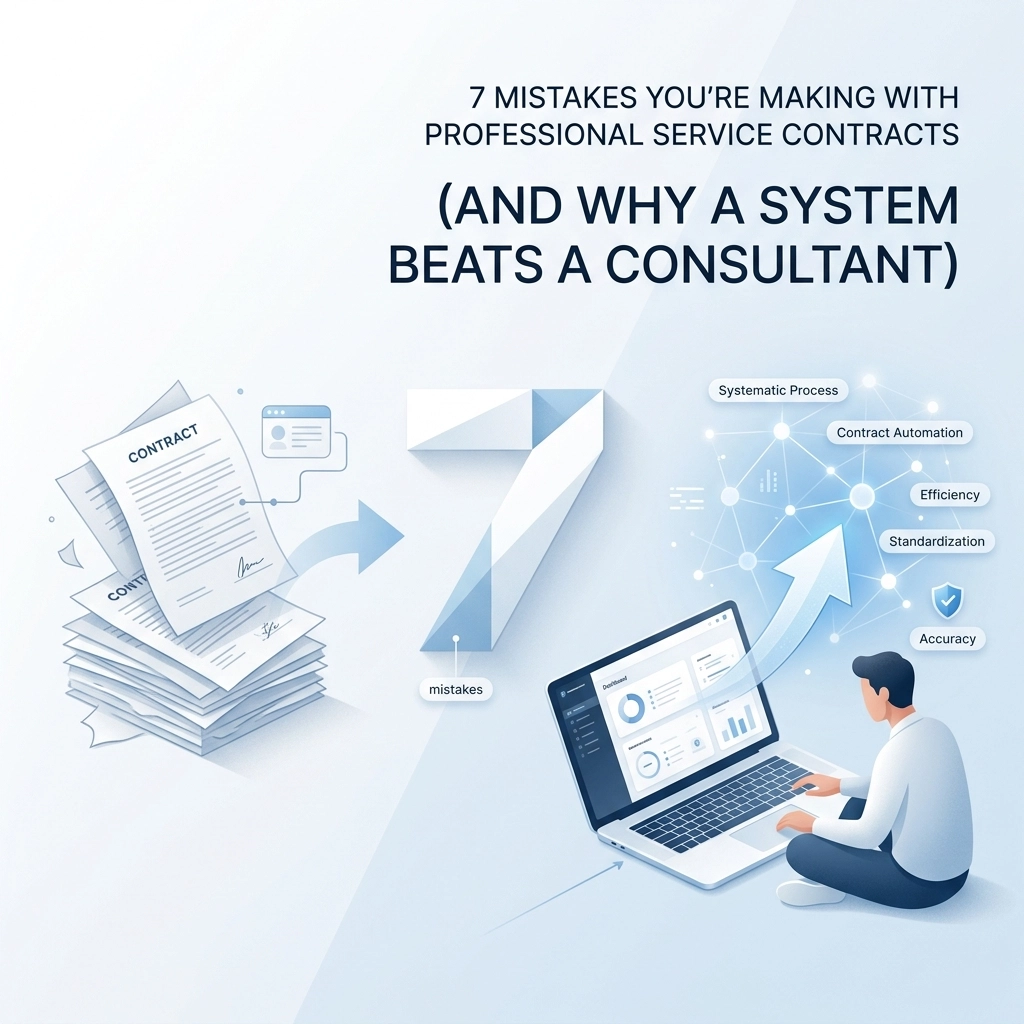
Professional Service Contracts are the structural integrity of your business revenue. If the contract is weak, the entire project, and your profit margin, is at risk of total collapse. Most agency owners and project managers treat these documents as a "set and forget" formality, often relying on a dusty template or an expensive consultant who hasn't looked at their workflow in eighteen months. This is a recipe for massive revenue leakage.
At GHW-Digital, we’ve seen how poorly managed agreements turn promising partnerships into legal and financial nightmares. If you are still managing your professional service contracts through a combination of manual oversight and occasional consultant advice, you are leaving your business exposed.
Here are the seven critical mistakes currently draining your resources, and why it is time to move beyond the consultant model toward an elite, automated system.
1. Defining Boundaries, Stop Scope Creep Immediately
The most common mistake in Professional Service Contracts is ambiguity in the "Statement of Work." When a deliverable isn't defined with surgical precision, the "moving goalposts" phenomenon begins. A client asks for a "minor tweak" that turns into a three-day overhaul. Without a system to track these deviations against the original agreement, you lose.
Scope creep kills margins. It is a silent profit killer that thrives in the grey areas of a contract. Consultants can tell you that scope creep is bad, but they aren't there at 2:00 PM on a Tuesday when a client pushes for a free feature. You need a shield. Our Scope Guard Elite tool is designed to be that guardian, ensuring that every hour worked is an hour billed.

2. Standardize Payment, Ensure Predictable Cash Flow
If your payment terms are "Net 30" but your tracking is "Whenever we remember to invoice," you are failing. Professional service contracts must dictate exactly when money moves, what triggers a payment, and the penalties for delays.
Many businesses make the mistake of using generic payment clauses that don't account for milestone-based delivery or fluctuating resource costs. Relying on a consultant to audit your invoices once a quarter is like checking for a leak after the basement is flooded. You need real-time enforcement of your financial boundaries. Explore more ways to tighten your operations at ghw-digital.com/ideas.html.
3. Update Templates, Mitigate Massive Legal Risks
Using a boilerplate contract you found online or inherited five years ago is a massive liability. Legislation changes, technology evolves, and the risks associated with data privacy and intellectual property are far higher today than they were even two years ago.
Professional Service Contracts must be living documents. A consultant will charge you thousands for a "one-time update," but as soon as they leave, the document starts aging again. Elite software tools, like those mentioned on our apps page, provide a framework that evolves with the industry.
4. Automate Renewals, Capture Every Revenue Opportunity
The "Silent Exit" happens when a contract expires without a renewal or extension in place. Work continues, but the legal protection and price locking disappear. This is a crucial mistake that often results in "zombie projects", work that is being done without a valid contract, leaving you with zero leverage if a payment dispute arises.
A system never forgets a date. While a consultant might miss a calendar notification, a dedicated Scope Sentry system ensures that you are alerted 60, 30, and 15 days before a contract lapses. This allows you to renegotiate terms or lock in renewals before you lose your competitive advantage.

5. Allocate Liability, Shift Risk Away From Your Core
Are you absorbing the risk of your vendors' failures? Many professional service contracts fail to properly address indemnification and risk transfer. If a third-party API goes down and your project stalls, who pays for the idle time? If you haven't explicitly defined risk allocation, the answer is usually you.
Consultants often focus on the "big picture" of a deal, but the devil is in the indemnification clauses. You need a systematic way to vet every contract for these hidden traps. Precision in language isn't just about sounding professional; it's about building a defensive perimeter around your company's assets. Check our latest insights for more on risk mitigation.
6. Centralize Control, Eliminate Fragmentation
Where is your latest contract? Is it in a PDF on a salesperson’s laptop? Is it a signed hard copy in a filing cabinet? Or is it a DocuSign link buried in an archive? Fragmentation is the enemy of enforcement. When Professional Service Contracts are scattered across different platforms and people, compliance becomes impossible.
A system provides a "single source of truth." By centralizing your agreements through Vow Guard Elite, you ensure that every team member, from sales to engineering, is working from the same set of rules. This eliminates the "I didn't know we promised that" excuse that leads to internal friction and client dissatisfaction.
7. Track Deliverables, Prove Value with Absolute Precision
The final mistake is failing to link the contract directly to the output. If your contract says you will deliver "Phase 1," but your internal project management tool calls it "Initial Sprint," you are creating a disconnect that clients can exploit during a dispute.
Your professional service contracts should be the blueprint for your project management. A system beats a consultant here because it integrates the two. It tracks what was promised versus what was delivered, providing an undeniable audit trail of value. For more strategies on aligning delivery with your agreements, visit ghw-digital.com/ideas.html.

Why a System Beats a Consultant
The traditional model of hiring a legal or business consultant to review your Professional Service Contracts is fundamentally flawed for the modern app development world.
- Consultants are Static; Systems are Dynamic: A consultant gives you advice for today. A system protects you every day.
- Consultants are Expensive; Systems are Scalable: You pay a consultant by the hour, which disincentivizes them from being efficient. A software system is a fixed-cost investment that grows with your project volume.
- Consultants are Fallible; Systems are Precise: Human error is the leading cause of contract disputes. A system doesn't "forget" to check a clause or miss a typo in a payment term.
- Consultants Lack Visibility: A consultant isn't inside your daily workflow. They don't see the scope creep as it happens. An elite tool like Scope Guard Elite lives where the work happens.
In the fast-paced world of app development, you don't need more meetings; you need better mechanics. You need a system that acts as a sentry, watching over your margins while you focus on building great products.
Stop making these seven mistakes. Stop relying on outdated manual processes. It’s time to secure your business with the precision and authority it deserves. Learn how to transform your contract management at ghw-digital.com/ideas.html.
Marblism Legal Shield
This blog post is provided by GHW-Digital for informational purposes only. While we specialize in high-performance app development and workflow systems, this content does not constitute legal advice. Professional service contracts are complex legal documents; we recommend pairing our elite automation tools with qualified legal counsel. GHW-Digital is committed to your privacy and data security. For more information, please review our Privacy Policy.
Leave a Reply