Author: gohugtheworld

  • Scope creep: The Absolute Worst Enemy of Crucial Agency Profitability

    Scope creep: The Absolute Worst Enemy of Crucial Agency Profitability

    Scope creep is an epidemic that destroys professional boundaries, guts profit margins, and drives elite digital professionals toward burnout. In the world of app development and digital agency work, it rarely arrives with a bang. Instead, it is a slow, silent erosion of your time. It begins with a "quick favor" or a "minor tweak" and ends with a four-week project ballooning into a four-month nightmare. For boutique agencies and independent contractors, this isn't just a project management issue, it is a financial crisis.

    When you allow the boundaries of a project to blur, you are effectively paying the client to work for them. Every unbilled hour spent on an "extra" feature is an hour stolen from a paying project or your personal life. At GHW-Digital, we have seen brilliant developers and designers lose their passion because they were trapped in a cycle of endless, uncompensated revisions. The reality is simple: if you don’t define the edges of your work with absolute precision, the client will define them for you, usually to your detriment.

    The Financial Impact of Scope creep

    Unchecked project expansion is the primary reason why high-revenue agencies still struggle with cash flow. According to the Project Management Institute, over 50% of projects experience some form of expansion beyond the original plan. For an agency operating on fixed-price contracts, this is catastrophic. Your profitability is calculated based on a specific allocation of resources over a specific timeframe. When the client demands "just one more page" or a "slight change in the UI logic," and you agree without a formal adjustment, your hourly rate plummets.

    Imagine a project quoted at £10,000 based on 100 hours of work. That is a healthy £100 per hour. However, when scope creep adds another 50 hours of unbilled work, your effective rate drops to £66. You are still paying your team, your overhead, and your taxes on the original 100-hour estimate. The extra 50 hours represent pure loss. This "leaking revenue" is the absolute worst enemy of agency growth because it remains invisible on the surface while rotting the bottom line from within.

    A minimalist hourglass leaking sand symbolizing how scope creep causes silent profit loss for creative agencies.

    Why Your Current Templates Are Failing You

    Most freelancers and small agencies rely on boilerplate contracts downloaded from generic "legal-lite" websites. These documents are designed to be "fair" and "accessible," which is often code for "vague." A contract that lacks a specific exclusions list is an invitation for abuse. If your agreement only states what you will do, it leaves an infinite vacuum regarding what you won't do.

    Generic contracts often fail to address the nuances of digital work, such as browser compatibility, third-party API changes, or the subjective nature of "design feedback." Without a structured framework, you are forced to negotiate every minor change from a position of weakness. You feel like the "difficult" one for asking to be paid for extra work. This psychological pressure is a tactic used by predatory clients to extract free labor. You need a system that shifts the burden of professionalism back onto the client.

    Eliminating Scope creep with ScopeGuard Pro Elite

    The solution is not to "be more assertive" in meetings; the solution is to bake protection into the very foundation of the engagement. This is why we developed ScopeGuard Pro Elite. This tool is not a generic generator; it is a sophisticated drafting partner that builds a 17-article Master Service Agreement (MSA) specifically designed to stop project bloat before the first line of code is written.

    Our framework doesn't just list deliverables; it creates a defensive perimeter around your time. By utilizing a structured, field-tested legal scaffolding, you project an aura of elite professionalism that commands respect. Clients are less likely to push boundaries when they see a contract that explicitly details how those boundaries are protected.

    Strong white pillars forming a secure perimeter to prevent scope creep and protect agency professional boundaries.

    Precise Exclusions: Defining the "No"

    One of the most powerful features of the ScopeGuard Pro framework is the Strict Scope Prevention clause. Most professionals make the mistake of only defining the "In-Scope" items. ScopeGuard Pro forces you to define the "Exclusions." By explicitly stating that items like "SEO migration," "custom iconography," or "IE11 compatibility" are not included, you transform a potentially awkward conversation into a simple reference to the signed agreement.

    When a client asks for something outside the initial brief, you don't have to say "no." You say, "That’s a great idea; as per Article 1 of our agreement, that falls under the Exclusions list. I’ll send over a Change Order so we can get that added to the roadmap." This moves the conversation from a conflict of personality to a standard business procedure. It protects your profitability while maintaining the relationship.

    Change Order Protocols: Turning Requests Into Revenue

    A project that grows isn't necessarily a bad thing, provided that growth is funded. Scope creep only kills profitability when the work is free. ScopeGuard Pro Elite drafts specific language that mandates a formal Change Order process. This ensures that any deviation from the original Statement of Work requires a written description of the change, an adjustment to the timeline, and: most importantly: an additional fee.

    By establishing this protocol on Day 1, you train the client to value your time. They quickly realize that "quick favors" have a price tag. Often, you will find that the "urgent" features suddenly become unnecessary when the client is asked to pay for them. This is the ultimate filter for separating serious partners from those looking for a handout.

    Client Delay Liability: Protecting Your Schedule

    Revenue isn't just lost through extra work; it's lost through stalled work. When a client takes three weeks to provide feedback or delays sending essential assets, they are effectively holding your production capacity hostage. You cannot easily fill that gap with another project because you are "on call" for the current one.

    ScopeGuard Pro includes Client Delay Liability clauses. These shift the financial burden of stalling back onto the client. If the project is delayed due to client inaction, the draft allows for timeline extensions and, in some cases, "restart fees" or adjusted milestones. This ensures that your agency's schedule is respected as a professional asset, not a flexible suggestion.

    A blue shield protecting a project timeline from client delays and scope creep to maintain agency profitability.

    Late Payment Mechanisms: The Legal Shield

    Profitability is meaningless if the cash never hits your bank account. Many agencies face a form of "terminal scope creep" where a client holds the final payment hostage until a new, unbilled feature is added. They use your final invoice as leverage.

    ScopeGuard Pro Elite drafts include explicit references to the Late Payment of Commercial Debts (Interest) Act 1998. By invoking the law by name and including statutory compensation and legal cost recovery provisions, you signal to the client's internal legal or finance team that you are not a disposable freelancer. You are a professional entity protected by a structured framework. This significantly reduces the "wait time" for invoices and protects your cash flow from predatory withholding tactics.

    Secure Your Margins Today

    The difference between a struggling boutique agency and a thriving, elite firm often comes down to the quality of their boundaries. You cannot build a sustainable business on the shifting sands of client whims. You need a rock-solid foundation that allows you to do your best work without the constant fear of being exploited.

    As noted in recent business analysis by Harvard Business Review, clear contractual boundaries lead to higher client satisfaction because they eliminate the ambiguity that causes friction. When everyone knows exactly what is being delivered, when, and for how much, the focus stays on the quality of the work rather than the "negotiation" of the scope.

    Stop working for free. Stop letting "one more thing" eat your profit. Utilize the power of ScopeGuard Pro Elite to draft a contract that works as hard as you do. Protect your time, defend your margins, and reclaim your professional autonomy.


    Marbalism Legal Shield & Privacy Commitment
    At GHW-Digital, we believe in radical transparency. ScopeGuard Pro is a drafting support tool, not a law firm. The documents generated are structured drafts intended to provide a high-level professional starting point. We always recommend that you have a qualified solicitor or attorney review your final contract to ensure it complies with your specific local jurisdiction and business needs. Your data is handled with enterprise-grade security; we do not sell your project details to third parties. We provide the framework; you provide the expertise. Together, we protect the future of digital work.

    Lock in your profit. Start drafting with ScopeGuard Pro Elite today.

    Special Offer: Use discount code BLOG20 for 20% off ScopeGuard Pro. Valid until April 1st, 2026.

    Powered by GHW Digital (Company No: 16834250). This document is an automated draft for business organization purposes only. It does not constitute legal advice. GHW Digital accepts no liability for disputes, financial loss, or enforceability. Users must consult a qualified professional in their jurisdiction before signing.

  • Freelance contract: The Ultimate Protective Shield for Elite Digital Professionals

    Freelance contract: The Ultimate Protective Shield for Elite Digital Professionals

    Freelance contract drafting is the line in the sand between a struggling creative and a high-performance business owner. In the digital economy, your skills are your currency, but without a rigid framework to protect them, you are effectively working for free. For too long, software engineers, UI/UX designers, and copywriters have relied on "handshake deals" or flimsy, downloaded templates that offer the legal protection of a paper shield.

    ScopeGuard Pro Elite was built to end this era of client abuse. We understand the "just one more thing" culture that erodes profit margins and destroys mental health. You aren't just a service provider; you are an elite professional. It is time your legal documentation reflected that status. By utilizing a structured, 17-article Master Service Agreement framework, you move from being a disposable freelancer to a respected partner who commands authority from day one.

    Why Every Freelance contract Must Prevent Scope Creep

    Scope creep is an epidemic. It starts with a small request: a minor color change, an extra page, or a "quick" feature: and ends with a project that is 300% over budget and four months behind schedule. Without a professional Freelance contract, you have no mechanism to stop the bleed. You become a victim of your own desire to please the client.

    A robust agreement does more than just list what you will do; it explicitly defines what you will not do. ScopeGuard Pro Elite enables you to draft exhaustive exclusions lists. When the client asks for that "one more thing," you don't have to feel awkward or confrontational. You simply point to the contract. The request becomes a formal, billable Change Order. This shift in dynamic is crucial for maintaining a healthy business relationship and ensuring that your time: your most valuable asset: is respected and paid for in full.

    Professional freelance contract on a desk preventing scope creep and client chaos.
    Alt Text: A professional Freelance contract preventing scope creep in a digital agency setting.

    Establishing Authority with an Elite Freelance contract Framework

    Most freelancers are intimidated by large corporate legal teams. When you enter a negotiation without a high-tier document, you are at the mercy of their terms. You are often expected to start work without a deposit, accept payment terms of 60 days or more, and hand over all Intellectual Property (IP) rights before a single invoice is cleared.

    By presenting a comprehensive, professional Freelance contract via ScopeGuard Pro Elite, you project an aura of established professionalism. You are signaling that you have systems, boundaries, and legal backing. This isn't about being "difficult"; it is about being an elite professional who understands business risks. A structured agreement ensures you are not just another line item in a client's budget, but a strategic asset with clear protections.

    The 17-Article Freelance contract Advantage

    The core of the ScopeGuard Pro Elite system is our proprietary 17-article Master Service Agreement. Unlike generic boilerplate that tries to please everyone, this framework is built specifically for the pain points of digital work.

    1. Strict Scope Prevention
    Every draft includes a definitive list of deliverables and an equally important list of exclusions. This transforms "favors" into "revenue opportunities."

    2. Kill Fee & Non-Refundable Deposit
    Cash flow is the lifeblood of your business. Our framework mandates non-refundable deposits and "Kill Fees" to ensure that if a client walks away mid-project, you are still compensated for your time and the opportunity cost of the slot you held for them.

    3. Three-Tier Intellectual Property Structure
    Retain leverage until the final penny is paid. Our structure distinguishes between your pre-existing IP and the bespoke deliverables. Full rights transfer only upon final payment.

    4. Late Payment Interest
    Stop chasing invoices. Our drafts explicitly reference the Late Payment of Commercial Debts (Interest) Act 1998, allowing you to claim interest at 8% above the base rate. This turns your late invoices into a legal liability the client cannot ignore.

    5. Client Delay Liability
    If a client stalls by not providing feedback or assets, they shouldn't be allowed to ruin your schedule. This clause shifts the cost of delays back to the client, making timeline overruns billable.

    Protective freelance contract shield securing intellectual property and digital assets.
    Alt Text: Using a professional Freelance contract to protect intellectual property rights.

    Securing Your Cash Flow with a Freelance contract

    When you use a professional Freelance contract from ScopeGuard Pro, you are invoking the same protections used by major corporations. One of the most overlooked aspects of freelance work is the right to get paid on time. Many independent professionals are unaware that the law is actually on their side.

    Beyond just the 8% interest rate, a high-tier contract includes provisions for statutory compensation and the recovery of legal costs. This means that if you have to hire a solicitor to collect a debt, the client: not you: is responsible for those fees. This single clause often acts as a massive deterrent against late payments, as clients realize that ignoring your invoice will result in an exponentially higher bill. You can find more details on how the Law Society views written contracts to understand the weight these documents carry in a court of law.

    Protection Beyond the Project

    An elite professional looks at the long-term health of their business. ScopeGuard Pro Elite includes a 12-month Non-Solicitation clause. This prevents clients from headhunting your team members or contractors to bypass your fees. It ensures that the human capital you have spent time and money building remains your competitive advantage.

    Furthermore, our framework includes a robust Limitation of Liability. Without this, a small error in a line of code or a missed deadline could theoretically expose your personal assets to a massive lawsuit. By capping your liability to the fees paid, you protect your future and your family from disproportionate legal exposure.

    Elite professional reviewing a structured freelance contract to limit business liability.
    Alt Text: Digital professional reviewing a Freelance contract generated by ScopeGuard Pro Elite.

    How the ScopeGuard Pro Elite System Works

    We have removed the friction from legal drafting. You don't need to spend £2,000 on a solicitor just to get a starting draft. Our system is designed for speed and precision.

    1. The Briefing: You answer a series of specific questions about your project, deliverables, and payment milestones.
    2. The Drafting Engine: Our backend processes your data against the 17-article framework, ensuring no hallucinations and complete structural integrity.
    3. Verification: Enter your unique License Key to unlock your document instantly.
    4. The Unveiling: Receive a professionally formatted Markdown or PDF draft that you can review and send to your legal counsel for final sign-off.

    This process takes minutes, not weeks. It allows you to move at the speed of business while maintaining the security of an elite firm. You can see how this integrates with our other app development services to provide a full-spectrum solution for digital builders.

    The Investment in Your Professional Future

    Calculate the cost of your last "bad" project. Think about the hours spent on unpaid revisions, the stress of a ghosting client, and the anxiety of an empty bank account because an invoice was 30 days late. Those costs far outweigh the investment in a professional tool.

    Investing in a high-tier Freelance contract is an investment in your mental health and your business’s scalability. ScopeGuard Pro Elite provides the framework; you provide the talent. Together, they form an impenetrable shield against the chaos of the freelance world.

    Stop negotiating against yourself. Stop being the "cheap" option that clients think they can push around. Assert your value, define your boundaries, and secure your margins today.

    Elite business growth supported by a solid freelance contract foundation and framework.
    Alt Text: The elite path to business growth using a professional Freelance contract.

    Ready to take control of your professional destiny? Explore the ScopeGuard Pro Elite framework and start protecting your work today.

    Special Offer: Use discount code BLOG20 for 20% off ScopeGuard Pro. Valid until April 1st, 2026.


    Marbalism Legal Shield

    The documents generated by ScopeGuard Pro Elite are structured drafts intended to support your professional drafting process. They do not constitute legal advice. GHW-Digital and Marbalism recommend that all final contracts be reviewed by a qualified solicitor or attorney in your specific jurisdiction before being relied upon commercially. Enforceability of specific clauses (such as liability caps, interest rates, or kill fees) varies by region. Use this tool as your expert drafting partner, but always ensure your legal professional provides the final seal of approval.

  • Scope Creep: The Crucial Protocol for Absolute Elite Professional Protection

    Scope Creep: The Crucial Protocol for Absolute Elite Professional Protection

    Scope creep kills margins. It isn’t a ghost. It doesn’t haunt your projects by accident, and it doesn’t appear out of thin air. In the world of high-value services and app development, scope creep is a business choice. Specifically, it is the choice to operate without a system.
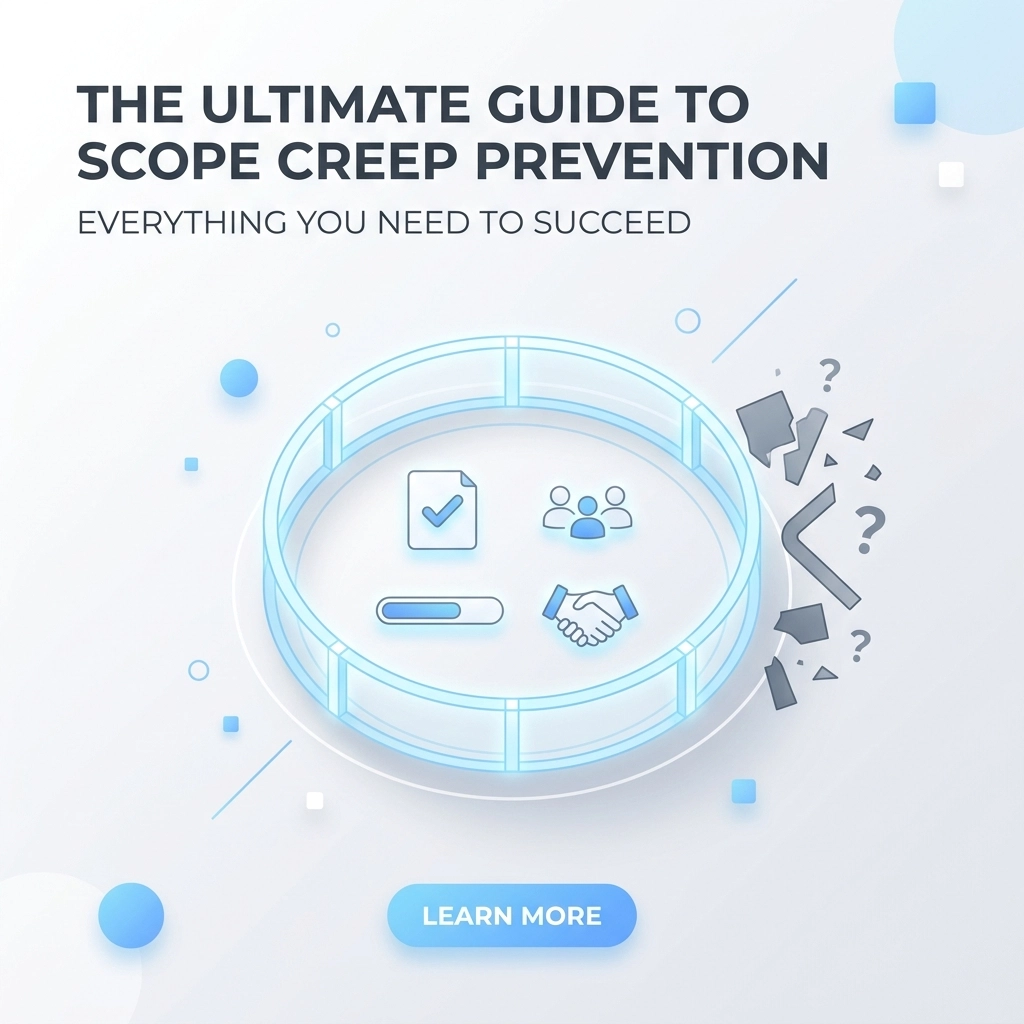
    When a client asks for "one small adjustment" and you agree without a formal adjustment to the timeline or budget, you are choosing to leak revenue. You are choosing to devalue your expertise. For the modern independent professional, the Digital Architect, this is unacceptable.

    To maintain a profitable practice, you must replace hope with a professional protection protocol. This is how you lock in your margins and defend your time.

    The Anatomy of a Leak: Why Scope Creep Makes Projects Fail

    Most freelancers and agency owners view scope creep as a social issue. They worry about "being difficult" or "damaging the relationship." This is a fundamental misunderstanding of the professional dynamic.

    A project without clear boundaries is not a relationship; it is a liability.

    Standard industry practice suggests that scope creep occurs when the initial requirements are vague. If the "Definition of Done" is not documented, the project has no ceiling. Without a ceiling, the client will naturally continue to add floors. This is "moving the goalposts" in real-time.

    Minimalist glass wall illustrating a project perimeter and professional boundaries to stop scope creep.

    Action: Define the Perimeter

    The Perimeter. Every project must have a hard boundary. If it is not explicitly listed in the initial agreement, it does not exist. This is the core philosophy behind the tools we build at GHW-Digital. We believe in systemic autonomy. You should not have to "negotiate" your time every Tuesday; the system should do it for you.

    The Foundation: The Freelance Contract Template That Stops Scope Creep

    Your first line of defense is your paperwork. A handshake is a gesture of goodwill, but an independent contractor agreement is a tool of protection.

    Too many professionals use generic, flimsy documents found in the dark corners of the internet. A high-value professional uses a robust freelance contract template that specifically addresses the mechanics of change.

    Standard industry practice suggests that a contract should not just outline the work, but the process for not doing work that falls outside the original agreement. This includes:

    • The Kill Fee. Protection against sudden project termination.
    • The Revision Limit. A hard cap on how many times a design or feature can be "tweaked."
    • The Change Order Clause. The mandatory protocol for any addition to the scope.

    Using a standardized freelance contract ensures that both parties are aligned before the first line of code is written. It transitions the conversation from "Can you just do this?" to "How does this fit into our established change protocol?"

    The Blueprint: Statement of Work (SOW) That Blocks Scope Creep

    The contract is the legal frame; the statement of work template is the architectural blueprint.

    While the contract handles the "what if," the SOW handles the "exactly what." A common protection strategy is to break the project down into granular deliverables. If you are building an app, do not simply write "App Development." Write "User Authentication Module," "Payment Gateway Integration," and "Database Schema Design."

    Systemic digital blueprint showing granular deliverables in a professional statement of work template to prevent scope creep.

    Benefit: Eliminate Ambiguity

    Granularity Equals Security. When the work is granular, "scope creep" becomes impossible to hide. If a client asks for a social sharing feature that wasn't in the SOW, the discrepancy is immediate and visible. You don't have to argue; you simply point to the blueprint.

    For those looking to automate this level of precision, ScopeGuard Elite provides a systemic solution to track these boundaries in real-time. It acts as a digital sentry, ensuring that the work being done matches the work that was bought.

    Systemic Protection: Deploying ScopeGuard Elite

    Digital Architects do not rely on memory or "gut feelings." They rely on data and systems. This is why we developed ScopeGuard Elite.

    Scope creep often happens in the "micro-moments", the 15-minute tasks that add up to 10 hours by Friday. ScopeGuard Elite is designed to catch these moments.

    Action: Lock In Your Margins

    • Track. Real-time monitoring of project requirements.
    • Calculate. Immediate visibility into how small changes impact the final delivery date.
    • Protect. A systemic "No" that takes the emotion out of the conversation.

    By positioning your business behind a tool like ScopeSentry, you are signaling to the client that you are a professional who respects their own systems. Clients do not push back against systems; they push back against people. Be the system.

    If you want external validation for why this matters, Harvard Business Review breaks down how uncontrolled scope creep quietly derails delivery and profitability: https://hbr.org/2013/06/battling-scope-creep-in-your-p

    The Professional Protocol: A Step-by-Step Defense

    Building a protection protocol requires a shift in mindset. You are not a "helper"; you are an architect. Standard industry practice suggests the following steps for every new engagement:

    1. Selection. Only work with clients who respect professional boundaries.
    2. Documentation. Use a comprehensive independent contractor agreement.
    3. Definition. Complete a detailed statement of work template for every phase.
    4. Automation. Implement ScopeGuard Elite to monitor deviations.
    5. Communication. Address scope changes the moment they appear. Never wait until the end of the month to "settle up."

    Minimalist silver sentry pillar illustrating a professional protection protocol to manage scope creep.

    Benefit: Professional Alignment

    Mutual Respect. When you enforce a protocol, you aren't just protecting yourself; you are protecting the project. Uncontrolled scope creep leads to missed deadlines and bugs. By saying "no" to unmanaged changes, you are saying "yes" to a high-quality finished product. This is how you build a reputation for reliability.

    Change Management: Turning Scope Creep Requests Into Revenue

    Scope creep is only a problem when it is unpaid. If a client wants more features, that is an opportunity for more revenue, provided you have the system to capture it.

    A common protection strategy is the "Change Request Form." This is a simple document that outlines:

    • The requested change.
    • The impact on the timeline.
    • The additional cost.

    Standard industry practice suggests that work on the new request should not begin until this form is signed. This turns "creep" into "upsell." It transforms a margin-killing mistake into a business-building expansion.

    For a plain-language legal reference point on formal contract change orders (what they are and why “in writing” matters), see Cornell Law School’s Legal Information Institute: https://www.law.cornell.edu/cfr/text/13/305.13

    The Minimalist Approach to Management

    Minimalism is not just an aesthetic; it is an operational strategy. It is about removing the friction of manual negotiation.

    At GHW-Digital, we focus on tools that provide autonomy. You should spend your time building, not defending your time. Whether you are using VowGuard Elite to manage commitments or ScopeSentry to watch your borders, the goal is the same: absolute control over your professional output.

    Minimalist blue slabs representing standardized freelance contract templates to control scope creep and maintain absolute project control.

    Action: Standardize Everything

    The Power of Templates. Do not write a new contract for every client. Have one freelance contract template that is battle-tested and refined. Do not wonder how to handle a revision. Have a protocol that dictates the process. The less you have to "think" about the rules, the more you can think about the work.

    Final Protocol Check (Stop Scope Creep Now)

    If your current project feels like it’s slipping away, ask yourself:

    • Is there a signed independent contractor agreement in place?
    • Does the statement of work template specifically exclude the new requests?
    • Am I using a tool like ScopeGuard Elite to track my time vs. my scope?

    If the answer to any of these is "no," you haven't been haunted by scope creep. You’ve invited it.

    Reclaim your autonomy. Deploy a system. Protect your profit.

    Stop the leak today. Visit GHW-Digital Apps to see how our tools can serve as your digital shield.

    Meta description: Scope creep kills margins and timelines. Use a simple protection protocol: perimeter definition, contract clauses, a tight SOW, and change control to lock in profit.

    URL slug: /avoid-scope-creep-protocol


    *Powered by GHW Digital (Company No: 16834250). This document is an automated draft for business organization purposes only. It does not constitute legal advice. GHW Digital accepts no liability for disputes, financial loss, or enforceability. Users must consult a qualified professional in their jurisdiction before signing.*