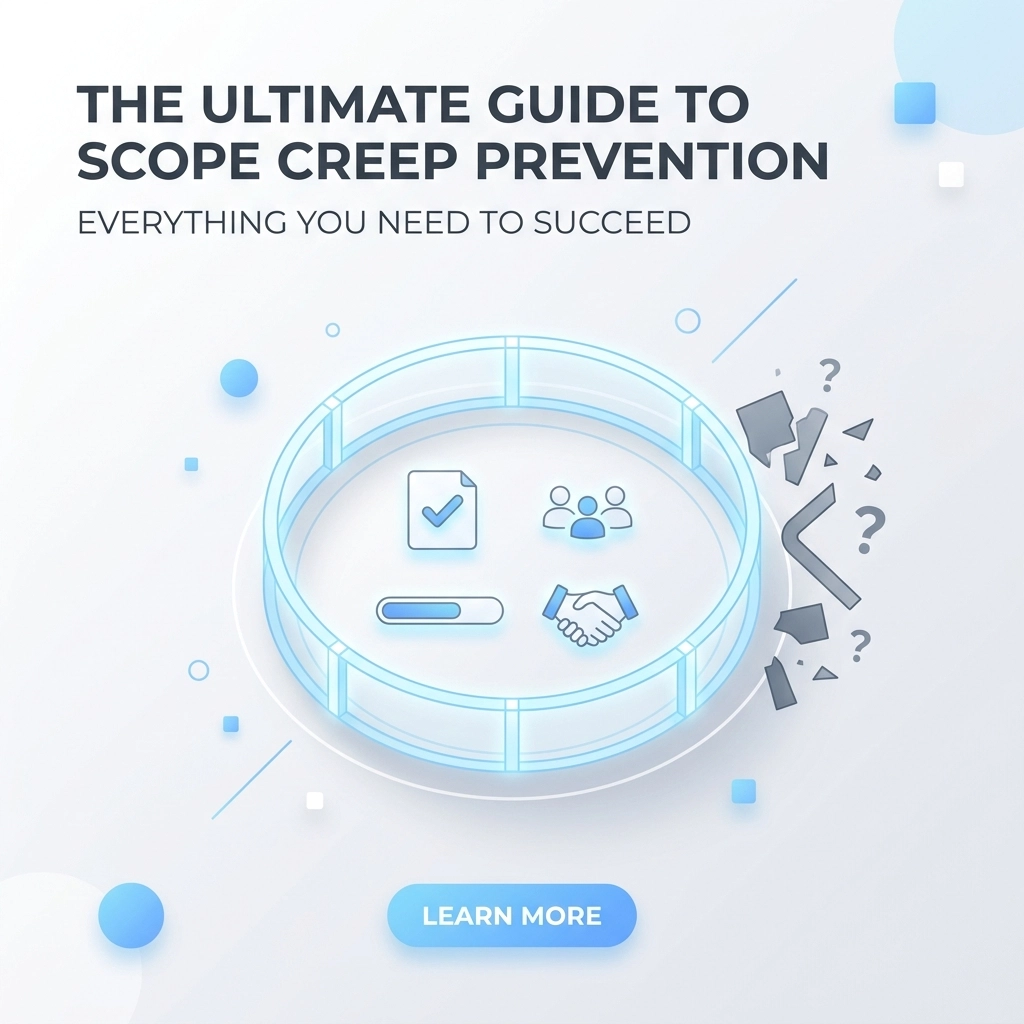
Scope creep management is the difference between a profitable launch and a slow-motion project disaster. If you are a freelancer or a boutique agency owner, you already know the symptoms. It starts with a simple "can you just add this button?" and ends with you working 20 hours of unpaid overtime on a Sunday night.
Scope creep kills margins. It erodes trust. It destroys the creative energy required to build exceptional digital products. To survive in the high-stakes world of app development, you need more than just good intentions. You need a fortress. You need a system that protects your time and your bank account from the inevitable drift of client expectations.
At GHW-Digital, we approach project management like digital architects. We don't just build features; we design boundaries. This guide is your blueprint for locking in your project parameters and ensuring you get paid for every ounce of value you deliver. If you are looking for fresh inspiration on how to structure your next build, check out our latest project ideas.
The Silent Margin Killer: Why Projects Bloat
Scope creep isn't usually a single, massive explosion. It is a series of tiny leaks. A small tweak here, a slight pivot there, and suddenly the original project roadmap is unrecognizable.
Most freelancers fall into the trap because they want to be "helpful." They want to over-deliver. But in the professional world, over-delivering without documentation is just poor business. When you fail to implement rigorous scope creep management, you aren't being nice; you are being un-professional. You are teaching your client that your time has no fixed value.
The cost of these shifts is cumulative. Every hour spent on an out-of-scope task is an hour stolen from another client or your own business development. You can see how we structure our own internal development pipelines at our ideas hub.

Alt-text: A minimalist digital blueprint showing a clear boundary line protecting a central project core, representing effective scope creep management.
Independent Contractor Agreements: Your Legal Perimeter
Your defense starts before the first line of code is written. Independent contractor agreements are not just legal formalities; they are your rules of engagement. If your contract is vague, your project is already at risk.
A robust agreement must define exactly what is in and, more importantly, what is out. Most freelancers focus on the deliverables. The Digital Architect focuses on the exclusions. By explicitly stating what you are not doing, you remove the gray areas where scope creep lives.
Your independent contractor agreements should include:
- A Detailed Statement of Work (SOW): Not just "build an app," but "build a 5-screen iOS application with Firebase integration as defined in Document A."
- A Change Request Protocol: A pre-defined process for how new ideas are handled.
- Payment Milestones: Tie your compensation to specific, undeniable progress points.
Don't leave your revenue to chance. Review your contract structures often and iterate based on your latest development concepts.
Action-Benefit: Lock in the Statement of Work
The Statement of Work is the foundation of the project. If the foundation is weak, the building collapses. To ensure effective scope creep management, your SOW must be granular.
Granularity Prevents Guesses. Vague requirements are the primary fuel for scope creep. When a requirement is "User Profile," a client might expect a basic name and photo. Later, they might "assume" it includes social media integration, a points system, and a marketplace. If your SOW specified "User Profile: Name, Email, Bio, and Profile Image upload (max 2MB)," the "assumption" disappears.
Traceability Tracks Growth. Every feature in your SOW should be linked to a specific business goal. When the client asks for a new feature, you can ask: "How does this map to the original goal?" If it doesn't, it’s a new project. You can explore how we map goals to features at GHW-Digital Ideas.

Alt-text: A high-contrast image of a contract with a magnifying glass over the "Exclusions" section, highlighting scope creep management.
The Communication Firewall: Managing Expectations
Communication is where most scope creep management efforts fail. If you are too accessible, you become a sounding board for every random thought the client has at 2 AM.
Establish the Protocol. Tell the client exactly how and when you communicate. No WhatsApp. No Slack messages on weekends. All requests must go through a formal channel. This isn't about being difficult; it's about maintaining the integrity of the project.
The Power of "Yes, And." You never have to say "no" to a client. Instead, use the Digital Architect's response: "That’s a great idea. It’s outside our current SOW, so I’ll put together a separate estimate for that additional phase." This frames the request as a professional transaction rather than an emotional negotiation.
By keeping the focus on the original project vision, you maintain the role of the expert, not the order-taker.
Change Management: The Professional Pivot
Changes are inevitable. Markets shift, and new information comes to light. Scope creep management isn't about preventing change; it's about managing the impact of that change on the budget and timeline.
The Change Request Form. Implement a mandatory form for any deviation from the SOW. This form should document:
- The requested change.
- The reason for the change.
- The impact on the delivery date.
- The additional cost.
When a client has to sign a document and see a price tag attached to their "small tweak," they suddenly become much more discerning about what is actually necessary.
Rebaseline Regularly. If a major change is accepted, you must rebaseline the entire project. The old timeline is dead. The old budget is gone. Update your documentation to reflect the new reality. Constant alignment is the key to long-term success. Learn more about aligning complex projects at our ideas page.

Alt-text: A minimalist UI design of a Change Request Form showing fields for 'Cost Impact' and 'Timeline Shift' to support scope creep management.
Tools for the Modern Digital Architect
You don't have to do this manually. Using the right software can automate the "sternness" for you. It’s easier for a tool to flag a delay than for you to have a difficult conversation.
- Scope Guard Elite: A specialized tool designed to monitor project boundaries in real-time.
- Scope Sentry: Keep a watchful eye on your development hours versus your SOW.
- Vow Guard Elite: Ensure that both parties are sticking to the independent contractor agreements signed at the start.
Using these tools signals to your client that you are a high-level professional who values precision. It removes the "human" friction and replaces it with data-driven guardrails. For more strategies on professional development workflows, browse our latest insights.
The Psychology of Boundaries
Setting boundaries feels uncomfortable for many freelancers. There is a fear that being "strict" will drive clients away. The opposite is true. According to studies by the Project Management Institute, projects with clear scope management are significantly more likely to succeed and lead to repeat business.
Clients don't actually want a "yes-man." They want a leader who can deliver a working product on time. When you let scope creep run wild, the project gets delayed, the quality drops, and the client becomes frustrated: even though they caused the problem.
By enforcing your independent contractor agreements and managing the scope, you are protecting the client from themselves. You are ensuring the project actually reaches the finish line. This authoritative stance is what separates top-tier developers from the rest of the pack. See how we maintain this standard across our app development concepts.

Alt-text: A minimalist black and white photograph of a stone pillar, representing the stability provided by firm scope creep management.
Securing Your Advantage
Effective scope creep management is a competitive advantage. While other developers are drowning in unbilled work and missed deadlines, you will be delivering high-quality products with predictable margins.
Treat your project perimeter as sacred. Document everything. Charge for changes. Use professional tools. Most importantly, never start work without a signed agreement that reflects the reality of the task at hand.
Stop leaking revenue. Start building with precision. If you're ready to start your next build with a clear vision, visit our ideas page for a head start.
Marblism Legal Shield
This content is provided for informational purposes only and does not constitute legal or financial advice. GHW-Digital and Marblism are not responsible for any project outcomes or legal disputes arising from the use of these strategies. Always consult with a qualified legal professional regarding your independent contractor agreements and business practices. We prioritize data integrity and transparent project management in all our digital architecture.
Leave a Reply