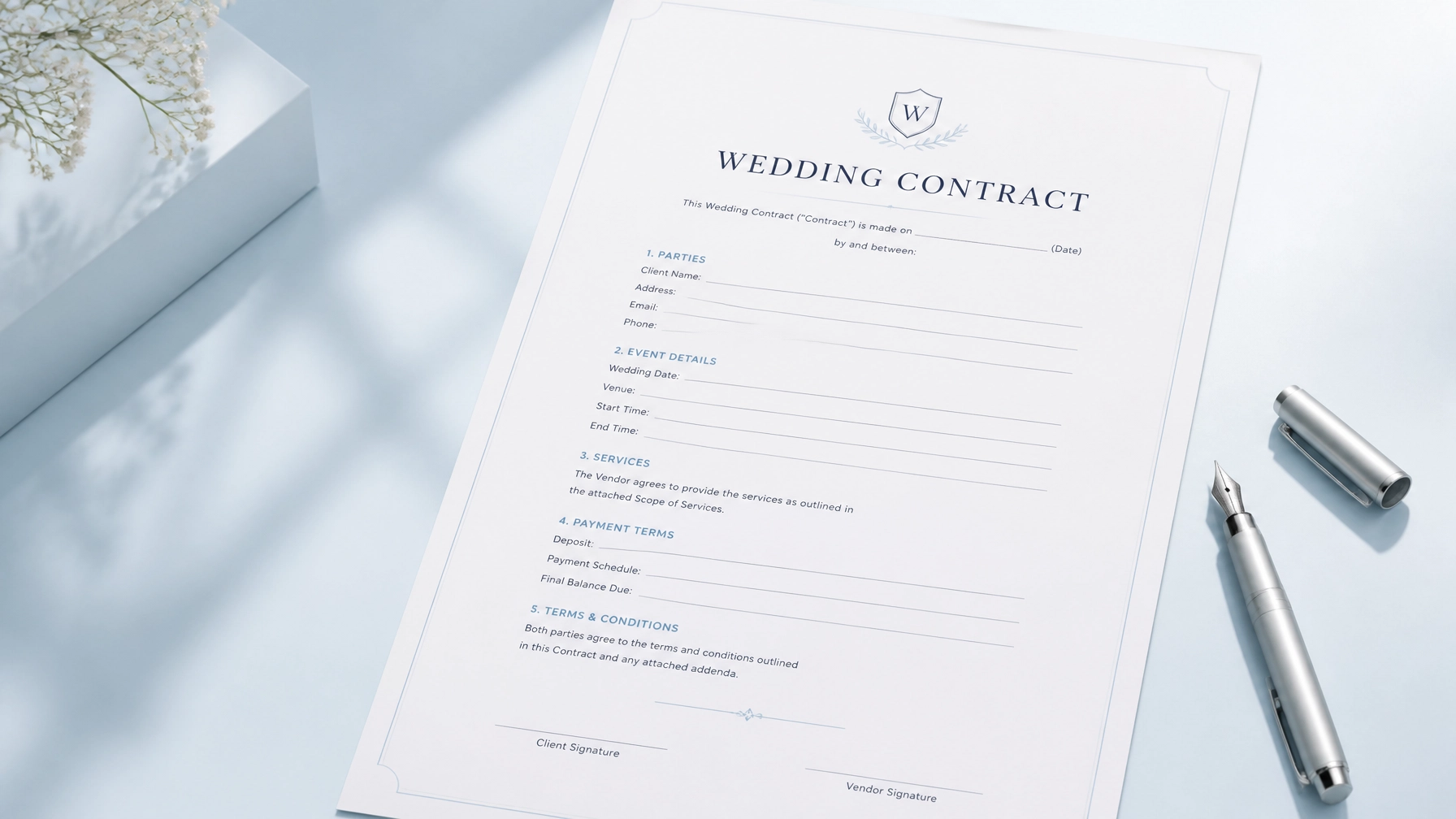
Wedding Supplier Contracts are the only thing standing between your dream celebration and a logistical nightmare. In the high-stakes world of wedding planning, many couples focus on the floral aesthetics or the tasting menu while inadvertently signing away their legal protections. Wedding vendors are experts at their craft, but their contracts are often designed as a one-way shield: protecting the business while leaving the couple vulnerable to "Scope Creep," service failures, and financial loss.
At GHW Digital, we view a contract not as a formality, but as a "Digital Asset" that must be engineered for your protection. If your agreement feels like a polite suggestion rather than a rigid protocol, you are at risk. Here are the red flags currently hiding in your wedding supplier contracts and the systemic ways to neutralize them.
1. The Ghost Substitution: Protecting Your Primary Professional
One of the most dangerous red flags in Wedding Supplier Contracts is the "Unlimited Substitution" clause. You spent months researching a specific photographer’s portfolio or a DJ’s mixing style, yet the fine print allows the company to send "any qualified staff member" at their sole discretion.
The Risk: You pay a premium for an elite professional but receive a junior associate on the day of the event.
Action-Benefit: Lock in the Lead. Insist that the specific name of your professional is written into the contract. Ensure any substitution requires your written consent, unless it is a documented medical emergency. If a substitution must occur, the contract should mandate that the replacement has equal or superior experience to the original professional.

2. The Force Majeure Imbalance: Securing Your Capital
A standard "Force Majeure" clause covers "Acts of God" like natural disasters. However, many Wedding Supplier Contracts use this to allow vendors to cancel their obligations without providing a refund. If the language is too broad, it might even cover the vendor’s own staffing shortages or supply chain issues.
The Risk: An event outside your control cancels your wedding, and the vendor keeps 100% of your deposit while providing zero service.
Action-Benefit: Equalize the Liability. Standard industry practice suggests that a Force Majeure event should trigger a choice: a "like-for-like" rescheduling (e.g., a Saturday for a Saturday) or a partial refund of the unearned portion of the fee. Never sign a contract that gives the vendor the right to cancel due to "unforeseen circumstances" without a corresponding refund protocol for the couple.
3. The Digital Gag Order: Preserving Your Right to Truth
The "Non-Disparagement" clause is a modern red flag that is becoming increasingly common in the wedding industry. These clauses literally forbid you from leaving an honest negative review if the service is substandard. Vendors use these "gag orders" to protect an inflated reputation.
The Risk: If your cake arrives collapsed or the band is four hours late, you cannot warn other couples without facing a legal penalty or a "liquidated damages" fine.
Action-Benefit: Maintain Transparency. According to legal resources like Brides, these clauses are often unenforceable, but they still create administrative chaos. Strike these clauses entirely. An honest professional should rely on their service quality, not a legal threat, to maintain their rating.
4. The Infinite Timeline: Tracking Your Deliverables
Too many Wedding Supplier Contracts omit the most crucial detail: the deadline. A photographer might capture stunning images, but if the contract doesn’t specify when you receive the gallery, you could be waiting six months or a year without any legal recourse.
The Risk: Your capital is tied up, but you have no control over the delivery of your physical or digital assets.
Action-Benefit: Define the Milestone. Every contract must include a specific delivery schedule. For example: "Sneak peek photos within 7 days; full digital gallery within 6 weeks." Use a high-impact "Action-Benefit" approach: by locking in dates, you gain the leverage to withhold final payments until milestones are met.

5. Vague Scope of Work: Eliminating Revenue Leaks
If your contract simply says "Wedding Day Photography," it is incomplete. "Scope Creep" happens when the boundaries of a service are not defined, leading to unexpected "overtime fees" or "travel surcharges" on the day of the event.
The Risk: You are hit with an invoice for an extra $1,000 because the "standard service" ended at 8:00 PM, but your cake cutting was at 8:30 PM.
Action-Benefit: Specify Every Asset. Your Wedding Supplier Contracts should list the exact start and end times, the number of staff members present, and the specific equipment provided. If you need inspiration for structuring these high-value professional problems, explore our logic at GHW Digital Ideas.
6. One-Sided Termination for Convenience
A "Termination for Convenience" clause allows a vendor to cancel your booking for any reason: or no reason at all: simply by giving notice. While this is common in corporate world, it is devastating for a wedding.
The Risk: The vendor finds a higher-paying client for your date and drops you two months before the wedding, returning only your deposit while leaving you with no service and higher last-minute costs elsewhere.
Action-Benefit: Reciprocal Protection. Ensure that if the vendor cancels for their own convenience, they are responsible for finding a comparable replacement or paying a penalty that covers the cost of a last-minute booking elsewhere.
7. Missing Liability and Insurance Protocols
Modern independent professionals must be insured. If a guest trips over a DJ’s cable or a photographer breaks an expensive venue heirloom, the contract must state who is liable.
The Risk: You, as the couple, become the default target for legal claims or venue damage costs.
Action-Benefit: Verify the Protocol. Demand proof of Public Liability Insurance. A professional vendor should have no issue attaching their certificate of insurance to the contract. This isn't just about safety; it's about elite protection for your financial peace of mind.
The Elite Solution: Vow Shield by GHW Digital
Identifying red flags is only half the battle; fixing them requires an "Autonomous Digital Asset" that acts as your private consultant. This is why we developed Vow Shield.
Unlike a static template you find on a generic blog, Vow Shield (part of our Vow Guard Elite suite) is an intelligent tool that interviews you about your wedding goals, detects hidden risks in your existing vendor proposals, and generates custom-engineered clauses to protect your interests. It replaces the need for an expensive lawyer with a 3-minute automated system designed for the Modern Independent Professional.
Whether you are dealing with a venue, a caterer, or a videographer, Vow Shield ensures that your Wedding Supplier Contracts are watertight. You are an expert at your wedding; let us be the architects of your protection.

Stop the Leakage: Secure Your Future Today
The "Moving Goalposts" of wedding planning can destroy your budget and your sanity. Do not treat your contracts as an afterthought. They are the protocols that govern your most significant financial and emotional investment.
If you are ready to stop being vulnerable and start being protected, visit our ideas vault to see how we are democratizing access to elite professional protection. Don't just sign it; shield it.
Powered by GHW Digital (Company No: 16834250). This document is an automated draft for business organization purposes only. It does not constitute legal advice. GHW Digital accepts no liability for disputes, financial loss, or enforceability. Users must consult a qualified professional in their jurisdiction before signing.
Leave a Reply