- SEO Title: Scope Creep Management: The Elite Strategy to Stop Massive Margin Bleed
- SEO Meta Description: Master scope creep management with these elite strategies. Learn how professional service contracts and software systems replace expensive consultants to protect your profits.
- Focus Keyword: Scope Creep Management
- URL Slug: scope-creep-management-elite-systems
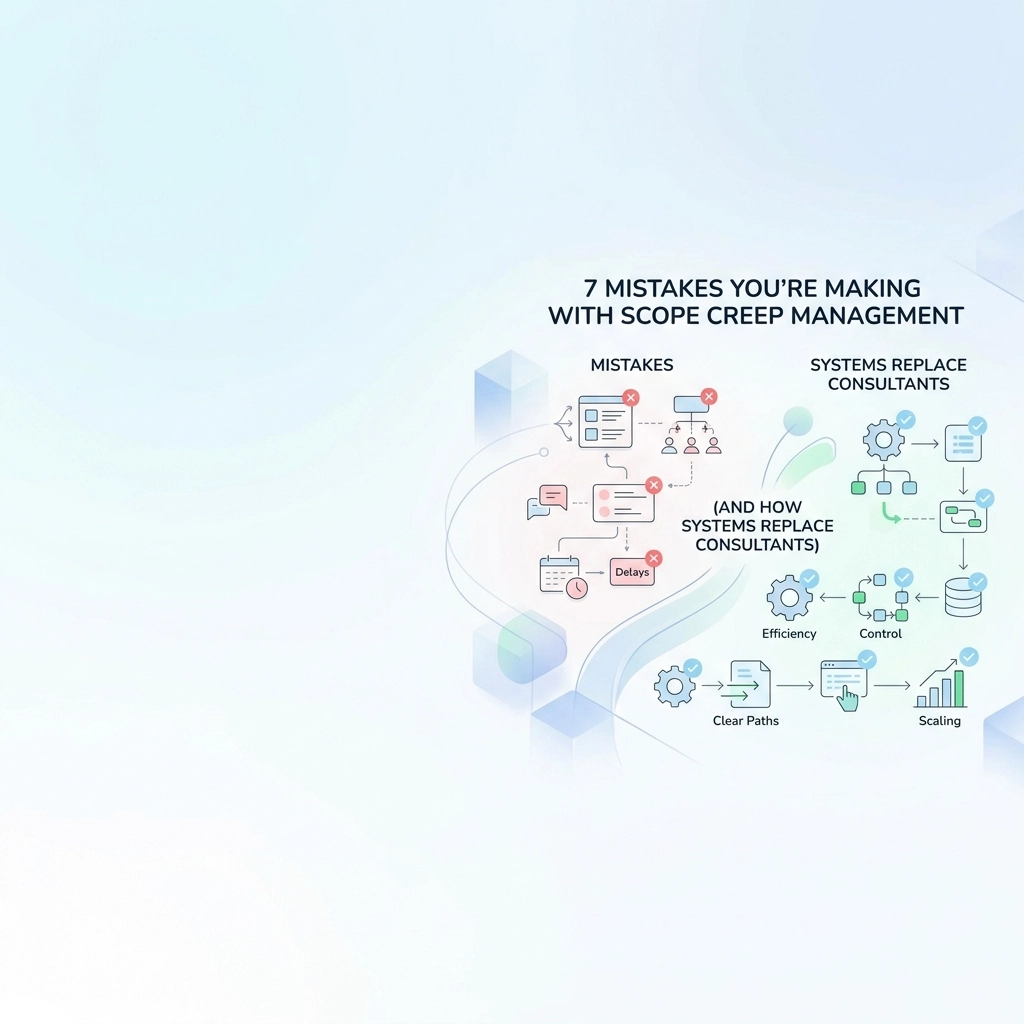
7 Mistakes You're Making with Scope Creep Management (And How Systems Replace Consultants)
Scope Creep Management is the single most critical factor determining whether your project remains a profitable asset or becomes a financial black hole. In the world of app development and professional services, "just one small change" is the siren song of margin erosion. Most firms try to combat this by hiring expensive consultants to police their projects, but humans are fallible, expensive, and prone to "friendship bias."
At GHW-Digital, we’ve seen how uncontrolled growth in project requirements can dismantle even the most promising startups. If you aren't guarding your boundaries with the same intensity you use to close deals, you aren't running a business; you're running a charity. To scale effectively, you need to move away from manual oversight and toward elite software systems that enforce Professional Service Contracts with clinical precision.
1. Draft Vague Professional Service Contracts
The first mistake begins long before a single line of code is written. If your Professional Service Contracts use broad, sweeping language like "provide cloud integration" or "enhance user experience," you have already lost. Vague language is an open invitation for clients to move the goalposts.
Elite Scope Creep Management requires surgical precision in documentation. Every deliverable must be defined by what it is and, more importantly, what it is not. If you are building a firewall solution, your contract should explicitly state if it includes 24/7 monitoring, third-party integrations, or user training. Without these boundaries, the client assumes everything is included, and you end up working for free. For more insights on structuring your project ideas effectively, visit our Ideas Gallery.
2. Rely on Expensive Consultants Over Automated Systems
Many firms believe that hiring a project management consultant is the solution to "scope bloat." This is a costly misconception. Consultants are human; they get tired, they miss emails, and they often avoid uncomfortable conversations about money to maintain a "good relationship" with the client.
Systems do not have these weaknesses. By implementing elite tools like Scope Guard Elite, you replace an expensive $300-an-hour consultant with a system that never sleeps. Software doesn't feel awkward when it tells a client that a new feature requires a budget adjustment, it simply presents the data. Systems provide a level of neutrality and consistency that no human consultant can match.

3. Skip the Technical Discovery Phase
Rushing into development to satisfy a client's "urgent" timeline is a recipe for disaster. When you skip a thorough technical discovery, you are essentially guessing. You cannot manage scope if you haven't fully mapped the terrain.
Effective Scope Creep Management demands a deep dive into technical requirements, success metrics, and acceptance criteria before a contract is signed. This phase isn't a delay; it's a defensive maneuver. It allows you to identify potential hurdles that would otherwise surface mid-project as "unforeseen requirements" that eat your profit. We recommend checking out our app development strategies to see how discovery saves projects.
4. Allow Fragmented Stakeholder Communication
When project decisions are scattered across Slack, WhatsApp, email, and verbal mentions during lunch, you are bleeding information. Fragmented communication makes it impossible to track where a requirement changed or who authorized it.
A centralized communication system is vital for Scope Creep Management. If it isn't documented in the system of record, it doesn't exist. This "source of truth" approach ensures that every stakeholder, including remote teams and the client’s C-suite, is looking at the same map. This prevents the "I thought we talked about this" defense that clients often use to push for free additions. You can find more on maintaining project integrity at GHW-Digital Ideas.
5. Neglect a Formal Change Control Process
Mistake number five is operating without a "gatekeeper." In many projects, change requests are handled ad hoc. A developer says "sure, I can add that button," and suddenly you’ve added forty hours of unscheduled QA work.
You need a formal change management system. This process should dictate:
- How a request is submitted.
- Who must approve the technical impact.
- How the budget and timeline are automatically updated.
Using a tool like Scope Sentry allows you to automate these gatekeeping functions, ensuring that no change enters the production pipeline without being accounted for.

6. Prioritize Speed Over Task Dependencies
When you fail to understand the hierarchy of tasks, you fall into the trap of "non-standardized project management." Adding a seemingly small feature might seem harmless, but if that feature sits at the base of a task dependency chain, it can delay ten other milestones.
Elite Scope Creep Management involves visualizing these dependencies. When a client asks for a change, a system-driven approach can immediately show them the cascade effect: "Adding Feature X delays Milestone Y by two weeks." This visual evidence is far more persuasive than a project manager’s verbal warning. To see how we structure these complex dependencies, explore our project frameworks.
7. Falling Into the Overengineering Trap
Sometimes the enemy is within. Technical teams often want to build the "perfect" solution rather than the "scoped" solution. Adding advanced encryption or audit logging that wasn't requested might seem like "going the extra mile," but it is actually a form of internal scope creep.
Managing this requires aligning technical excellence with the stated requirements of your Professional Service Contracts. Your job is to deliver exactly what was promised to the highest standard, not to exceed the scope at your own expense. Systems like Vow Guard Elite help keep development teams focused on the agreed-upon deliverables, preventing "gold-plating" before it starts.
How Systems Replace Consultants
The shift from human-led oversight to system-driven Scope Creep Management is a competitive necessity. Consultants are a variable cost that increases with project complexity. Elite software is a fixed investment that scales infinitely.
Software doesn't "forget" to document a change. It doesn't get intimidated by an aggressive client. It provides a transparent, data-backed history of every decision made during the project lifecycle. This transparency builds trust. When a client sees a system-generated report showing the impact of their requests, they respect your boundaries because the data is undeniable.

Action-Benefit: Secure Your Profit Margins
- Lock in Boundaries: Use software to define the "Finished" state before work begins.
- Automate Enforcement: Remove the emotional labor of saying "no" by letting the system handle change requests.
- Track Real-Time Impact: Instantly see how a scope change affects your bottom line and delivery date.
- Protect Your Developers: Prevent burnout by ensuring your team is only working on approved, high-priority tasks.
By moving away from manual, consultant-heavy processes and toward elite automated systems, you aren't just managing projects; you are protecting your agency’s future. Stop letting your profit leak through the cracks of "small favors" and "vague promises."
For more resources on how to protect your business and optimize your digital strategy, visit our main site or dive deep into our daily updates at ghw-digital.com/ideas.html.
Marblism Legal Shield:
This content is provided for informational purposes only and does not constitute legal or financial advice. GHW-Digital and its affiliates are not responsible for any project failures or financial losses resulting from the use of these strategies. Professional Service Contracts should be reviewed by qualified legal counsel in your jurisdiction. We value transparency and data integrity; for information on how we handle data, please refer to our Privacy Policy.
Stop the bleed. Secure your competitive advantage. Implement a system, not a consultant.
Leave a Reply