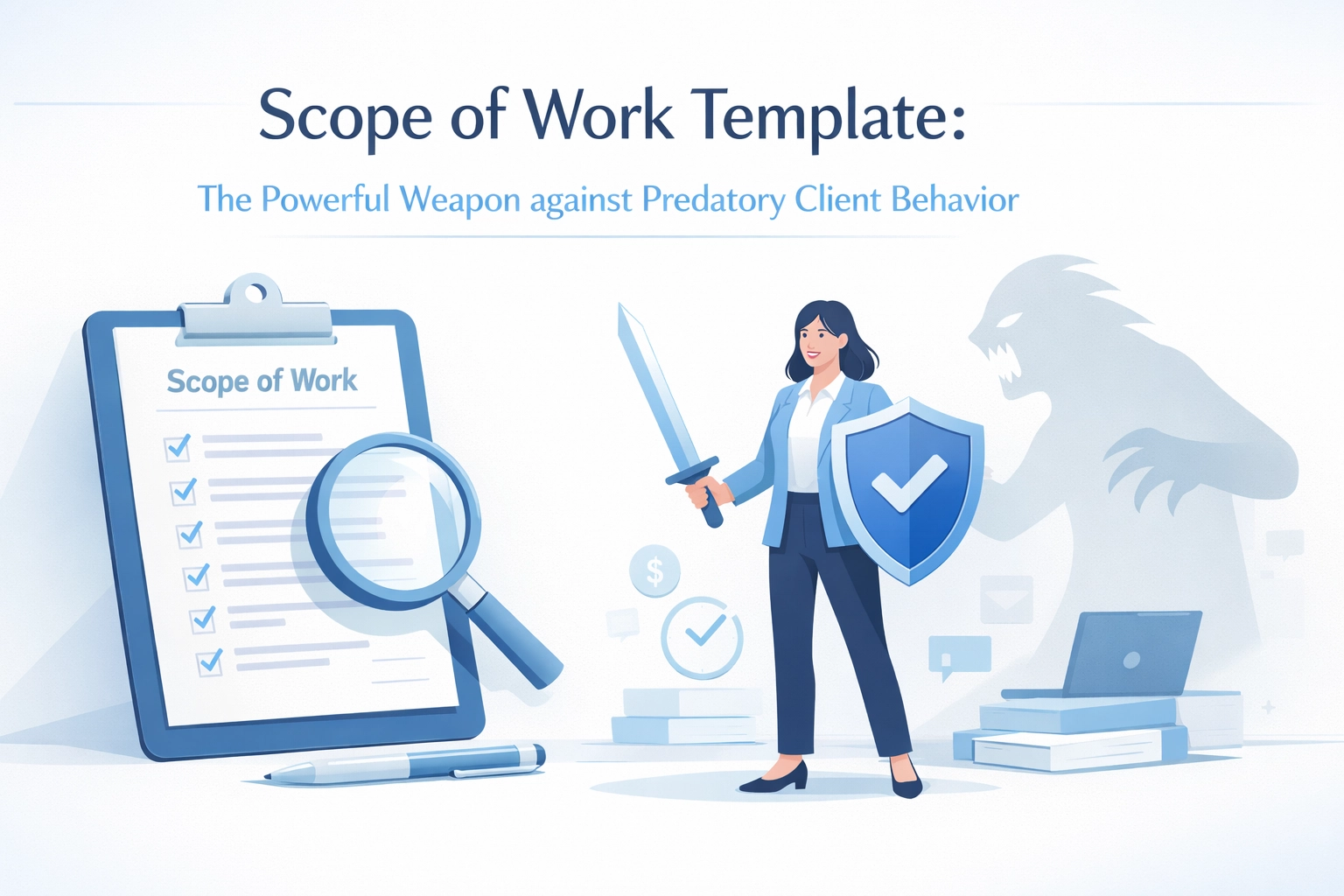
Scope of work template implementation is the primary defensive maneuver every digital professional must master to survive in a landscape filled with predatory client behavior. For too long, freelancers and boutique agencies have entered project engagements with nothing but a "gentleman’s agreement" or a loosely worded email. This lack of structure is an open invitation for scope creep to dismantle your profitability and erode your mental health.
In the digital services industry, predatory behavior doesn't always look like an overt threat. More often, it looks like a client asking for "just one more small tweak" at 9:00 PM on a Friday. It looks like a project that was supposed to last four weeks stretching into four months because the client is "still gathering feedback." Without a structured framework, you are not a business partner; you are a subsidised resource for the client's internal inefficiencies. You need a weapon to fight back.
Defining the Battleground: Why Your Current Contracts Fail
Most generic contracts focus on the "what if" of a legal catastrophe but completely ignore the "what is" of daily project management. They are reactive rather than proactive. A standard boilerplate agreement might tell you what happens if you get sued, but it won’t tell your client that adding a new API integration halfway through a sprint is going to cost them an extra £2,000.
Predatory clients rely on ambiguity. They thrive in the grey areas of your agreement. When a deliverable isn't explicitly defined down to the version number or the specific browser compatibility, the client has the leverage to demand infinite revisions. A professional scope of work template removes the grey. It sets the hard boundaries required to keep a project on track and profitable.

Explicit Deliverables: Locking in the Objective
The core of any scope of work template must be an exhaustive list of deliverables. This is not the place for vague language like "website development" or "social media management." Predatory clients will interpret "website development" as "unlimited pages, custom animations, and a full e-commerce backend" even if you only quoted for a five-page brochure site.
To protect yourself, your deliverables must be granular. Specify the number of pages. Specify the number of revision rounds. Specify the file formats. If you are a UI/UX designer, state exactly how many wireframes are included. If you are a software engineer, define the specific features and user stories that are in scope. By being hyper-specific, you create a document that acts as an objective truth. When the client asks for something outside that list, you don't have to be the "bad guy": the contract does the talking for you.
Defining Exclusions: The Power of Saying No Upfront
One of the most powerful sections of a high-end scope of work template is the exclusions list. This is where you explicitly state what you are not doing. Most freelancers feel uncomfortable listing what they won't do, fearing it makes them look unhelpful. In reality, listing exclusions projects an aura of extreme professionalism. It shows that you have a deep understanding of the project's boundaries.
If you are building a website, exclude SEO copywriting unless it's a paid line item. If you are developing an app, exclude third-party API costs or ongoing server maintenance. By defining these boundaries on day one, you prevent the "assumed inclusion" trap that predatory clients use to squeeze extra work out of you. This is the hallmark of the ScopeGuard Pro Elite system: it focuses as much on what is outside the fence as what is inside it.
Financial Defense: Milestones and Kill Fees
A predatory client’s greatest leverage is the final payment. They know that if they withhold the last 25% of the fee, they can force you to perform weeks of additional, out-of-scope labor just to get paid. A robust scope of work template dismantles this leverage by implementing a strict milestone payment structure.
Never work without a non-refundable deposit. This ensures the client has "skin in the game" and covers your initial overhead. Furthermore, you must include a "Kill Fee." If a client decides to pivot, take the work in-house, or simply disappears for three weeks, they should be contractually obligated to pay for the work completed up to that point. This prevents you from being left holding the bag for a project that fails through no fault of your own.

The Change Order Protocol: Converting Creep into Cash
Scope creep only happens when you allow it to happen for free. In a professional engagement, there is no such thing as "just one more thing." There are only "Change Orders." Your scope of work template should include a formal process for handling requests that fall outside the original agreement.
When a client asks for a new feature, your response should be: "That’s a great idea, it’s currently out of scope according to our MSA, so I’ll draft a Change Order and a price for that additional work." This shifts the dynamic from a negotiation to a transaction. Predatory clients hate Change Orders because they require them to pay for their indecision. Professional clients, however, respect them because they reflect a structured, business-minded approach.
Late Payment Mechanisms: Invoking the Law
Many freelancers are unaware that they are protected by specific legislation regarding late payments. A powerful scope of work template doesn't just ask nicely for payment; it invokes the law by name. In the UK, for instance, the Late Payment of Commercial Debts (Interest) Act 1998 allows you to charge interest at 8% above the Bank of England base rate, plus statutory compensation for debt recovery costs.
Including this language in your draft signals to the client’s accounts department that you are not a hobbyist. You are a professional entity that understands its rights. This often ensures your invoice moves to the top of the pile while other, less protected freelancers wait months for their checks to clear.
IP Ownership: The Ultimate Leverage
The most significant mistake a digital professional can make is transferring Intellectual Property (IP) rights before the final invoice is paid. Your scope of work template must clearly state that all rights, titles, and interests in the deliverables remain with you until you have received payment in full.
This is your ultimate insurance policy. If a client refuses to pay the final milestone but tries to launch the website or app regardless, they are committing copyright infringement. This gives you: and your legal counsel: massive leverage to resolve the dispute quickly. The Law Society frequently highlights the importance of clear IP clauses in commercial contracts to avoid lengthy litigation.

Client Delay Liability: Reclaiming Your Time
Predatory behavior often manifests as silence. A client who takes three weeks to provide feedback on a design is effectively holding your schedule hostage. You can’t finish the project, and you can’t easily take on new work because you’re waiting for them to move.
A sophisticated scope of work template includes a "Client Delay" clause. This clause states that if the client fails to provide necessary feedback or assets within a specified timeframe (e.g., 48 hours), the project timeline is automatically extended, and a "Restart Fee" or "Holding Fee" may apply. This puts the cost of the client’s disorganization back onto them, rather than forcing you to absorb the loss.
ScopeGuard Pro: The Elite Drafting Partner
Creating this level of protection from scratch is a daunting task. Most freelancers don't have the time to research 17 articles of legal scaffolding or the budget to hire a solicitor for every new project. This is why we built ScopeGuard Pro.
ScopeGuard Pro is not a static document; it is an advanced drafting tool. It uses a proprietary framework of field-tested clauses designed specifically for the digital industry. You provide the project details through a structured wizard, and the engine populates a professional draft that protects your cash flow, your IP, and your time. It’s about starting every project from a position of strength.
Assert Your Professionalism Today
The era of being a "disposable freelancer" is over. To scale your agency or your independent practice, you must stop negotiating against yourself. You must stop hoping for "nice" clients and start building systems that protect you from the "bad" ones.
A scope of work template is more than just a list of tasks; it is a declaration of your value. It tells the client that you respect your own time and expertise enough to defend it. When you present a professionally structured, 17-article Master Service Agreement, you change the power dynamic of the entire relationship. You are no longer a vendor; you are an essential partner with clear boundaries.
Stop allowing scope creep to bleed your business dry. Use a professional tool to lock in your deliverables and secure your profit margins.
Start drafting with ScopeGuard Pro Elite today.
Special Offer: Use discount code BLOG20 for 20% off ScopeGuard Pro. Valid until April 1st, 2026.
Marbalism Legal Shield & Data Integrity Notice
ScopeGuard Pro is a contract drafting support tool, not a law firm. All generated documents are structured drafts intended to serve as a starting point for professional negotiation. We strongly recommend that all final contracts are reviewed by a qualified solicitor or attorney in your specific jurisdiction to ensure compliance with local laws. Your data is processed securely via enterprise-grade infrastructure; we never sell your project details or personal information to third parties. Professionalism begins with protection.
Leave a Reply