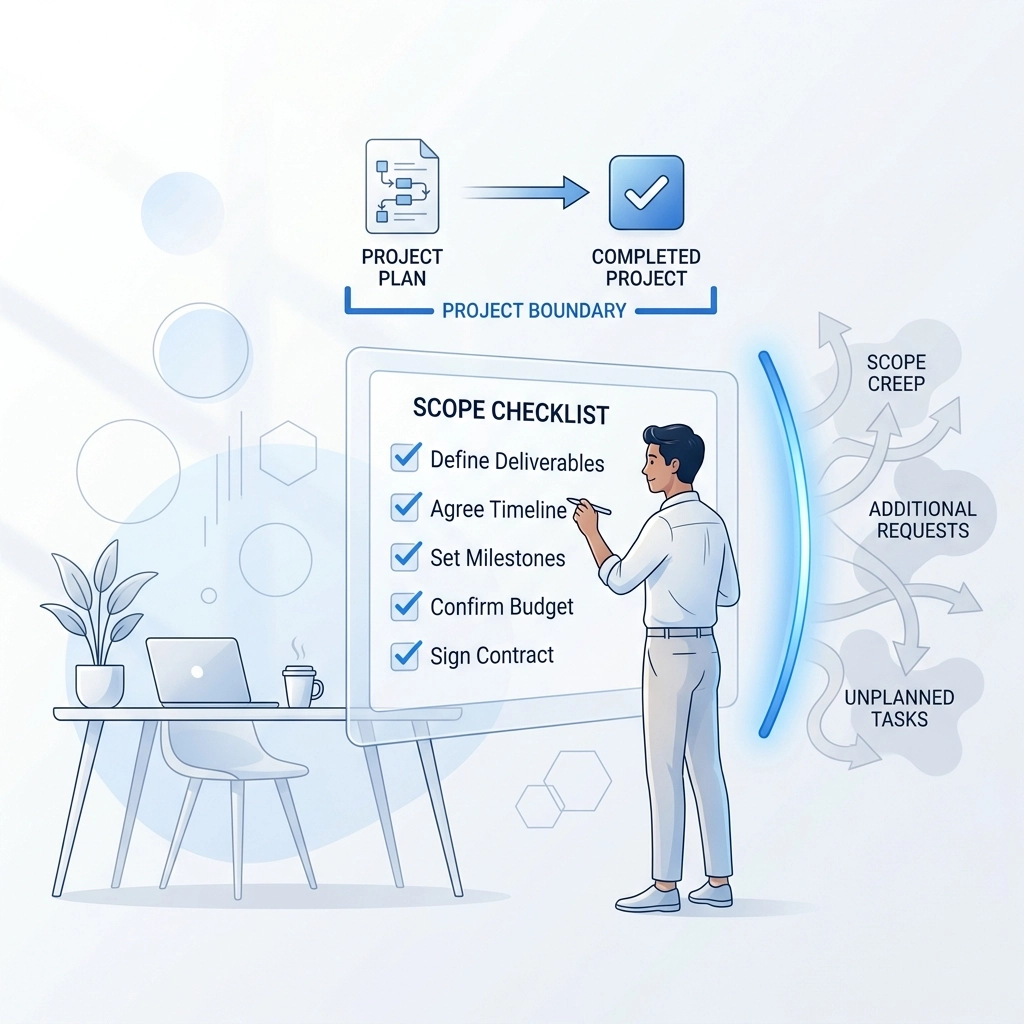
Scope creep management is the difference between a thriving practice and a slow, agonizing burnout. In the world of independent development and digital architecture, your time is your only inventory. When a project begins to swell, an extra feature here, a "small" revision there, your inventory vanishes without compensation. This isn't just a nuisance; it’s a direct hit to your profitability.
Scope creep kills margins. It turns high-value partnerships into resentment-filled slogs. If you aren't actively protecting your boundaries, you aren't just being a "nice guy", you’re subsidizing your client’s business with your own life.
At GHW-Digital, we see this constantly. Whether you are building complex apps or refining digital systems, the pressure to "over-deliver" is a trap. You need a shield. You need a system that treats your project scope as a rigid structural blueprint, not a suggestion.
Why Scope Creep Management is Your Digital Foundation
Scope creep occurs when the project’s requirements evolve in an uncontrolled way. It starts with vague project definitions and ends with you working weekends for free. Without a baseline of what is explicitly included and excluded, you are building on sand.
Effective scope creep management involves setting the rules of engagement before the first line of code is written. It’s about being a Digital Architect: designing the boundaries of a project so precisely that any deviation is immediately visible and billable.
To understand how to stop the leak, you must recognize the root causes:
- Vague Requirements: If "Phase 1" isn't defined to the pixel, it’s open to interpretation.
- Communication Gaps: Stakeholders who aren't aligned on the final output will always want "one more thing."
- Lack of Change Control: Accepting a request via Slack or email without a formal update to the agreement is a recipe for disaster.

Alt: A digital architect implementing scope creep management strategies to protect project boundaries.
Master Scope Creep Management with Better Contracts
Your primary line of defense is your paperwork. Independent Contractor Agreements are not just legal formalities; they are the architectural drawings of your professional relationship. If the agreement is weak, the project will sag.
When drafting these agreements, you need to be surgical. Most freelancers focus on what they will do. The pros focus on what they won't do. A high-impact Statement of Work (SOW) must include a list of explicit exclusions. If you are building a mobile app, state clearly that web-based administration panels are not included unless specified.
Visit our ideas page to see how we structure high-level project concepts that maintain clear boundaries.
The Anatomy of a Guarded Agreement
To ensure your Independent Contractor Agreements actually protect you, they must feature:
- Fixed Deliverables: Precise descriptions of the final product.
- Milestone Markers: Clear stages of completion that trigger approval and payment.
- The "Out-of-Scope" Clause: A section that defines exactly how additional requests will be handled (and billed).
- Change Order Process: A mandatory workflow for any deviation from the original SOW.
By treating the contract as a living shield, you transform potential conflicts into structured business negotiations. You aren't being difficult; you are being professional.
The Change Control Shield
Once the project is live, scope creep management moves from the contract to the daily workflow. You need a formal Change Control System. This is a simple but firm process: every time a client asks for something new, it is met with a standardized response.
"That’s a great addition. I’ll add it to the change request log and send over an estimate for the additional time and budget required."
This response does three things:
- Validates the client’s idea: You aren't saying "no."
- Establishes value: You are reminding them that your time costs money.
- Forces prioritization: If the client has to pay extra, they suddenly realize that "must-have" feature is actually a "nice-to-have."
For more insights on managing project flow, check out our latest ideas.

Alt: A minimalist dashboard showing a change control system used for scope creep management.
Pricing as a Deterrent
Your pricing structure is a tool for scope creep management. Fixed-fee projects are the most vulnerable to creep because the client’s cost remains static while your effort increases. To counter this, build a "contingency buffer" into your initial quote, usually 15-20%.
However, the most effective way to protect yourself is through transparency. If a client knows that every hour beyond the SOW costs $200, they will be much more disciplined with their requests. Use your Independent Contractor Agreements to hard-code these rates.
When you make the financial impact of change explicit, you stop emotional pleading. It becomes a logic-based business decision. You can find more strategies on how to value your digital assets at GHW-Digital Ideas.
Action-Benefit: Proactive Tools for the Independent Pro
You don't have to police your projects alone. Software can act as the "bad guy" so you don't have to. We recommend using specialized tools designed to lock in scope and track deviations in real-time.
- Lock in Deliverables: Use Scope Guard Elite to create immutable records of project requirements.
- Track Deviations: Implement Scope Sentry to monitor task expansion before it becomes a budget-killer.
- Enforce Agreements: Lean on Vow Guard Elite to ensure both parties stay aligned with the initial contract terms.
These tools represent a shift from passive project management to active defense. They serve as a constant reminder to the client that the project has walls.

Alt: An independent professional using digital tools to manage project scope and prevent revenue leaks.
The Daily Habit of Protection
Scope creep management is not a one-time event; it is a daily discipline. You must monitor your progress against the original SOW constantly.
- Spot the early signs: Look for "while you're at it" or "it should only take five minutes." According to Wikipedia's entry on project management, these small additions are the primary cause of project failure.
- Document everything: If it isn't in writing, it didn't happen. Use a centralized system to track all client communication.
- Align stakeholders early: Ensure everyone who has a say in the project understands the limits from day one. This prevents the "mystery stakeholder" from appearing in week six with a list of new demands.
For a deeper dive into the technical side of project architecture, browse our full list of articles.
Fairness Through Boundaries
There is a misconception that strict scope creep management hurts client relationships. The opposite is true. Unmanaged scope creep leads to missed deadlines, poor quality work, and a frustrated freelancer. That is a recipe for a bad review and a burnt bridge.
By maintaining firm boundaries, you ensure that the client gets exactly what they paid for, high-quality work delivered on time. You provide clarity. You provide professional certainty. For more on how we handle professional app development and client relations, see our app development page.
Maintaining a professional stance regarding boundaries emphasizes respect. You respect the client’s budget and time; they must respect your expertise and capacity. It’s a fair trade.

Alt: A clean, professional workspace illustrating the focus and discipline of scope creep management.
Secure Your Competitive Advantage
The independent landscape is crowded. Those who survive and thrive are those who master the business of their craft, not just the craft itself. Protecting your margins through rigorous scope creep management and rock-solid Independent Contractor Agreements gives you the financial stability to choose the projects you actually want to work on.
Don't let your profits leak through the cracks of a poorly defined project. Treat your SOW as a sacred document. Use tools that enforce your boundaries. Stop giving away your most valuable asset, your time, for free.
If you are ready to take your project management to the next level, start by reviewing our framework for digital innovation.
Stop the bleed. Lock in your scope. Secure your future.
Marblism Legal Shield
This content is provided for informational purposes only and does not constitute legal or financial advice. GHW-Digital and its associates are not responsible for any project outcomes resulting from the implementation of these strategies. We value your data and privacy; for more information, please visit our Privacy Policy.
Leave a Reply