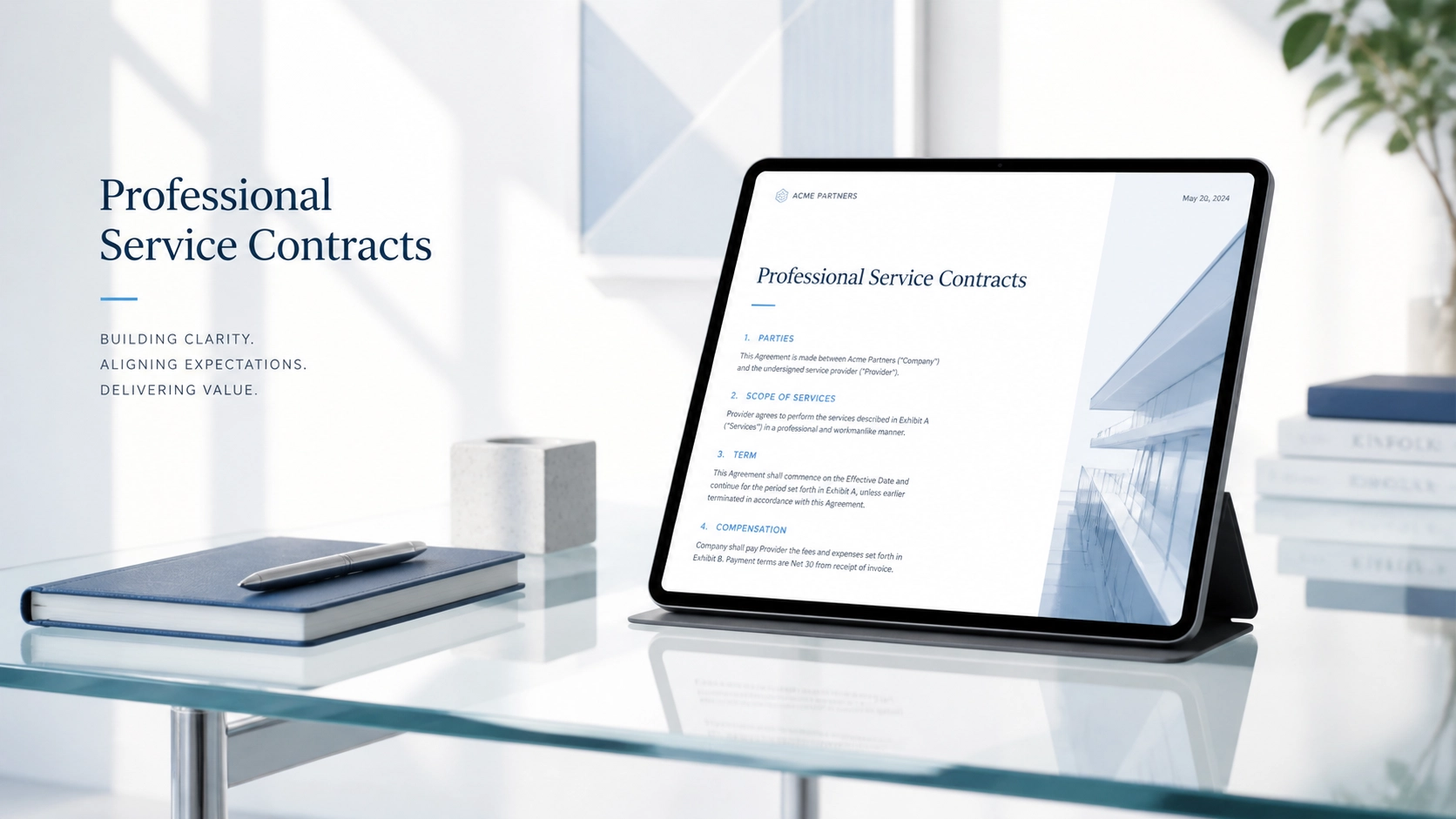
Professional Service Contracts are the invisible foundation upon which every elite wedding business is built. For the modern independent professional: the photographers, the planners, the cinematographers: the choice is no longer between having a contract and not. The choice is between the slow, expensive friction of human consultants and the systemic precision of autonomous assets.
In the high-stakes wedding industry, a single misunderstood clause can result in thousands of dollars in lost revenue or, worse, a devastating blow to your professional reputation. Traditional consultants will tell you that you need their billable hours to stay protected. They are wrong. You don’t need a person; you need a protocol.
The Fragility of Manual Professional Service Contracts
Standard industry practice suggests that a contract is a static document. In reality, a contract is a living defensive perimeter. When you rely on a human consultant to draft your Professional Service Contracts, you are inheriting their biases, their fatigue, and their hourly rate.
Consultants often charge between $200 and $400 per hour to review a single document. For a wedding photographer managing forty clients a year, this model is not just unsustainable; it is a leak in your business hull. Manual drafting is prone to "The Human Factor": the tendency to overlook a critical indemnification clause or fail to account for the unique risks of "Force Majeure" in a post-pandemic landscape.
Scope creep kills margins. Without a rigid, systemically engineered agreement, you are inviting your clients to move the goalposts. A consultant might suggest a conversation to resolve these issues; an autonomous asset prevents the conversation from ever being necessary by locking in the boundaries from day one.
Why Autonomous Assets Outperform Professional Service Contracts Consultants

At GHW Digital, we don’t build templates. We build "Autonomous Digital Assets." These are intelligent software tools: like Vow Guard Elite and Scope Guard Elite: that act as active guardians for your time and profit.
The difference is structural. While a consultant looks at a page, an autonomous asset looks at the logic. Our tools interview the user, detect hidden risks, and generate custom-engineered solutions in real-time. This isn’t just "automation"; it is the democratization of elite professional protection.
Action-Benefit: Pair Function with Tangible Results
- Risk Detection: The software identifies high-liability requests (e.g., specific "must-have" shot lists) and automatically inserts artistic discretion clauses.
- Revenue Lockdown: Payment schedules are calculated and enforced through the document logic, ensuring retainers are truly non-refundable under consumer protection law.
- Scope Insulation: By defining exactly what is not included, you eliminate the emotional pleading that leads to unpaid overtime.
By leveraging these assets, the freelance community can replace a $1,500 legal bill with a system that delivers a watertight result in three minutes. This is how you gain a competitive advantage: by being more protected, more professional, and more profitable than those still waiting for a lawyer to "get back to them next Tuesday."
The Digital Architect vs. The Billable Hour

Choosing an autonomous asset over a consultant is a shift in identity. You are moving from being a "vendor" who takes advice to a "Digital Architect" who builds systems. The consultant model relies on your dependence; the autonomous asset model relies on your autonomy.
When you use an elite tool like Scope Guard Elite, you aren't just filling in blanks. You are engaging with a system designed to solve high-value problems for free or low cost. These tools are built to be systemic and minimalist, removing the fluff of corporate jargon and replacing it with high-impact clarity.
If you have a specific problem that our current tools don't solve, we want to hear it. We invite you to share your requirements at our Ideas Area. We read every submission, ensuring that our next generation of assets is built to solve the real-world friction you face every day.
Protocol-Driven Defense: The Vow Guard Elite Method
Wedding professionals often face the "I don't like the photos" dispute. This is rarely about the quality of the work and almost always about a failure of alignment in the initial agreement.
An autonomous asset solves this by forcing alignment during the drafting process. It doesn't just ask for names and dates; it establishes a protocol for artistic judgment. It defines the "Creative License" in a way that is enforceable and clear.
Standard industry practice suggests that a handshake is enough for small details. A common protection strategy is to realize that nothing is a "small detail" when thousands of pounds are at stake. Professional Service Contracts generated through autonomous systems ensure that every detail is codified, every boundary is marked, and every liability is capped.
Secure Your Competitive Advantage
The wedding industry is evolving. The professionals who survive and thrive are those who embrace systemic efficiency. Stop leaking revenue to expensive consultants who provide static solutions to dynamic problems.

Autonomous assets are the shield your business deserves. They provide the leverage you need to scale without the administrative chaos of manual contract management. By adopting these protocols, you aren't just protecting your current event; you are securing your professional future.
Professional Service Contracts are too important to leave to human error. It is time to replace the consultant with the asset.
Stop the cycle of administrative vulnerability. Start building your digital fortress.
Powered by GHW Digital (Company No: 16834250). This document is an automated draft for business organization purposes only. It does not constitute legal advice. GHW Digital accepts no liability for disputes, financial loss, or enforceability. Users must consult a qualified professional in their jurisdiction before signing.
Leave a Reply