Category: Blog

Your blog category

  • The Ultimate Guide to Wedding Contract Templates: Everything Couples Need to Secure Their Vendors

    The Ultimate Guide to Wedding Contract Templates: Everything Couples Need to Secure Their Vendors

    [HERO] Wedding Supplier Contracts: The Ultimate Guide to Protecting Your Big Day with Crucial Security

    Wedding supplier contracts are the only line of defense between a dream ceremony and a logistical nightmare. When you begin planning your wedding, you aren't just selecting flowers and tasting cakes; you are entering into high-stakes business agreements. Most couples make the mistake of viewing these documents as mere formalities. They aren't. They are legal shields designed to ensure you get exactly what you pay for.

    At GHW-Digital, we understand the importance of precision. Just as we build robust digital solutions, we believe every couple deserves a robust legal framework for their wedding. In this guide, I’m going to show you how to flip the script on vendor agreements. Usually, these contracts are written to protect the professional. I’m here to tell you how to ensure they protect you.

    Analyzing Wedding Supplier Contracts to Protect Your Investment

    The reality of the wedding industry is that most vendors use standard templates that favor their own interests. If a photographer misses your first dance or the caterer runs out of entrees, a weak contract leaves you with zero leverage. You need to approach wedding supplier contracts with a "security-first" mindset.

    A contract is not a gesture of trust; it is a mechanism for accountability. It defines the boundaries of the professional relationship. If the boundaries aren't clear, the vendor can drift. In the software world, we call this "scope creep," and it’s just as dangerous for a wedding as it is for an app launch. You can find more about managing expectations and project scopes at our ideas page.

    Wedding bands protected by a blue shield for secure wedding supplier contracts.

    Identify Red Flags in Wedding Supplier Contracts Early

    Before you sign anything, you must be able to spot the warning signs. A vendor who is hesitant to specify details is a vendor who may not deliver. Here are the primary red flags to watch for:

    • Vague Deliverables: If a florist writes "seasonal blooms" without specifying a quantity or style, they can swap expensive peonies for cheap carnations without legal consequence.
    • Non-Refundable Everything: While deposits are standard, a contract that allows the vendor to keep 100% of the fee regardless of when or why a cancellation occurs is predatory.
    • The "Best Effort" Clause: If a contract says the vendor will use their "best effort" to show up, strike it out. You aren't paying for effort; you are paying for results.
    • Missing Liability Insurance: If a vendor doesn't mention insurance, they are a risk to your venue and your wallet.

    We often discuss the importance of rigorous vetting and clear documentation in our latest development ideas. The same logic applies here: if it isn't documented, it doesn't exist.

    Lock in Deliverables to Ensure Service Delivery

    To secure your wedding, your wedding supplier contracts must be granular. You want to see specific numbers, times, and names.

    Photographers: Don't just agree on "8 hours of coverage." Specify the start and end times, the number of shooters, the minimum number of edited images, and the delivery deadline for the gallery.
    Caterers: List the exact menu, the number of servers, the breakdown of the "service charge" (is it a tip or an admin fee?), and the policy for leftover food.
    Venues: Ensure the contract specifies setup and strike times. If you don't, you might find yourself paying "overtime" fees that were never clearly defined.

    Using a tool like Vow Guard Elite can help you keep track of these specific requirements, ensuring that nothing falls through the cracks. It’s about creating a "Vow Shield" around your event: a layer of protection that ensures every dollar spent translates into the service promised.

    A magnifying glass identifying red flags in wedding supplier contracts.

    The Vow Shield: Your Defense Against Vendor Failure

    The concept of a "Vow Shield" is simple: you create a standardized set of expectations that every vendor must meet before you sign. This isn't about being a "bridezilla" or a "groomzilla"; it's about being a responsible project manager for the biggest event of your life.

    When you use high-quality wedding supplier contracts, you are essentially installing a firewall. If a vendor fails to perform, the contract dictates the remedy. This might include a partial refund, the provision of a replacement vendor of equal quality, or liquidated damages.

    We apply this same rigorous defensive logic to our app development projects. We believe that clear contracts lead to better relationships because both parties know exactly where they stand. There is no room for "moving goalposts."

    Critical Clauses for Every Couple

    To truly protect yourself, ensure these three clauses are in every one of your wedding supplier contracts:

    1. The Substitution Clause: If the specific lead photographer or DJ you hired cannot make it, who is the backup? You should have the right to approve the substitute or cancel for a full refund.
    2. The Force Majeure Clause: This protects you in case of "acts of God." Ensure this clause is mutual. If the venue burns down, you get your money back. If a global pandemic hits, you have a clear path to rescheduling without massive penalties.
    3. The Dispute Resolution Clause: Avoid the nightmare of a public court battle. Stipulate that any disagreements will be handled via mediation or binding arbitration.

    For more strategies on securing your professional agreements, check out the resources at GHW-Digital Ideas.

    A wedding cake secured by a grid representing locked-in vendor deliverables.

    Why You Need a Professional Template

    Creating a contract from scratch is a recipe for disaster. You are not a lawyer, and neither is your florist. Using an attorney-drafted template is the most cost-effective way to secure your wedding. These templates are designed to be "plug and play," allowing you to insert your specific details into a framework that has already been legally vetted.

    Think of it like using a proven software architecture. You don't reinvent the wheel every time you build an app; you use a solid foundation and customize it. Your wedding deserves that same level of structural integrity.

    Securing the Future of Your Celebration

    Securing your vendors is about more than just a signature. It’s about alignment. When a vendor sees that you are using a comprehensive, professional wedding supplier contract, they immediately understand that you are a client who values professionalism and accountability. This often leads to a higher level of service. They know they can't cut corners because the "Vow Shield" is watching.

    Don't let the excitement of wedding planning blind you to the business reality of the event. Every vendor is a line item in your budget and a potential point of failure. Treat them as such. Use Scope Guard Elite or similar logical frameworks to map out your requirements before you ever sit down at the negotiating table.

    If you are looking for more ways to streamline your planning or want to see how we apply this "shield" mentality to digital products, visit our main site. We specialize in building systems that work, whether that's a custom app or a strategy to protect your most important milestones.

    Final Checklist for Wedding Supplier Contracts

    Before you commit your hard-earned money, run through this final scan of your wedding supplier contracts:

    • Is every promise made in an email or phone call written into the document?
    • Are the payment milestones tied to specific dates or deliverables?
    • Is there a clear "exit ramp" if the vendor's quality drops significantly before the wedding?
    • Does the contract specifically protect you, the couple, rather than just the vendor's profit margin?

    Protecting your wedding is a full-time job until the last guest leaves. Start with a strong foundation. For more insights on professional standards and "guarding your scope," head over to ghw-digital.com/ideas.html.

    Stop leaving your wedding day to chance. Secure your vendors, lock in your deliverables, and build your Vow Shield today.


    Marblism Legal Shield

    At GHW-Digital, we value transparency and data integrity. This content is provided for informational purposes and does not constitute legal advice. We recommend consulting with a qualified legal professional before signing any binding agreements. Your data privacy is our priority; we do not track your personal planning details through this blog. For more information, see our privacy policy.

    Abstract pillars symbolizing the structural integrity of a wedding legal shield.

    Take control of your wedding security. Explore our professional ideas and start building your defense.

  • Efficient Result Delivery

    Efficient Result Delivery

    Efficient result delivery is the antidote to the modern digital landscape. We live in an era where software developers are obsessed with "stickiness" and "engagement metrics." Most applications are designed to keep you trapped inside their ecosystem, clicking through endless menus and managing complex dashboards. At GHW-Digital, we believe this approach is fundamentally broken. We refuse to participate in the attention economy. Our manifesto is built on a different premise: a digital tool should execute its primary function perfectly and then get out of your way.

    The digital world has become a cluttered room. Between constant notifications, bloated features, and the psychological trickery of dark patterns, users are reaching a breaking point. We see this fatigue every day. People don't want more "features" to learn; they want their problems solved so they can return to their real lives. This is why we prioritize Efficient Result Delivery above all else. It is not just a technical goal; it is a moral commitment to respecting your time.

    The Core Principles of Efficient Result Delivery

    To achieve true efficiency, a tool must be built with the "In-and-Out" philosophy. This means that from the moment you open a GHW-Digital application, the path to your answer should be the shortest distance possible. We don't want you living inside our apps. We don't want you managing accounts or exporting data unnecessarily. We want you to grab the information you need and walk away.

    This philosophy requires a radical departure from standard industry practices. While other companies are adding "social" features to calculators or "gamifying" productivity tools, we are stripping everything back to the essentials. This is our Point 18 in action: Get in, get your result, and get on with your day. If you spend more than three minutes in one of our tools, we consider that a design failure on our part.

    A minimalist digital interface illustrating efficient result delivery and simple user experience.
    Alt: Efficient result delivery through clean and focused digital interfaces.

    Why Efficient Result Delivery Requires Minimalist Design

    Design must serve function. This is a non-negotiable rule at GHW-Digital. Aesthetics matter deeply to us, we believe a tool should be a pleasure to use, but clarity and ease of use are the ultimate goals. A beautiful interface that hides the "Submit" button or buries a result under three layers of navigation is not good design; it is a hurdle.

    When we build for humans who are tired and overwhelmed, we have to account for cognitive load. According to research by the Nielsen Norman Group, user control and freedom are vital for a positive experience. By providing a clear, jargon-free path to an outcome, we reduce the stress associated with digital tasks. Our tools are built to work exactly when you need them, without requiring constant updates or babysitting. This reliability is a feature in itself.

    Abolishing Digital Friction for Efficient Result Delivery

    Friction comes in many forms. Sometimes it is a hidden fee. Sometimes it is a mandatory account creation process just to see a single piece of data. We view these as "digital taxes" that drain your energy and focus. By killing the subscription model and refusing to use dark patterns, we eliminate the friction that slows you down.

    Software should be a tool, not a tax. Whether you are a freelancer or an individual, we refuse to charge endless monthly rent for digital access. We charge a fair price for a premium result. This radically fair pricing ensures that your relationship with us is honest and upfront. You aren't a "user" to be harvested for monthly recurring revenue; you are a person with a problem that needs solving. When the problem is solved, our job is done.

    A clean white corridor representing a frictionless path to efficient result delivery.
    Alt: A visual representation of abolishing digital friction and ensuring efficient result delivery.

    Efficient Result Delivery and the 'In-and-Out' Philosophy

    The "In-and-Out" philosophy is about more than just speed. It is about the preservation of your mental space. In a world where every app wants to be a "platform," we choose to be a "utility." Consider the difference between a town square and a screwdriver. A town square is designed for lingering, socializing, and spending time. A screwdriver is designed to turn a screw.

    We build digital screwdrivers.

    When you use our apps, you aren't entering a gated community where you have to worry about your data being held hostage. We don't collect massive amounts of your personal or business data. This simplicity is also our greatest security feature. If we don't have your data, bad actors can't steal it from us. You get the result, and we forget you were here. That is the ultimate form of digital respect.

    The Human Impact of Efficient Result Delivery

    We build for real life. Real life is messy, fast-paced, and often stressful. Whether you are navigating a major life milestone or managing a small agency, you need tools that reduce anxiety, not add to it. By focusing on immediate answers and zero baggage, we provide a sense of relief and clarity.

    This human-centric approach is rooted in Britain but built for a global audience. We deliver elite, globally competitive digital products that respect your device's battery, your data limits, and your patience. Our applications are incredibly fast and lightweight because we believe that performance is a sign of respect for the user.

    A calm professional experiencing efficient result delivery through high-performance software design.
    Alt: Human-centric design focused on efficient result delivery for stressed professionals.

    Technology as an Equalizer

    For too long, high-end digital tools have been reserved for giant corporations with massive budgets. These tools are often complex, requiring extensive training and dedicated staff just to operate them. At GHW-Digital, we take that high-end logic and simplify it for everyday people. We take the "corporation-grade" results and deliver them in a format that a freelancer can use in seconds.

    We believe technology should be an equalizer, not a barrier. By speaking in plain English and focusing entirely on outcomes, we empower our users to achieve results that were previously out of reach. This is the core of our "No Jargon" rule. We don't care about looking clever; we care about you feeling capable.

    Help Us Build What Matters Next

    We are constantly looking for ways to improve the digital experience for humans. Our manifesto isn't just a list of rules; it’s a living document that guides every line of code we write. We want to know what problems are still causing you stress. What digital tasks feel like a chore? What subscriptions are you tired of paying?

    We have created a dedicated space for your input at our Ideas Area. If you have a suggestion for a tool that follows our "In-and-Out" philosophy, we want to hear it. We can't guarantee we'll build it but we guarantee we'll read it!

    Your ideas help us stay grounded in the needs of real people. Whether it's a tool for personal life or business, if it helps eliminate confusion and anxiety, it fits our mission. We are here to help you buy the result and own the peace of mind.

    Final Thoughts on Mastery

    Efficient result delivery is a discipline. It requires the discipline to say "no" to unnecessary features. It requires the discipline to prioritize the user's time over the company's "engagement" stats. Most importantly, it requires empathy for the person on the other side of the screen.

    As we move forward, GHW-Digital will continue to champion the "In-and-Out" philosophy. We will continue to build tools that are fast, fair, and incredibly effective. We want to be the shortest part of your workday and the most reliable part of your digital toolkit. We want to provide the answer, and then we want you to close the tab and get back to your life.

    The future of software isn't about more time on screens; it's about more time away from them.

    A tranquil scene showing a person enjoying life away from screens after efficient result delivery.
    Alt: A peaceful professional enjoying time away from the screen thanks to efficient result delivery.

    ScopeGuard Elite: Lock In Scope, Protect Your Time

    Scope creep is just friction with a suit on. It drains margin, blurs responsibilities, and turns “quick tweaks” into unpaid deliverables.

    ScopeGuard Elite is our contract drafting engine for the Freelance Community. It helps you generate clear, professional agreements fast—so expectations are locked in before the work begins.

    For a limited time, you can use the discount code BLOG20 for 20% off (valid until April 1, 2026).

    Want to shape what we build next? Drop your idea in the Ideas Area.


    Powered by GHW Digital (Company No: 16834250). This document is an automated draft for business organization purposes only. It does not constitute legal advice. GHW Digital accepts no liability for disputes, financial loss, or enforceability. Users must consult a qualified professional in their jurisdiction before signing.

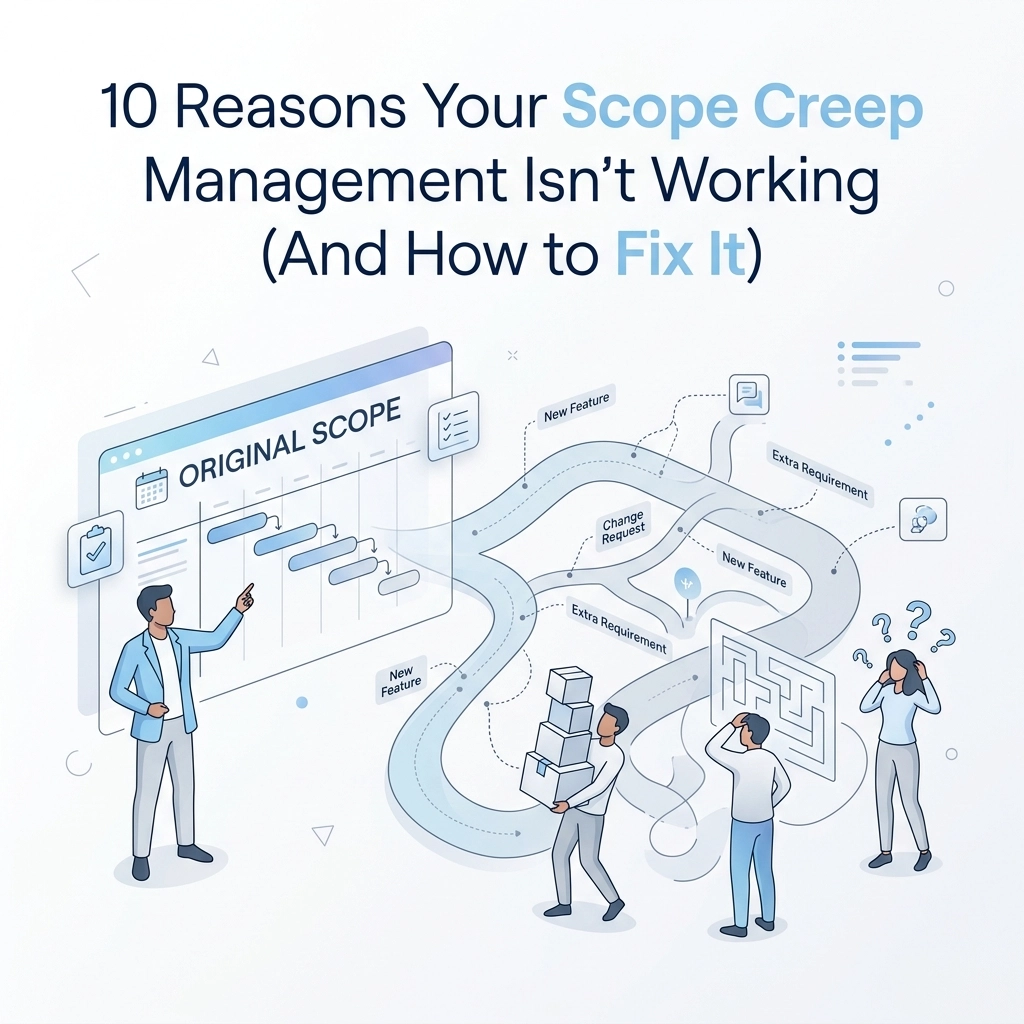
  • 10 Reasons Your Scope Creep Management Isn’t Working (And How to Fix It)

    10 Reasons Your Scope Creep Management Isn’t Working (And How to Fix It)

    Scope Creep Management for Freelancers and Agencies

    Scope Creep Management is the only thing standing between your project's profitability and a total collapse of your margins. If you’ve ever reached the end of a sprint only to realize you’ve done 40% more work for 0% more pay, you don’t have a "difficult client" problem. You have a structural failure in your workflow.

    As a Digital Architect at GHW-Digital, I see this every day. Projects don't fail because of a lack of talent. They fail because the boundaries were made of sand. We treat software development like construction, yet we often forget to sign off on the blueprints before we start pouring the concrete. If you want to protect your time and your sanity, you need to stop reacting and start architecting your defense.

    1. Ambiguity is the Silent Margin Killer

    The most common reason for failure in Scope Creep Management is a lack of precision. Vague terms like "user-friendly," "fast," or "modern" are traps. They are subjective. When a client says "fast," they might mean a 100ms load time. You might think 2 seconds is fine.

    Without a technical baseline, you are essentially giving the client a blank check to define "done" however they feel on a Tuesday morning. You need a Work Breakdown Structure (WBS) that translates "vibes" into "variables." If it isn't documented with a specific metric, it doesn't exist. This is where most Independent Contractor Agreements fail; they cover the money, but they don't cover the technical definition of success.

    2. Your Independent Contractor Agreements Are Too Soft

    A contract isn't just a legal formality; it is your shield. If your Independent Contractor Agreements don't explicitly define what constitutes a "change request" versus a "bug fix," you are asking for trouble.

    Many freelancers use generic templates that are too broad. To fix this, your agreements must include a "Scope Freeze" clause. This locks the requirements at a specific date. Anything added after that date isn't a "small tweak", it's a new invoice. We leverage tools like Vow Guard Elite to ensure these boundaries are legally and operationally clear from day one.

    A digital shield protecting project data, illustrating secure scope creep management boundaries in contracts.

    3. The "Just One Quick Thing" Trap

    Scope creep doesn't usually happen in a massive explosion. It happens in whispers. A quick color change here, an extra button there. These micro-requests are the termites of the development world. Individually, they seem harmless. Collectively, they bring the house down.

    Effective Scope Creep Management requires a "No Free Lunch" policy. Even a five-minute task has an administrative cost. It breaks developer flow and pushes back testing. If you don't track these "quick things," you lose visibility on the project's true velocity. Check out our thoughts on velocity and ideas to see how we handle these shifts.

    4. Lack of Formal Change Control

    If a client can request a feature over a casual Slack message, your process is broken. Verbal or informal requests are the primary drivers of project drift.

    You need a formal Change Request Form. It should include:

    • The description of the change.
    • The impact on the timeline.
    • The impact on the budget.
    • A signature (digital or physical).

    By forcing a formal process, you introduce "friction" for the client. This friction isn't bad; it forces the client to evaluate if the change is actually worth the cost. According to the Project Management Institute, uncontrolled changes are the leading cause of project failure.

    5. You Haven't Defined What Is Out of Scope

    Standard Scope Creep Management focuses on what you will do. Expert management focuses on what you won't do.

    Every proposal should have a "Not Included" section.

    • "We will build the API, but we will NOT handle third-party integration maintenance."
    • "We will design the UI, but we will NOT provide custom photography."

    By explicitly stating the exclusions, you eliminate the "I thought that was included" conversation before it starts. This clarity is essential for any robust Independent Contractor Agreements that aim to protect the service provider.

    6. Ignoring the Monitoring Phase

    You cannot manage what you do not measure. If you aren't comparing your actual progress against your initial baseline every single week, you aren't managing scope; you're just hoping for the best.

    Variance analysis is your best friend. If you planned for 40 hours and you've spent 60 on a feature that is "almost done," you have a leak. Tools like Scope Sentry help you visualize these deviations before they become catastrophic.

    Visualizing project path alignment to prevent budget leaks and improve scope creep management monitoring.

    7. Fear of Saying "No"

    Freelancers and small agencies often suffer from a fear of conflict. They worry that saying "no" to a request will damage the relationship or lead to a bad review.

    In reality, saying "yes" to everything is what ruins relationships. When the project is two months late and you're asking for more money because you're exhausted, the client won't remember the 50 "small favors" you did. They will only remember that you missed the deadline. Professionalism is about setting boundaries. A "no" today is a "thank you" on launch day.

    8. Requirements Gathering is Too Shallow

    If your requirements gathering process takes less than 10% of the total project time, it’s too shallow. Most Scope Creep Management fails because the foundation was built on assumptions.

    You need to act like a detective. Ask the "dumb" questions.

    • "What happens if the user loses internet connection here?"
    • "Who approves the content for this section?"
    • "Where does this data actually come from?"

    Uncovering these details during the discovery phase is cheap. Uncovering them during the coding phase is expensive. We dive deep into this on our app development philosophy page.

    9. Stakeholder Fragmentation

    Who is the "Captain" of the project? If you are taking orders from three different people at the client's company, you are doomed. Stakeholder A wants more data; Stakeholder B wants a cleaner UI; Stakeholder C wants it done yesterday.

    Your Independent Contractor Agreements should specify a single Point of Contact (POC). This person is the only one authorized to approve scope changes. This prevents "scope by committee," where features are added to satisfy internal office politics rather than project goals.

    Centralized alignment of project requirements to avoid fragmented stakeholder scope creep management.

    10. You Aren't Using the Right Tools

    Managing scope in a spreadsheet is like trying to build a skyscraper with a hand-saw. It might work for a tiny shed, but it won't scale.

    Modern Scope Creep Management requires integrated tools that link your contracts, your tasks, and your time tracking. This is why we developed Scope Guard Elite. It creates a digital perimeter around your project, ensuring that every shift is documented, priced, and approved.

    The Fix: Moving Goalposts into Locked Gates

    The solution to scope creep isn't to work harder; it's to work with better governance. You need to transition from a "service provider" mindset to a "Digital Architect" mindset.

    1. Re-Baseline Regularly: If a major change is approved, reset your baseline. Don't try to cram new work into an old timeline.
    2. Educate the Client: Most clients don't want to ruin your life; they just don't understand the technical implications of their requests. Explain the "Trade-off Triangle": Quality, Time, or Cost. If one moves, at least one other must change.
    3. Audit Your Agreements: Ensure your Independent Contractor Agreements are updated to reflect the realities of modern dev cycles.

    As noted by Harvard Business Review, the most successful projects are those where expectations are managed as rigorously as the code itself.

    Digital architecture with a defined perimeter, showing boundary-setting for scope creep management.

    The Bottom Line

    Scope creep is a choice. You either choose to manage it, or you choose to let it manage you. By implementing a strict change control process, hardening your legal agreements, and using precision tools, you can reclaim your margins and deliver better products.

    Stop leaking revenue. Start building with a shield.


    Marblism Legal Shield & Privacy Commitment
    At GHW-Digital, we believe in radical transparency. All project data and contract architectures managed through our platforms are encrypted and handled with zero-party data principles. We do not sell your project metrics or client lists. Our goal is to protect your intellectual property and your profits through blunt, honest, and ethical software solutions. Your boundaries are our business.

    Ready to lock down your next project? Explore our Ideas and Solutions to see how we can help you stop the creep.

  • How to Create a Watertight Independent Contractor Agreement in 5 Minutes Without the Consultant Fee

    How to Create a Watertight Independent Contractor Agreement in 5 Minutes Without the Consultant Fee

    [HERO] Watertight Independent Contractor Agreement for Professional Service Contracts

    Watertight independent contractor agreement creation used to be a grueling marathon through expensive legal offices. You would sit in a mahogany-lined room, paying $500 an hour to a consultant who simply filled in the blanks on a template they’ve used for a decade. Those days are over. In the modern landscape of app development and digital services, agility is your greatest asset. If your legal framework isn't as fast as your code, you are losing money.

    At GHW-Digital, we see it every day: brilliant projects derailed by "handshake deals" or flimsy "downloaded-for-free" templates that offer zero protection. Professional service contracts are the backbone of your business. They aren't just paperwork; they are the guardrails that prevent your margins from being swallowed by misunderstandings and moving goalposts.

    The High Cost of the Consultant Trap

    For years, the industry thrived on the myth that only a high-priced consultant could draft a secure contract. This myth persists because it’s profitable for the consultants. However, for a business owner, this is a massive bottleneck. Waiting three days for a draft while your developer is ready to start right now is a recipe for project delay.

    Professional service contracts shouldn't be a gatekeeper. They should be an enabler. By utilizing elite software tools, you can bypass the middleman. You don’t need a law degree to understand that a project without clear boundaries is a liability. You need a system that enforces those boundaries automatically.

    Elite software tools on a tablet replacing old pens for a watertight independent contractor agreement.
    Alt: Elite software tools replacing consultants for a watertight independent contractor agreement

    The Anatomy of a Watertight Independent Contractor Agreement

    To protect your interests, you need more than just a signature. You need a document that addresses the specific high-stakes nature of technical work. A standard watertight independent contractor agreement must cover the "Critical Nine":

    1. Identity and Effective Date: Know exactly who you are hiring and when the clock starts.
    2. Scope of Work: The "What" and, more importantly, the "What Not."
    3. Duration: Project-based or time-bound? Be precise.
    4. Payment Terms: Milestones, hourly rates, and expense reimbursement.
    5. Contractor Status: Confirming they are not an employee to avoid tax nightmares.
    6. Work Location: Crucial for security protocols and jurisdictional issues.
    7. Termination Clause: How do you part ways if things go south?
    8. Confidentiality/IP: Who owns the code? (Hint: It should be you).
    9. Governing Law: Where will the fight happen if there is one?

    If your current agreement is missing even one of these, it’s not a shield, it’s a suggestion. In the realm of app development, your intellectual property is your lifeblood. If your contract doesn't explicitly state that you own the work product from the moment of creation, you are building on borrowed ground.

    Action-Benefit: Lock in Your Scope to Protect Your Revenue

    Scope creep is a silent killer. It starts with a "small favor" and ends with a project that is three months behind and 20% over budget. A watertight independent contractor agreement must include a rigid definition of deliverables.

    When we develop Professional Service Contracts, we prioritize the exclusion of "extra" work without formal change orders. This isn't about being difficult; it's about fairness. You pay for what you get, and the contractor delivers what is promised.

    Glass barrier representing scope creep prevention in a watertight independent contractor agreement.
    Alt: Visualizing scope creep prevention in a watertight independent contractor agreement

    Our tool, Scope Guard Elite, was built precisely to handle this. It acts as a digital sentinel, ensuring that the work performed aligns perfectly with the signed agreement. When the scope is locked in, the revenue is protected. It’s that simple.

    Intellectual Property: Ownership is Non-Negotiable

    In the world of professional services, the code is the currency. We have seen countless founders realize too late that their contractor technically owns the repository because the contract was vague. An elite watertight independent contractor agreement includes a "Work Made for Hire" clause.

    This clause ensures that the second a line of code is written, it belongs to your company. No disputes, no ransom situations, no legal gray areas. If you are using external talent to build your vision, you must own the results. This is where tools like Vow Guard Elite come into play, providing the verification and tracking necessary to ensure your IP remains yours.

    The Software Revolution: Five Minutes to Total Defense

    Why wait for a consultant when you can use elite software? The transition from manual drafting to automated generation is the most significant competitive advantage you can adopt this year.

    The 5-Minute Workflow:

    • Step 1: Select a high-performance template tailored for App Development.
    • Step 2: Define your milestones and payment triggers.
    • Step 3: Insert your IP and confidentiality clauses using pre-validated legal blocks.
    • Step 4: Deploy for e-signature.
    • Step 5: Archive in a secure, searchable database.

    This process doesn't just save time; it ensures consistency. Consultants can have an "off day." Software doesn't. Every contract generated is as strong as the last one. You can find more strategies on streamlining your operations at GHW-Digital Ideas.

    A digital shield forming to show fast contract generation for a watertight independent contractor agreement.
    Alt: Fast digital contract generation for a watertight independent contractor agreement

    Terminating for Cause: The Exit Strategy

    Nobody enters a partnership expecting it to fail, but professional service contracts are written for the divorce, not the wedding. You need a clear, "no-nonsense" termination clause. This section should outline exactly what constitutes a breach and how much notice is required to end the engagement.

    A watertight independent contractor agreement should allow you to cut ties quickly if milestones are missed or if the quality of work drops below the agreed-upon standards. Without this, you could find yourself trapped in a contract with a sub-par performer, bleeding cash while your competitors pull ahead.

    Executing Your Watertight Independent Contractor Agreement Daily

    Contracting isn't a "one-and-done" task. As your business grows, your needs evolve. You might start with a simple project-based agreement and move toward a more complex retainer model. Regardless of the scale, the core principles of a watertight independent contractor agreement remain the same: clarity, ownership, and protection.

    We recommend auditing your contracts daily or whenever a new project phase begins. If you’re not sure where to start, looking at external resources like LawDepot or PandaDoc can give you a baseline, but for high-stakes software development, you need the precision that only specialized tools can provide.

    Digital scan of professional service contracts ensuring maximum legal security for software projects.
    Alt: Reviewing professional service contracts for maximum security

    Stop Leaking Revenue Today

    Every minute you spend worrying about a vague contract is a minute you aren't spending on growth. The era of the expensive legal consultant is fading, replaced by elite software that offers better protection at a fraction of the cost.

    At GHW-Digital, we provide the tools you need to stay agile. Whether it's through Scope Sentry to monitor your projects or our comprehensive guides on Sitemaps, we are here to ensure your business is a fortress.

    Don't leave your future to chance. Lock in your agreements, protect your IP, and stop the revenue leaks. It takes five minutes to secure your next project. Why wait?


    Marblism Legal Shield
    This blog post is provided for informational purposes only and does not constitute legal advice. While we believe elite software provides superior protection for professional service contracts, we recommend consulting with a legal professional to ensure your specific jurisdictional requirements are met. At GHW-Digital, we value your privacy; for details on how we handle data, please visit our Privacy Policy.

    Secure your margins. Stop scope creep. Get Started with GHW-Digital now.

  • The Proven “Future Protocols” Framework: How GHW Digital Turns Expertise into Self-Help Tools

    The Proven “Future Protocols” Framework: How GHW Digital Turns Expertise into Self-Help Tools

    Future Protocols Framework is the engine behind a quiet revolution in how professional expertise is consumed. For decades, the model for high-level advice has been the same: book a meeting, pay a premium hourly rate, and wait for a human to deliver a manual result. It is slow, it is prone to human error, and it is fundamentally unscalable. At GHW-Digital, we realized that the world doesn’t just need more consultants; it needs more access to the logic that consultants use.

    We created the Future Protocols Framework to solve the bottleneck of human-dependent services. By encoding elite professional expertise into digital tools, we are moving away from "rent-a-brain" models and moving toward a world of Autonomous Digital Assets. This isn't just about app development; it’s about democratizing the high-level strategies that were previously reserved for the elite few who could afford them.

    The Massive Impact of the Future Protocols Framework

    Traditional expertise is a trapped resource. It sits in the minds of professionals like lawyers, project managers, and engineers, gated by high fees and calendar availability. When we apply the Future Protocols Framework, we are essentially extracting the "if-this-then-that" logic of a seasoned pro and building it into a self-help tool.

    The Future Protocols Framework by GHW Digital converting complex logic into streamlined digital tools.
    Alt text: A visualization of the Future Protocols Framework converting complex logic into streamlined digital interfaces.

    The goal is simple: Protection. We protect the user from making rookie mistakes by giving them a digital guardian that embodies years of experience. Whether it is managing a project's boundaries with Scope Guard Elite or ensuring contractual integrity, we are putting the power of a senior partner into the palm of your hand.

    Build Autonomous Digital Assets – Stop Selling Time

    The most crucial shift any professional business can make is the transition from services to assets. We call these Autonomous Digital Assets (ADAs). An ADA is a tool that provides value 24/7 without requiring the creator to be present.

    When we use the Future Protocols Framework, we look for "leaking revenue" in your current processes. Most businesses lose money because their expertise isn't standardized. It's locked in silos. By building ADAs, we allow you to:

    • Scale Infinitely: Your expertise can serve 1,000 people as easily as it serves one.
    • Ensure Precision: Software doesn't have "off days." The logic is applied perfectly every time.
    • Create Value: You are no longer selling hours; you are selling a result.

    This philosophy is what drives our work at GHW-Digital. We believe that if a process can be mapped, it can be automated. This is how we turn ideas into reality for our clients every single day.

    Democratizing Expertise Through the Future Protocols Framework

    Why do we do this? Because the current system is broken. High-level professional guidance shouldn't be a luxury. By democratizing expertise, we empower small business owners, freelancers, and individuals to operate with the same level of strategic rigor as a Fortune 500 company.

    Digital tools created via the Future Protocols Framework providing professional guidance on a modern device.
    Alt text: Digital tools created via the Future Protocols Framework providing elite-level guidance to users.

    According to leading research on digital transformation trends, the future of work isn't just about AI doing the work; it's about AI and software guiding the work. Our Future Protocols Framework does exactly that. It doesn't just do the task; it teaches the user the "right way" to do it by enforcing a protocol.

    Action-Benefit: How the Framework Protects Your Business

    The Future Protocols Framework is built on several key pillars that ensure every tool we build is a "shield" for the user.

    1. Protocol Mapping: Lock In the Workflow
    We begin by identifying the exact steps an expert takes to solve a problem. We don't settle for "general advice." We demand a protocol. By locking in these steps, we eliminate the "moving goalposts" that often lead to project failure.

    2. Boundary Enforcement: Protect Your Margins
    Tools like Scope Sentry are born from this pillar. If you don't have a digital boundary, you have a leak. The framework ensures that the tool knows exactly where the service ends and where the "extra" begins.

    3. Algorithmic Intuition: Calculate Risk in Real-Time
    Expertise is often just a very fast calculation of risk. We build those calculations into the software. Instead of "feeling" like a contract is risky, the tool uses the protocol to calculate the risk based on pre-defined parameters.

    Turning Your Intuition into a Product

    Many professionals fear that their "gut feeling" can't be coded. They are wrong. Most "gut feelings" are actually high-speed pattern recognition. The Future Protocols Framework is designed to deconstruct those patterns.

    A professional using the Future Protocols Framework to map out unique business logic and expertise patterns.
    Alt text: A professional using the Future Protocols Framework to map out their unique business logic.

    When we work with partners to develop new tools, we aren't just looking for an "app idea." We are looking for a protocol that works. If you have a method that consistently delivers results, you have the foundation for a massive digital asset. We are committed to scaling these ideas into products that define their niche.

    Stop the Bleeding – Secure Your Competitive Advantage

    If you are still delivering your expertise manually, you are vulnerable. You are vulnerable to burnout, you are vulnerable to competitors who are faster, and you are vulnerable to your own human limitations. The Future Protocols Framework is your defense mechanism.

    We invite you to look at the tools we have already built using this framework. From Vow Guard Elite to our various internal prototypes, each one is a testament to the power of codified logic. We don’t just build apps; we build guardians for your business interests.

    Your Ideas, Our Architecture

    We are constantly looking for the next protocol to digitize. The philosophy of GHW-Digital is rooted in the belief that the best software comes from the front lines of professional experience. We don’t want to guess what you need; we want to build the tool you’ve already designed in your head.

    The conceptual workflow of the Future Protocols Framework building a secure Autonomous Digital Asset.
    Alt text: The conceptual workflow of the Future Protocols Framework from idea to Autonomous Digital Asset.

    If you have a framework, a checklist, or a "secret sauce" that you’ve used to win for years, it’s time to stop giving it away for hourly rates. It’s time to turn it into an Autonomous Digital Asset.

    Join us in democratizing professional expertise. Share your vision with us at GHW-Digital Ideas.


    Marblism Legal Shield

    The information provided in this blog post regarding the Future Protocols Framework and Autonomous Digital Assets is for educational and informational purposes only. While GHW-Digital strives to provide accurate and up-to-date content, the implementation of these frameworks and the creation of digital assets involve inherent risks and variables beyond our control. GHW-Digital makes no guarantees regarding the specific financial or operational outcomes of using these protocols. Users should perform their own due diligence and consult with professional advisors before making significant business or technological changes. GHW-Digital is not liable for any losses or damages arising from the use of or reliance on the information provided herein. All software products mentioned are subject to their own respective terms of service and privacy policies.

    Last Updated: March 27, 2026

  • Wedding Supplier Contracts: Crucial Mistakes and Elite Fixes to Protect Your Wedding

    Wedding Supplier Contracts are the only thing standing between a seamless celebration and a logistical catastrophe. When you are planning the most important day of your life, you aren't just hiring a florist or a DJ; you are entering into a series of high-stakes legal agreements. Most couples view these documents as a formality, a "click-and-sign" hurdle on the way to picking out cake flavors. This is a massive tactical error.

    In the world of professional event planning, your contract is your shield. Without a robust agreement, you are exposed to shifting timelines, disappearing vendors, and "scope creep" that can hemorrhage your budget. At GHW-Digital, we believe in radical transparency and technical precision. We don't just build apps; we build systems that protect assets. Whether you’re exploring new innovative ideas for your ceremony or finalizing your vendor list, you need to treat every signature like a defensive maneuver.

    Here are the crucial mistakes you are likely making with your Wedding Supplier Contracts and how to deploy the fixes necessary to protect your interests.

    1. Accepting Vague Service Descriptions

    One of the most common pitfalls in Wedding Supplier Contracts is the use of generic language. If your contract simply says "Photography Services," you have essentially signed a blank check for disappointment. This lack of specificity is where quality begins to leak.

    You must lock in the specifics. A professional contract should act as a blueprint. It needs to detail exactly how many hours the vendor will be on-site, the specific names of the individuals providing the service, and a granular list of deliverables. If you’ve spent time looking through creative ideas for your wedding visuals, ensure those specific styles are mentioned.

    The Elite Fix: Demand a "Statement of Work" style breakdown. List the arrival time, the "wheels up" departure time, and a specific inventory of equipment or products. If it isn't on the page, it doesn't exist.

    ![Magnifying glass and pen reviewing specific service details in a Wedding Supplier Contract. A close-up of a pen resting on a detailed legal contract with a magnifying glass nearby, symbolizing attention to detail. Alt: Detailed Wedding Supplier Contracts being reviewed for service specifics.]

    2. Skimming the "Fine Print" on Deliverables

    Many couples treat the signing process as a race to the finish line. They skim the terms and conditions, assuming that the vendor's reputation is enough. Reputation is not a legal defense. When you fail to read the fine print in Wedding Supplier Contracts, you often miss critical clauses regarding intellectual property, meal requirements, and "working condition" mandates.

    For example, did you know some photographers own the copyright to your images forever, and you are only granted a "license" to use them? If you don't negotiate these terms upfront, you could find your private moments being used in global marketing campaigns without your consent.

    The Elite Fix: Treat your contract review like a code audit. Every line should have a purpose. If you find a clause that seems lopsided or "standard," challenge it. You are the employer; you set the boundaries. For more on how to structure professional agreements, check our latest strategy ideas.

    3. Ignoring the Absence of a Vow Shield or Guarantee

    In the tech world, we use "Service Level Agreements" (SLAs) to ensure uptime. In the wedding world, you need a Vow Shield. Most Wedding Supplier Contracts are written by the vendor to protect the vendor. They include clauses that allow them to swap out staff or change products with "comparable" alternatives without your approval.

    This is where service delivery fails. You need a mechanism that guarantees the specific quality you paid for. We often recommend using tools like Vow Guard Elite to track these commitments. A Vow Shield approach ensures that if a vendor fails to meet a specific milestone, there is an immediate, pre-negotiated remedy.

    The Elite Fix: Insert a "Quality Guarantee" clause. If the lead photographer isn't the one who shows up, or if the "premium" floral arrangements are substituted for lower-grade stock, the contract should trigger an automatic partial refund.

    ![A digital Vow Shield interface representing protection and guarantees for Wedding Supplier Contracts. A digital dashboard showing contract milestones and protection status, representing the Vow Shield concept. Alt: Digital protection tools for Wedding Supplier Contracts.]

    4. Agreeing to "Non-Refundable" Terms Without Flexibility

    Vendors love the term "non-refundable deposit." While it’s fair for a business to protect its time, a 100% non-refundable policy with zero flexibility is a red flag in Wedding Supplier Contracts. Life is unpredictable: pandemics, family emergencies, and venue issues happen.

    If your contract doesn't have a "Rescheduling Clause," you are essentially gambling with your deposit. You need a sliding scale that protects your capital. According to the American Bar Association, contract fairness often hinges on the balance of risk between both parties. If all the risk is on you, the contract is poorly drafted.

    The Elite Fix: Negotiate a tiered refund schedule. For example, 100% of the deposit is kept if canceled within 30 days, but 50% is returned if canceled six months out. This aligns with best practices in project management.

    5. Overlooking Hidden Fees and "Plus Expenses" Leaks

    Vague pricing is the silent killer of wedding budgets. Many Wedding Supplier Contracts include a base price followed by a "plus expenses" or "plus travel" addendum. Without a cap on these expenses, your $5,000 vendor can easily become a $7,000 liability.

    You should never sign a contract that leaves the total cost open-ended. Gratuities, sales tax, setup fees, and "breakdown charges" should all be itemized. If you are looking for ways to optimize your budget, start by closing these financial loopholes.

    The Elite Fix: Demand an "All-In" price or a "Hard Cap" on expenses. If the vendor requires travel and lodging, specify the maximum reimbursement amount and the class of service allowed.

    6. Accepting Unfair Force Majeure Clauses

    The "Act of God" clause: Force Majeure: is often the most misunderstood section of Wedding Supplier Contracts. Many vendors use broad language that allows them to cancel and keep your money if something "unavoidable" happens. This is unacceptable.

    A fair Force Majeure clause should outline what happens to the money in the event of a cancellation. Does it go toward a future date? Is it refunded minus costs already incurred? You need to ensure the clause isn't just a "get out of jail free" card for the vendor. For more insights on protecting your digital and physical assets, see our resource page.

    The Elite Fix: Specify that in the event of Force Majeure, both parties are released from their obligations, and any unearned fees (money not yet spent on materials or labor) must be returned to the couple.

    ![Professional handshake over a signed folder to finalize fair terms in a Wedding Supplier Contract. A couple shaking hands with a vendor in a professional office setting, both holding a folder. Alt: Finalizing fair terms in Wedding Supplier Contracts.]
    7. Relying on Verbal Agreements and Handshakes

    The biggest mistake you can make is thinking a "good vibe" replaces a legal document. "Don't worry, I'll take care of it" is not a contract. In the heat of a wedding day, memories fade and "he said, she said" won't get your flowers delivered on time.

    Every email, every phone call, and every brainstorming session where a promise is made must be reflected in the written Wedding Supplier Contracts. If you change the arrival time over coffee, send a contract amendment immediately.

    The Elite Fix: Use a digital contract management system or a simple "Amendment Log." Any change to the original agreement must be signed or initialed by both parties to be valid.

    Securing Your Competitive Advantage

    Your wedding is a massive investment of time, emotion, and capital. Treating it with anything less than professional rigor is a disservice to your future. By identifying these red flags in Wedding Supplier Contracts, you aren't being "difficult": you are being a steward of your own interests.

    At GHW-Digital, we apply this same level of scrutiny to everything we build, from enterprise apps to the ideas we share on our blog. We believe that protection is the foundation of success.

    Don't let the excitement of the "Big Day" blind you to the realities of the "Big Contract." Lock in your details, shield your deposits, and ensure that your vendors are as committed to your vision as you are.

    Stop letting vague terms dictate your wedding's success. Secure your ceremony by demanding better Wedding Supplier Contracts today.


    Marblism Legal Shield
    This blog post is provided for informational purposes only and does not constitute legal, financial, or professional advice. While we strive for accuracy, the legal landscape regarding contracts varies by jurisdiction. GHW-Digital and its affiliates are not law firms and do not provide legal representation. Always consult with a qualified legal professional before signing any binding agreements. We prioritize data integrity and ethical transparency in all our digital solutions.

    Ready to protect your vision with elite precision? Explore our project guardrails today.

  • SEO Title: Scope Creep Management: Massive Mistakes That Are Crucial To Fix

    SEO Title: Scope Creep Management: Massive Mistakes That Are Crucial To Fix

    SEO Meta Description: Stop losing money on every project. Master Scope Creep Management and refine your Independent Contractor Agreements to protect your margins today.

    URL: ghw-digital.com/scope-creep-management-mistakes

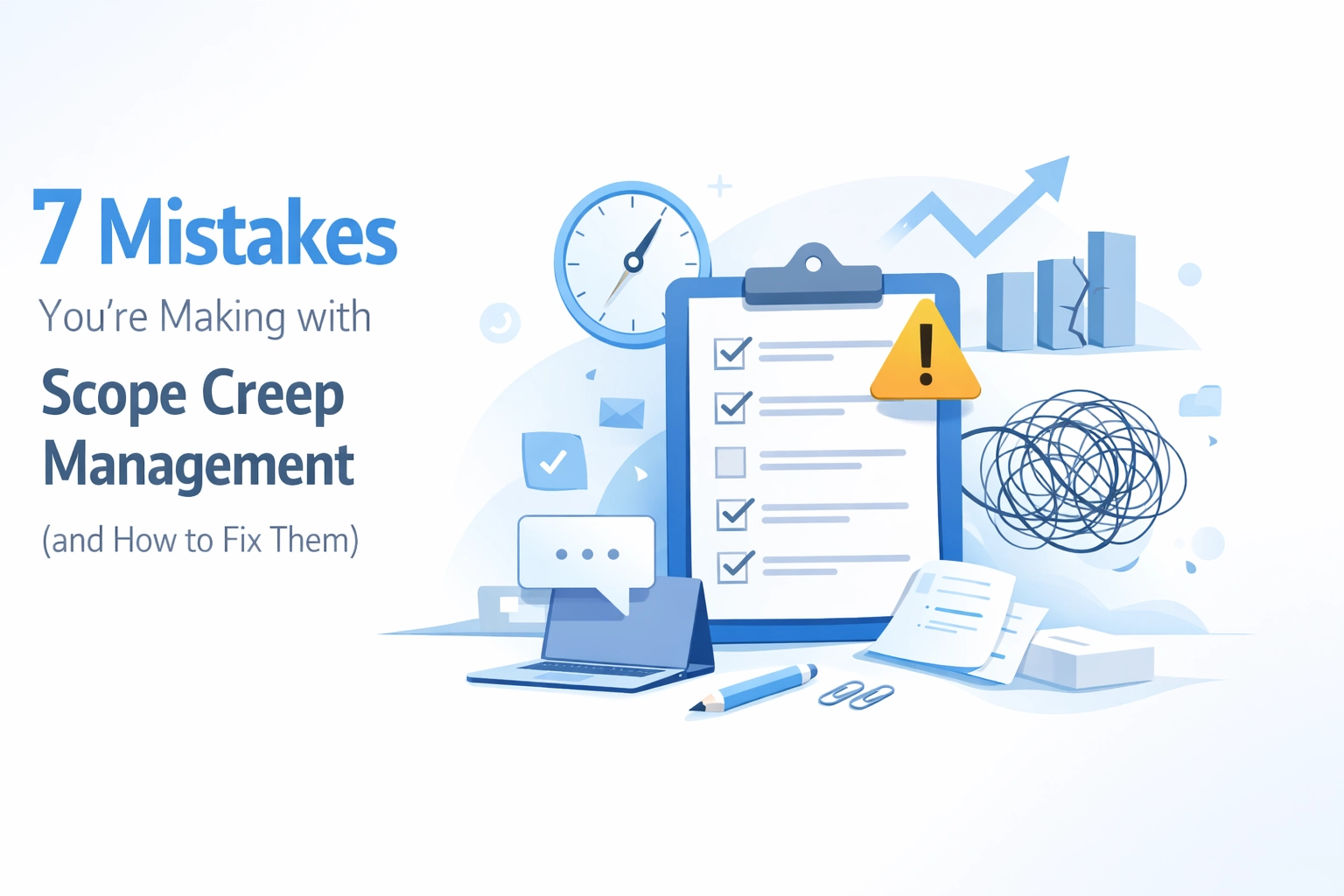
    7 Mistakes You’re Making with Scope Creep Management (and How to Fix Them)

    Scope Creep Management is the difference between a profitable agency and a sinking ship. In the world of app development, the boundaries of a project are often treated like suggestions rather than hard borders. This is a mistake. When you allow a project to expand without adjusting the budget or timeline, you aren't being "helpful", you are being exploited.

    As a Digital Architect, your job is to build structures that stand. That includes the legal and operational structures that protect your time. If you want to survive the 2026 market, you need to stop bleeding resources.

    1. Ambiguity in Initial Definitions: The Silent Margin Killer

    The most common failure in Scope Creep Management happens before the first line of code is written. If your project description is a collection of "vibes" and general goals, you’ve already lost. Ambiguity is the crack in the foundation where profit leaks out.

    Vague terms like "user-friendly interface" or "robust backend" are traps. They mean different things to different people. To a client, "user-friendly" might mean a three-year iterative design process. To you, it means a clean CSS framework.

    The Fix: Build a Granular Work Breakdown Structure (WBS).
    Break every feature into its smallest possible components. If you can't measure it, you can't protect it. Map out every screen, every API call, and every user flow. This level of detail shouldn't just be in your head; it needs to be reflected in your Independent Contractor Agreements.

    Precise structural planning of project components to ensure effective Scope Creep Management.

    2. Weak Independent Contractor Agreements: Your Paper Shield

    Many freelancers and boutique agencies treat their contracts as a formality. This is a dangerous oversight. Your Independent Contractor Agreements are the only thing standing between you and "just one more quick feature" that takes forty hours to implement.

    If your agreement doesn't explicitly define what happens when the scope changes, you are essentially working for free. A contract without a change-order clause isn't a contract; it’s a suicide note for your business.

    The Fix: Hardcode Change Management into Every Contract.
    Your agreements must include a "Scope Guard" clause. This clause should state that any deviation from the original WBS requires a written Change Order and a corresponding increase in fees. Use tools like Vow Guard Elite to ensure your legal language is as precise as your code. Never start a project without a signature on a document that respects your boundaries. You can find more structured ideas here for your next contract.

    3. The "Yes" Habit: Failing at Scope Creep Management

    We all want to please the client. We want the referral. We want the testimonial. But saying "yes" to an out-of-scope request without a conversation about cost is not professional, it’s amateur.

    Every time you say "yes" to a "small tweak," you are teaching the client that your time has no value. This behavior creates a cycle of "feature bloat" that pushes deadlines and destroys team morale.

    The Fix: Adopt the "Yes, And" Framework.
    When a client asks for something extra, your response should be: "Yes, we can definitely add that, and it will require a Change Order for $X and an extension of the timeline by Y days." This isn't being difficult; it’s being transparent. It places the decision-making power back with the client. If they want the feature, they pay for it. If they don't want to pay, the feature isn't that important. For more strategies on professional communication, check out our latest ideas.

    4. Neglecting the Change Control Process

    Even if you have the right mindset, you will fail without a system. Most agencies don't have a formal way to track requests that fall outside the original scope. If requests are coming in via Slack, email, and mid-meeting "by the ways," they will fall through the cracks.

    Without a centralized Change Control Process, you can't perform effective Scope Creep Management. You’ll look back at the end of the month and wonder why you worked 80 hours but only billed for 40.

    The Fix: Centralize All Requests.
    Implement a strict rule: if it isn't in the project management tool, it doesn't exist. Every request must be logged, evaluated for its impact on the project, and approved by the stakeholder. Use Scope Sentry to monitor these shifts in real-time. By documenting every change, you create a trail of accountability that protects both parties.

    A protective digital barrier filtering changes to maintain strict Scope Creep Management control.

    5. Ignoring the Early Warning Signs of Scope Creep Management

    Scope creep rarely happens all at once. It’s a slow erosion. It starts with a client asking for a different color, then a different font, then a complete redesign of the onboarding flow.

    If you aren't monitoring the velocity of your project against your original baseline, you won't see the creep until the project is already underwater. This is why monitoring tools are essential for modern developers.

    The Fix: Weekly Scope Audits.
    Set aside 30 minutes every Friday to compare the work performed against the original agreement. Are you still building what you said you would build? Or have you veered off-track? Catching a 5% deviation in week two is easy to fix. Catching a 50% deviation in month three is a catastrophe. Keeping a pulse on these ideas will save your margins.

    6. Lacking a Scope Baseline: Building Without a Blueprint

    You cannot manage what you have not measured. A common mistake is failing to establish a formal "Scope Baseline" at the start of the project. This is the documented version of the project that both the developer and the client have agreed upon.

    Without a baseline, Scope Creep Management is impossible because there is no reference point. You can't prove something is "extra" if you haven't defined what was "included."

    The Fix: The Formal Sign-Off.
    Before any work begins, the client must sign off on the Scope Baseline. This document should be referenced in your Independent Contractor Agreements. It serves as the "Source of Truth" for the duration of the project. If a disagreement arises, you point to the baseline. It is the objective reality of the project. For more on building these blueprints, look through our resource section.

    A digital blueprint representing a project baseline for consistent Scope Creep Management.

    7. Manual Monitoring in a Digital World

    If you are trying to track scope creep using Excel spreadsheets and memory, you are working in the past. Human error is the biggest threat to your profitability. You get busy, you forget to log a change, or you feel awkward bringing up money again.

    Manual monitoring is reactive. By the time you notice the problem, the damage is done. You need a proactive defense mechanism.

    The Fix: Automate Your Defense.
    Leverage specialized software designed to guard your boundaries. Systems like Scope Guard Elite are built to flag potential issues before they become financial losses. As a Digital Architect, you use tools to build apps; use tools to build your business integrity as well. Automation removes the emotion from the conversation, allowing you to focus on the work while the system focuses on the scope.

    The Cost of Inaction

    Failure to master Scope Creep Management isn't just about losing a few dollars here and there. It’s about the long-term sustainability of your career. Burnout in the development industry is often just a symptom of poor boundary management. When you work 60 hours but only see the progress of 30, the frustration is inevitable.

    Your clients don't actually want scope creep. They want a successful project delivered on time. By allowing the scope to balloon, you are actually jeopardizing the delivery of the core product. You are doing them a disservice by not being the professional who says "no."

    Protect your time. Protect your profit. Lock in your boundaries with robust Independent Contractor Agreements and never look back. The future belongs to those who control their architecture: both in code and in business.

    Stop the leak. Secure your project. Visit GHW-Digital Ideas for more insights on maintaining your professional edge.


    Marblism Legal Shield
    The information provided in this blog post is for educational and informational purposes only and does not constitute legal advice. While we strive to provide accurate and up-to-date information, the laws surrounding Independent Contractor Agreements vary by jurisdiction. Always consult with a qualified legal professional before finalizing your contracts or business processes. GHW-Digital is not liable for any actions taken based on the content of this article.

  • Wedding planner agreement: The Absolute Crucial Protocol

    Wedding planner agreement: The Absolute Crucial Protocol

    A wedding planner agreement is the ultimate defensive perimeter for your once-in-a-lifetime event. Planning a wedding is an exercise in complex logistics, high-stakes finance, and emotional investment. Without a rigid protocol in place, you are vulnerable to scope creep, hidden fees, and vendor failures. At GHW-Digital, we understand that every successful project: whether it is a software rollout or a high-end wedding: requires a definitive contract that leaves nothing to chance.

    The industry is full of vague promises and "gentlemen’s agreements," but these offer zero protection when a venue cancels or a coordinator disappears weeks before the ceremony. You need more than a handshake; you need a strategic asset. This is why we are developing Vow Shield. It is a specialized tool designed to dissect your wedding supplier contracts, identifying hidden risks and ensuring your legal standing is absolute. Your wedding planner agreement should not be a document you sign and forget; it is the blueprint for your security.

    Define Deliverables: Protect Your Vision

    The most common point of failure in any professional relationship is a lack of clarity regarding scope. In the context of a wedding planner agreement, this is where the "Absolute Crucial Protocol" begins. You are not just hiring a "planner"; you are securing specific services that must be enumerated with surgical precision.

    Are you paying for full-service planning, partial guidance, or mere day-of coordination? Each level of service demands a different set of contractual protections. A full-service agreement should detail the process of vendor selection, budget management, and design execution. If these are not listed as deliverables, they do not exist in the eyes of the law. Vow Shield serves as your digital auditor, scanning these sections to ensure that the services promised in the sales pitch are actually codified in the contract. Without this verification, you are essentially gifting the planner a blank check for your time and expectations.

    White flower in a protective glass prism representing a secure wedding planner agreement.

    Secure Financials: The Absolute Mechanism for Cost Control

    Money is the primary source of friction in the wedding industry. Your wedding planner agreement must act as a financial barrier against unexpected costs. A professional agreement outlines a structured payment schedule that aligns with milestones, not just arbitrary dates.

    Deposits are standard, but their "non-refundable" status must be scrutinized. Is the deposit reasonable, or is it an unfair penalty? An absolute protocol requires clarity on interim payments and final balances. If a planner expects the final 50% of their fee sixty days before the event, you must ensure there is a mechanism for recourse should they fail to deliver in that final two-month sprint.

    Furthermore, late payment penalties must be clearly defined. Vow Shield identifies these "predatory clauses" that can turn a simple administrative delay into a massive financial drain. By using a tool to assess your wedding planner agreement, you lock in your budget and eliminate the possibility of "surprise" administrative fees or unapproved expenses.

    Establish Boundaries: The Protocol for Scope Management

    In the world of app development at GHW-Digital, we know that scope creep kills profit. In weddings, scope creep kills the experience. Your wedding planner agreement must establish exactly how many hours, meetings, and site visits are included.

    If your planner's contract mentions "unlimited communication," you are likely looking at a vague clause that will be walked back when things get busy. A robust agreement specifies the communication channels and expected response times. It should also define what happens when you request services outside the original deal. This is where the principles of our Scope Sentry logic apply: every shift in scope must have a corresponding shift in pricing and documentation.

    Minimalist hourglass symbolizing time and scope management in a wedding planner agreement.

    Mitigate Catastrophe: The Absolute Requirement for Force Majeure

    The unexpected is the only thing you can truly count on. A wedding planner agreement without a comprehensive Force Majeure clause is a liability. Whether it is a global health crisis, extreme weather, or sudden illness, the protocol for "acts of God" must be clear.

    Who bears the cost if the wedding is postponed? Does your planner have a backup professional of equal caliber ready to step in? These are not "what-if" scenarios; they are essential contingencies. A professional agreement will detail the process for rescheduling and the transfer of fees to a new date. Vow Shield looks for these specific protections, ensuring that you aren't left holding the bill for an event that cannot legally or safely take place. According to industry standards at The Knot, a well-drafted Force Majeure clause is one of the top protections for modern couples.

    Guarantee Accountability: The Crucial Role of Liability Insurance

    If a guest is injured or property is damaged during your event, the fallout can be devastating. Your wedding planner agreement must mandate that the planner carries professional liability insurance. This is not negotiable.

    The agreement should include an indemnity clause that protects you from legal action resulting from the planner’s negligence. This is the "shield" in Vow Shield. We believe that professional services must be backed by professional accountability. When you upload your contract to our platform, we verify that the insurance requirements meet the absolute minimums for a high-value event. This ensures that you aren't just hiring a creative mind, but a responsible business entity.

    A blue umbrella protecting a light orb, depicting liability in a wedding planner agreement.

    Intellectual Property: Defending Your Private Data

    In the age of social media, your wedding is content. However, that content belongs to you. Your wedding planner agreement should address who owns the images, the design concepts, and the vendor lists.

    Planners often want to use your wedding for their portfolio. While this is standard, it should be done on your terms. An absolute protocol includes confidentiality clauses that prevent the disclosure of your private information or guest lists to third parties without consent. This is a matter of digital security and personal privacy. Protecting your "intellectual property": even if that property is your wedding theme: is a vital part of the modern contract landscape. For more on how we handle data and privacy at a corporate level, you can review our privacy policy.

    Resolve Conflict: The Mechanism for Dispute Resolution

    No one enters a wedding planning journey expecting a legal battle, but the absolute professional prepares for one regardless. Your wedding planner agreement must include a clear path for dispute resolution.

    Rather than heading straight to court, a crucial protocol suggests mediation or arbitration. This keeps costs down and resolutions fast. The contract should specify the jurisdiction where disputes will be handled: usually your local county. Vow Shield flags contracts that try to force you into out-of-state arbitration, which is a common tactic used to discourage clients from pursuing legitimate claims.

    A balanced scale representing fair dispute resolution within a wedding planner agreement.

    Final Validation: The Vow Shield Advantage

    A contract is only as strong as your understanding of it. Most couples sign a wedding planner agreement because they like the planner’s Instagram aesthetic, not because they’ve vetted their legal protections. This is a tactical error.

    By employing the logic we use in app development, Vow Shield provides a high-level audit of your agreements. It turns a ten-page document of "legalese" into a clear dashboard of risks and protections. We believe in empowering the consumer through technology. Just as businesses use Scope Sentry to manage their professional boundaries, couples must use Vow Shield to manage their matrimonial assets.

    Stop guessing. Start protecting. Your wedding planner agreement is the most important document you will sign this year. Ensure it is an absolute protocol, not an absolute liability.


    Vow Shield: Lock In Elite Protection With BLOG20

    Vow Shield is being built to turn vague wedding supplier paperwork into a clear risk map. If you want early access at a lower price, use discount code BLOG20 for 20% off our upcoming Vow Shield tool (valid until April 1, 2026). Stop guessing. Start protecting.


    Data & Privacy Notice:
    At GHW-Digital, we believe in blunt honesty. We don't use marketing "tricks" or hidden trackers to sell your data. When you use our tools, your contract data is analyzed for your benefit alone. We maintain a minimalist approach to data collection: if we don't need it to protect you, we don't ask for it. Our systems are built for efficiency and security, ensuring that your private event details remain private. We don't trade in your personal information; we trade in elite digital protection.

    Powered by GHW Digital (Company No: 16834250). This document is an automated draft for business organization purposes only. It does not constitute legal advice. GHW Digital accepts no liability for disputes, financial loss, or enforceability. Users must consult a qualified professional in their jurisdiction before signing.

  • Project Scope Shift: Why Elite Autonomous Systems Crush Crucial Consultant Costs

    Project Scope Shift: Why Elite Autonomous Systems Crush Crucial Consultant Costs

    Project scope shift is the silent killer of profitability in the app development world. It starts with a small request, a minor UI tweak here, an extra API integration there, and ends with a depleted budget and a frustrated team. Historically, companies relied on expensive external consultants to navigate these murky waters. They paid for "expert intuition" and "strategic oversight."

    At GHW-Digital, we’ve seen the damage these manual interventions cause. Professional Service Contracts are often too rigid to account for the fluid nature of modern development, yet too vague to protect the bottom line when things go sideways. The reality is that human consultants, while well-meaning, are slow, biased, and incredibly expensive.

    To stay competitive, you need to stop reacting to changes and start preventing them. Elite software tools are now replacing the need for high-priced advisory roles by providing autonomous, data-driven governance. If you want to see how we rethink project evolution, check out our latest innovation ideas.

    The High Price of Human Error in a Project Scope Shift

    When a project scope shift occurs, the first instinct for many legacy firms is to call a meeting. They bring in a consultant to "assess the impact." This human-centric approach is fundamentally flawed. Humans are prone to the "sunk cost fallacy" and are often hesitant to deliver the hard truth to a client: that their new request will break the timeline.

    Consultants often rely on spreadsheets and manual tracking, which are outdated the moment they are saved. By the time a consultant identifies a shift, the damage is already done. You’ve leaked hours of billable time and moved away from the original vision. This is why we focus on building better apps through automation rather than just adding more bodies to a problem.

    Digital precision sphere contrasting with messy papers to stop a project scope shift.

    How Autonomous Systems Enforce Professional Service Contracts

    Autonomous systems, like Scope Guard Elite, don’t have "off" days. They don't feel awkward about pointing out a contract breach. These tools act as a digital fortress around your Professional Service Contracts.

    Instead of waiting for a monthly review, an autonomous system monitors every pull request, every ticket, and every communication. It compares real-time activity against the predefined boundaries of the project. If a project scope shift is detected, the system flags it instantly.

    Key benefits of autonomous enforcement include:

    • Precision: Algorithms don't "guesstimate." They calculate exact deviations.
    • Speed: Identification happens in milliseconds, not weeks.
    • Impartiality: The software doesn't care about politics; it only cares about the contract.
    • Consistency: Every project is guarded with the same level of elite scrutiny.

    For more insights on how these systems integrate into your workflow, explore our ideas page.

    Real-Time Detection vs. Retroactive Reporting

    The biggest weakness of a consultant is that they are retroactive. They look at what happened last week and try to fix it today. In the fast-paced world of app development, last week is ancient history.

    An autonomous project scope shift detection engine operates in the "now." It integrates directly with your development environment. Tools like Scope Sentry provide a level of visibility that no human can match. When a developer begins working on a feature that wasn't in the initial brief, the system intervenes. It forces a conversation before the work is done, not after the invoice is sent.

    This proactive stance is what separates elite developers from the rest. We believe in providing robust ideas that empower businesses to maintain their margins without sacrificing quality.

    A protective blue shield over a grid preventing an unmanaged project scope shift.

    Eliminating the "Favors" That Drain Revenue

    One of the most common causes of a project scope shift is the "quick favor." A client asks a developer for a small change, and the developer, wanting to be helpful, says yes. These favors are never tracked, never billed, and collectively, they can sink a project.

    Consultants rarely catch these micro-shifts. They are focused on the big picture, missing the "death by a thousand cuts." Autonomous systems provide the granular oversight needed to stop this leak. By using something like Vow Guard Elite, you ensure that every promise made is documented and aligned with the Professional Service Contract.

    We talk about this frequently in our daily ideas updates. Protecting your time is just as important as protecting your code.

    The Financial Logic: Replacing Consultants with Elite Software

    Let’s talk numbers. A high-level consultant can cost upwards of £200-£500 per hour. They require onboarding, meetings, and management. Even then, they are only as good as the data you give them.

    In contrast, an autonomous system is a one-time or subscription-based investment that works 24/7. It doesn't require a desk, it doesn't need a pension, and it doesn't get sick. When you calculate the ROI of preventing just one major project scope shift, the software pays for itself within the first month.

    According to research from the Project Management Institute, scope creep affects nearly 50% of projects. Reducing that percentage even slightly has a massive impact on the bottom line. Businesses that leverage GHW-Digital solutions find they can scale faster because their management overhead is drastically reduced.

    Blue energy pulse showing the speed of managing a project scope shift autonomously.

    Scaling Without the Growing Pains

    As your business grows, the complexity of managing a project scope shift increases exponentially. If you rely on consultants, you have to hire more of them as you take on more projects. This is a linear growth model that eats into your profits.

    Autonomous systems offer a non-linear scaling path. Whether you are managing one project or one hundred, the software performs with the same level of accuracy. This allows your senior talent to focus on high-value strategy rather than policing task lists. You can find more about scaling your tech stack on our ideas blog.

    Blue droplet symbolizing the immediate halt of a project scope shift and revenue leak.

    Why Human Intuition is a Liability in Contract Management

    There is a common argument that "software lacks the human touch" needed for complex negotiations. In the context of a project scope shift, the "human touch" is actually a liability. Professional Service Contracts are legal documents meant to be followed. When you introduce emotion or personal relationships into contract enforcement, you create inconsistency.

    Consistency builds trust. When a client knows that your systems automatically track and flag changes, they respect the boundaries of the project more. It removes the "negotiation" phase of scope creep and replaces it with a factual discussion about budget and resources. This level of professionalism is what we strive for at GHW-Digital.

    Minimalist graph showing budget stability despite a potential project scope shift.

    The Future is Autonomous

    The debate between consultants and autonomous systems is quickly becoming one-sided. For managing a project scope shift, the precision, speed, and cost-effectiveness of AI-driven tools are unmatched.

    Stop letting your margins leak through manual oversight. It’s time to move away from the expensive "expert" model and embrace the elite, automated guardian. Your Professional Service Contracts deserve the best protection available.

    Explore our full suite of development ideas and see how we can help you lock in your profits and secure your project’s success.


    Marblism Legal Shield

    This content is provided for informational purposes only and does not constitute legal or financial advice. GHW-Digital and its tools are designed to assist in project management and contract adherence but should be used in conjunction with your own legal counsel to ensure full compliance with local regulations and specific contract law. We prioritize data integrity and ethical automation in all our software solutions. For more information, please visit our privacy page.

  • The Ultimate Guide to Future Protocols: Everything You Need to Secure Your Autonomy

    The Ultimate Guide to Future Protocols: Everything You Need to Secure Your Autonomy

    Future Protocols are no longer a concept for the next decade; they are the active battleground for your digital independence today. In an era where centralized platforms treat your data as a commodity and your privacy as an obstacle, reclaiming your autonomy requires more than just a strong password. It requires a fundamental shift in how we build, deploy, and interact with digital systems.

    At GHW-Digital, we see the cracks in the old foundation every day. Legacy systems are leaking revenue, scope creep is killing margins, and central authorities are tightening their grip on the tools we use to innovate. The solution isn't just "better security", it’s a complete pivot toward Autonomous Digital Assets.

    The Identity Crisis: Beyond Baseline Encryption

    Encryption used to be the gold standard. In 2026, it is merely the baseline. If you aren't protecting your metadata and identity patterns, you aren't secure. Future Protocols must address the fact that adversaries no longer just want to read your messages; they want to map your behavior, identify your nodes, and predict your next move.

    The vulnerability lies in the "footprint." Even if your data is encrypted, the metadata, who you talk to, when you talk to them, and how often, is a roadmap for state-sponsored actors and corporate harvesters. We are moving toward a "metadata shielding" model. This means controlling what external systems can observe about your communication architecture. It is a decisive break from the legacy practices that allow "harvest-now, decrypt-later" attacks. To secure your autonomy, you must implement continuous cryptographic proof of identity at every single connection point.

    Luminous identity core with shielding layers to protect Future Protocols and secure digital autonomy.

    Architecture of Autonomy: Matter, Thread, and Spatial Awareness

    Securing your environment requires a unified language. In the world of app development and smart infrastructure, the fragmentation of the past was a security nightmare. Today, Future Protocols like Matter have unified the application layer, allowing devices to talk across Thread, Wi-Fi, and Ethernet without the need for vulnerable, third-party bridges.

    • Thread (IEEE 802.15.4): This is the backbone of the autonomous edge. It’s a self-healing mesh architecture. As you add more devices, the network gets stronger, not weaker. It eliminates the single point of failure that centralized hubs represent.
    • Ultra-Wideband (UWB): This protocol provides the spatial awareness necessary for autonomous mobile systems. If a system doesn't know exactly where it is in physical space, it cannot be truly autonomous. UWB provides the precision positioning that Bluetooth and Wi-Fi simply can’t match.
    • LTE-M and NB-IoT: For those building outside the home or office, these cellular protocols provide the wide-area connectivity needed for global logistics. They allow for software-led networks that maintain stable connections across borders, ensuring your assets remain under your control, no matter where they travel.

    By utilizing these standards, you aren't just building a "smart" system; you are building a resilient one. You can explore how we integrate these into custom solutions at GHW-Digital Apps.

    The Philosophy of Autonomous Digital Assets

    At GHW-Digital, we believe in the democratization of professional expertise. For too long, high-level technical and legal protection was reserved for the elite few with massive budgets. We are changing that by turning professional knowledge into Autonomous Digital Assets.

    What does this mean for you? It means that the expertise required to protect a project or secure a contract is baked directly into the protocol. You shouldn't need a team of twenty lawyers and developers to ensure your "Scope Guard" is active. It should be a self-executing, autonomous part of your digital ecosystem.

    When we democratize this expertise, we empower the individual creator and the small business owner to stand on equal footing with giants. We believe that if you have a great idea, the protocol should work for you, not against you. If you're ready to see how your vision fits into this new world, check out our Ideas Portal.

    Eliminate Vulnerabilities: The Move to Memory Safety

    If your code is built on a shaky foundation, no protocol can save you. The industry is seeing a massive migration away from C and C++ toward Rust for protocol stack development. Why? Because Rust eliminates up to 70 percent of common memory-unsafe vulnerabilities, like buffer overflows, at the compiler level.

    Future Protocols built in Rust are inherently more secure because the language itself refuses to let you make the mistakes that hackers have exploited for thirty years. This is the "us vs. the problem" mentality in action. We don't just patch holes; we build walls that don't have holes in the first place. This level of precision is exactly what we implement in tools like Scope Guard Elite, where every boundary is locked in and every margin is protected.

    Interconnected mesh network nodes illustrating the resilient infrastructure of Future Protocols.

    Action-Benefit: Secure Your Assets Now

    Using the right protocols isn't just a technical choice; it's a business strategy. Here is how you can use Future Protocols to secure your advantage:

    • Lock In Your Margins: Use automated scope management to prevent "feature creep" from draining your resources.
    • Track Every Asset: Implement Scope Sentry to maintain a real-time, cryptographic log of project changes and asset movements.
    • Calculate Risk in Real-Time: Use AI-integrated network planning to detect faults and security threats before they manifest into downtime.
    • Protect Your Intellectual Property: By utilizing Vow Guard Elite, you ensure that your agreements are as autonomous and unbreakable as the code you write.

    AI Integration: The Network is the Intelligence

    In 2026, AI is no longer something that sits on top of a network; it is inside the network. Agentic AI models within Future Protocols now handle radio optimization and security operations autonomously. These systems sense conditions, make decisions, and execute actions with zero human intervention.

    This level of automation is what allows for "Transmission on-demand." Instead of the slow, traditional procurement cycles for high-capacity bandwidth, software-like automation allows for deterministic provisioning. Your autonomous workflows can now span multiple clouds and physical locations with the same ease as opening a new tab in your browser.

    Precision architectural blocks representing memory-safe code for secure Future Protocols.

    The Road to 6G and Beyond

    We are already looking toward the horizon. Early 6G initiatives are exploring the terahertz spectrum, promising ultra-low latency that will make today’s "real-time" look like slow-motion. Hybrid terrestrial and satellite networks will soon ensure that no corner of the globe is "off-grid."

    However, as these systems become more complex, the primary bottleneck isn't speed, it's interoperability. If two autonomous systems cannot interpret each other's data, they are useless. Standards bodies like The Thread Group and organizations focusing on Rust-lang are critical in ensuring that the future of the web remains open, secure, and truly autonomous.

    Secure Your Competitive Advantage

    The "moving goalposts" of the digital economy are designed to keep you in a cycle of dependency. Future Protocols are the shield you need to stop the leak. Whether it's through metadata shielding, memory-safe coding, or the philosophy of Autonomous Digital Assets, the goal is the same: absolute control over your digital destiny.

    Stop letting legacy limitations dictate your growth. It’s time to adopt a stern, professional stance on your digital boundaries. Align your projects with the protocols of the future and ensure that your expertise remains your own.

    Take Control of Your Vision Today
    Don't wait for the next breach or the next central platform "update" to take away your autonomy. Start building with the future in mind. Submit your idea to GHW-Digital and let’s build an autonomous future together.


    Marblism Legal Shield
    This content and the concepts of Autonomous Digital Assets described herein are protected under the Marblism Legal Shield framework. We believe in blunt honesty and ethical transparency. Your data is your own; our protocols are designed to ensure it stays that way. For more information on our commitment to your digital rights, please visit our Privacy Policy. All rights reserved by GHW-Digital, 2026.