Category: Blog

Your blog category

  • The Ultimate Guide to the Wedding Supplier Contract: Securing Your Assets Before the ‘I Do

    The Ultimate Guide to the Wedding Supplier Contract: Securing Your Assets Before the ‘I Do

    Wedding Supplier Contracts are the only thing standing between a seamless celebration and a logistical nightmare. When you are planning the most expensive day of your life, a handshake is a liability. You aren't just buying flowers or booking a band; you are investing capital into a complex web of service providers. Without a rigorous, written framework, your assets are at risk.

    At GHW-Digital, we understand that precision is the foundation of any successful project. Whether we are building innovative app solutions or you are building a wedding day, the principles of scope management remain the same. If it isn't in writing, it doesn't exist. This guide focuses exclusively on how you, the couple, can use a contract to shield yourselves from vendor negligence and ensure every "I do" is backed by an "I will."

    Wedding Supplier Contracts: Your First Line of Defense

    A contract is not a gesture of goodwill; it is a defensive tool. Most couples enter negotiations with an emotional bias, viewing vendors as partners in a dream. This is a mistake. Vendors are business entities with their own overhead, risks, and profit margins. You must approach these agreements with a professional mindset.

    A comprehensive contract clarifies deliverables, establishes a rigid timeline, and provides a roadmap for conflict resolution. It protects your deposit and ensures that the quality you were promised in the showroom is what arrives at the venue. If you are looking for ways to streamline your planning logic, explore our ideas page for digital solutions that can track these commitments.

    Two wedding rings on a digital tablet illustrating a secure and binding Wedding Supplier Contract.

    Audit the Scope: No More Moving Goalposts

    The biggest threat to your wedding budget is scope creep, the gradual expansion of costs due to vague language. Wedding Supplier Contracts must be granular.

    • Specify Units: Do not accept "floral arrangements." Demand "ten centerpieces consisting of white hydrangeas and eucalyptus."
    • Time Blocks: Do not accept "evening coverage." Define it as "6:00 PM to 12:00 AM, with setup complete by 5:30 PM."
    • Personnel: If you booked a specific photographer because of their portfolio, ensure the contract names them as the primary shooter.

    Vague terms allow vendors to cut corners when they are overbooked. By locking in the scope, you ensure that the value you pay for is the value you receive. This is similar to how we manage app development scopes to prevent budget overruns.

    Identify Red Flags: Spotting Vendor Evasion

    Before you sign, you must look for "poison pills" in the fine print. Many vendors use boilerplate templates designed to protect themselves at your expense.

    1. The Substitution Clause: This is a major red flag. If a contract says the vendor "reserves the right to substitute services or performers of equal value," you lose control. You might end up with a replacement DJ who doesn't fit your vibe or a caterer using inferior ingredients. Demand a "right of refusal" clause, ensuring you must approve any substitutions in writing.
    2. Indemnity Gaps: Ensure the vendor has their own liability insurance. If a guest trips over a photographer’s tripod, the vendor’s policy should cover it, not your personal savings.
    3. Vague Cancellation Policies: If a vendor cancels on you, a "full refund of deposit" is often insufficient. You should seek "restitution for the cost of a last-minute replacement."

    For more insights on managing complex agreements and professional standards, check out our latest strategy ideas.

    Enforce the Payment Schedule: Leverage is Your Asset

    Never pay 100% upfront. Your strongest leverage is the final payment. Wedding Supplier Contracts should ideally follow a tiered structure:

    • Initial Deposit: To secure the date (typically 20-30%).
    • Mid-way Milestone: Paid only after a specific deliverable (e.g., a menu tasting or engagement shoot).
    • Final Payment: Delivered 7-14 days before the event or, in some cases, upon delivery of the final product.

    By spreading out the payments, you keep the vendor incentivized to perform. If a vendor demands the full balance months in advance, they are using your capital to fund their current operations, which is a sign of financial instability. We apply similar rigorous standards to our Scope Sentry protocols to ensure project health.

    A professional stylus over blue milestones depicting a secure Wedding Supplier Contract payment plan.

    Force Majeure and Contingency: Preparing for the Unthinkable

    The global events of the past few years have proven that "unprecedented" is the new normal. Your Wedding Supplier Contracts must include a robust Force Majeure clause. This protects you if the wedding cannot happen due to acts of God, pandemics, or government restrictions.

    Ensure the clause works both ways. If the venue is flooded, you shouldn't just lose your deposit; you should be entitled to a reschedule or a refund. Furthermore, demand a "Contingency Plan" for the vendor themselves. If the lead photographer gets sick, who is the vetted backup? What is their portfolio like? Security is about redundancy.

    Vow Shield: The Modern Security Layer

    In an era of digital complexity, traditional contracts sometimes feel like they belong in the past. This is why we advocate for advanced protection layers like Vow Shield. While a paper contract is your legal base, Vow Shield (and related technologies like Vow Guard Elite) provides a framework for real-time accountability.

    Think of it as a digital auditor for your wedding day. It ensures that every milestone is tracked and every vendor is held to the high standards they promised. When you combine a strong legal document with a digital oversight tool, you create an impenetrable barrier around your wedding investment. You can find more about integrating these types of protective logics into your projects at GHW-Digital Ideas.

    A glass shield protecting a wedding bouquet representing asset security in Wedding Supplier Contracts.

    Smart Negotiation: Get Everything in Writing

    A common mistake couples make is relying on verbal promises made during a tour or a phone call. "Oh, we can definitely throw in the extra hour of open bar" means nothing if it isn't in the signed document.

    Negotiation Tactics for the Couple:

    • The Paper Trail: After every meeting, send an email summarizing what was discussed. Mention that you expect these points to be reflected in the final contract.
    • The "First Right of Refusal": If a vendor mentions they are double-booked for your date but "might be able to make it work," demand the first right of refusal in writing so they cannot drop you for a higher-paying client.
    • Bundle and Protect: If a vendor offers multiple services (e.g., lighting and sound), ensure each service has its own line item in the contract. If the lighting fails, you shouldn't still be paying full price for the "package."

    The Final Review: Before You Ink the Deal

    Before you sign any Wedding Supplier Contracts, perform a final audit.

    • Does it list the exact address of the venue?
    • Are the arrival and departure times explicit?
    • Is there a "clean-up" clause (to ensure you aren't hit with venue fees for vendor trash)?
    • Is there a clear dispute resolution path (e.g., mediation before litigation)?

    Once signed, keep a digital copy in a secure cloud folder and a physical copy in a dedicated wedding binder. Access to this information should be immediate if an issue arises on the day of the event. For more tips on organizing complex data and assets, visit our ideas section.

    Securing Your Legacy

    Your wedding is a celebration, but the planning of it is a business transaction. By treating Wedding Supplier Contracts with the gravity they deserve, you aren't being "difficult": you are being diligent. You are protecting your partner, your family's investment, and your own peace of mind.

    At GHW-Digital, we believe in building things that last, whether that's a high-performance app or a perfectly executed event. Use the tools at your disposal, demand transparency from your vendors, and never settle for a vague promise when you can have a binding guarantee.

    Stop leaving your wedding day to chance. Secure your assets, lock in your vendors, and ensure that the only thing you have to worry about on your big day is saying "I do."


    Marblism Legal Shield

    This blog post is provided for informational purposes only and does not constitute legal advice. While we strive for accuracy, laws regarding contracts and consumer protection vary by jurisdiction. Always consult with a qualified legal professional before signing binding agreements. GHW-Digital and Marblism are not liable for any disputes arising from the use of the information provided herein. Your data and privacy are handled in accordance with our Privacy Policy.

  • Scope Creep Management Matters: Why Your Freelance Protocol Needs an Upgrade

    Scope Creep Management Matters: Why Your Freelance Protocol Needs an Upgrade

    [HERO] Scope Creep Management: Urgent Strategies for Crucial Freelance Protection

    Scope Creep Management is the single most important discipline you will master as a digital architect. In the world of app development and freelance consulting, your time is the primary asset. When a project begins to bleed beyond its original boundaries, you aren't just doing "extra work", you are actively devaluing your expertise and subsidizing your client’s lack of planning.

    At GHW-Digital, we see it constantly: a "simple" app build that morphs into a complex ecosystem because of a few casual emails. If you don't have a protocol to stop this, you don't have a business; you have an expensive hobby. You need to upgrade your defense. You need to turn your Independent Contractor Agreements into ironclad shields that protect your margins and your sanity.

    The Invisible Margin Killer: Why Projects Drift

    Scope creep is a slow death. It rarely happens all at once. It starts with a "while you’re under the hood" request or a "minor tweak" to the UI. Without a rigorous Scope Creep Management strategy, these micro-deviations compound. Before you know it, the project timeline has doubled, but your fee has remained static.

    This isn't just about money; it's about the integrity of the build. As a Digital Architect, you know that every feature added late in the game introduces technical debt and potential bugs. When the scope shifts without a formal review, the quality of the entire application suffers. You can find more insights on maintaining project integrity at our ideas page.

    Structural digital architecture representing Scope Creep Management and project integrity for freelancers.
    Alt: A professional digital architect implementing Scope Creep Management tools to protect project margins.

    Independent Contractor Agreements as Your First Line of Defense

    Your contract is not a formality; it is a blueprint. Most freelancers fail because their Independent Contractor Agreements are too vague. A professional agreement must define exactly what is being built, but more importantly, it must define what is not being built.

    To implement effective Scope Creep Management, your contracts must include:

    • Granular Deliverables: Don't just say "App Development." Specify the number of screens, the exact APIs to be integrated, and the supported devices.
    • The "Out of Scope" Clause: Explicitly list features or services that are excluded. If it's not in the "In-Scope" list, it’s a paid extra.
    • Revision Limits: Define exactly how many rounds of feedback are included. "Unlimited revisions" is a suicide mission for your profit margins.

    If you are looking to streamline this process, our Vow Guard Elite provides a framework for setting these boundaries from day one.

    The Digital Architect’s Protocol: Precision Over Pleading

    Stop asking for permission to be paid for your work. A casual tone with clients is fine for rapport, but when it comes to the build, you must be a minimalist architect. Precision is your best friend. When a client suggests a new feature, your response shouldn't be a nervous "I'll see what I can do." It should be a standard protocol.

    Scope Creep Management requires a formal Change Control Process. This means every request outside the original Statement of Work (SOW) triggers a specific sequence:

    1. Identify: Flag the request as an out-of-scope item immediately.
    2. Assess: Calculate the impact on the budget and the delivery date.
    3. Propose: Present a Change Order. The client chooses: pay the extra cost and accept the delay, or move the feature to a "Phase Two" list.

    This process removes the emotion from the negotiation. It’s not a confrontation; it’s a calculation. For more strategy on how to handle these conversations, check out GHW-Digital Ideas.

    Lock in Your Revenue with Scope Guard Elite

    Why leave your income to chance? At GHW-Digital, we believe in proactive protection. Our Scope Guard Elite and Scope Sentry tools are designed specifically to help freelancers and agencies maintain their boundaries.

    By using professional-grade tools, you signal to the client that you are an elite operator. Clients are less likely to push boundaries when they see a structured, automated system tracking the project's health. It turns the "moving goalposts" problem into a transparent data point that both parties can see. According to the Project Management Institute, formal change control is one of the top factors in project success. Without it, you are flying blind.

    Clean digital dashboard showing project success metrics for Independent Contractor Agreements.
    Alt: Digital dashboard displaying Scope Creep Management metrics for independent contractor agreements.

    The "Phase Two" Strategy: Protecting the Current Build

    One of the most effective tools in Scope Creep Management is the "Phase Two" bucket. This is where good ideas go to wait their turn. When a client comes to you with a brilliant new idea mid-sprint, don't say "no": say "not now."

    "That’s a fantastic feature for Phase Two. Let’s document it now so we don't forget, and we can tackle it as soon as the current version is live."

    This approach:

    • Validates the client's creativity.
    • Protects the current launch date.
    • Secures future work for you.
    • Maintains the integrity of your Independent Contractor Agreements.

    By pushing additions to a subsequent phase, you ensure that the primary project remains lean and focused. You can see how we structure these phases for our own clients at GHW-Digital Apps.

    Calculating the Real Cost of "Just One More Thing"

    Every "small" change has a ripple effect. If you change a button's functionality, you might have to update the documentation, re-test the integration, and adjust the UI on five different screen sizes. What looked like 10 minutes of coding is actually 3 hours of total work.

    Effective Scope Creep Management involves educating your client on these ripples. Be blunt. Show them the technical path. When they realize that their "small" request impacts the stability of the entire app, they often reconsider. It is your job as the expert to protect them from themselves.

    For those who need a more robust legal framework to back up these discussions, reviewing standard Independent Contractor Guidelines can provide the necessary context to strengthen your stance.

    Why Minimalism Wins in App Development

    The "Digital Architect" approach favors minimalism. A minimalist build is easier to maintain, faster to launch, and more profitable to produce. When you allow scope creep to take over, you end up with "bloatware": an application that tries to do everything but does nothing well.

    Your Scope Creep Management protocol should reflect this minimalist philosophy. Keep your SOWs clean. Keep your communication direct. Use our Scope Sentry to monitor your progress and stay within the lines. The more disciplined you are, the more respect you will command from high-value clients.

    Minimalist app interface elements emphasizing Scope Creep Management boundaries and disciplined development.
    Alt: Minimalist app design interface emphasizing clean Scope Creep Management boundaries.

    Conclusion: Secure Your Competitive Advantage

    The freelance market is crowded, but the market for disciplined, professional Digital Architects is wide open. By mastering Scope Creep Management and refining your Independent Contractor Agreements, you position yourself as a vital partner rather than a disposable commodity.

    Stop letting project shifts kill your margins. Upgrade your protocol today. Use the tools available at GHW-Digital to lock in your profit and protect your time.

    If you're ready to see how professional-grade scope management can transform your workflow, dive into our latest concepts at https://ghw-digital.com/ideas.html. The goalposts are only moving because you haven't bolted them down yet. Bolt them down.


    Marblism Legal Shield

    This content is provided for informational purposes only and does not constitute legal, financial, or professional advice. While GHW-Digital strives for accuracy, the freelance landscape is constantly evolving. Always consult with a qualified legal professional regarding your specific Independent Contractor Agreements and business protocols. We value your privacy and handle all data with the utmost transparency. For more details, see our Privacy Policy.

  • Wedding venue contract guide: The Ultimate Peerless Strategy

    Wedding venue contract guide: The Ultimate Peerless Strategy

    Wedding venue contract guide strategies are the only thing standing between a seamless event and a financial catastrophe. A wedding is not just a celebration; it is a high-stakes legal merger involving significant capital and complex logistics. When you sign a venue agreement, you are entering a defensive perimeter. If that perimeter has holes, your assets are at risk.

    Most couples approach their wedding venue with emotion. This is a tactical error. The venue is a business entity designed to protect its own interests, often at your expense. To secure your position, you must adopt a Digital Architect’s mindset: clinical, precise, and defensive. This guide outlines the peerless strategy required to assess, dissect, and lock down a venue contract before you commit a single cent to a deposit.

    Executing the Wedding venue contract guide Strategy

    The primary objective of a wedding venue contract guide is to eliminate ambiguity. Ambiguity is where venues hide additional fees, restrictive clauses, and liability shifts. In the world of high-end app development, we call this "scope creep." In the wedding industry, it is simply called "unforeseen expenses." Both result in the same outcome: leaking revenue.

    To prevent this, you must treat the contract as a codebase. Every line must serve a purpose. Every variable must be defined. If a clause is "null" or "undefined," it must be rewritten or deleted. You are not asking for favors; you are establishing the parameters of a professional engagement.

    Digital scan of a wedding venue contract guide for precise legal risk assessment on a modern tablet.
    Alt: A professional analyzing a wedding venue contract guide to ensure peerless asset protection.

    Critical Elements of a Wedding venue contract guide

    A robust contract assessment begins with the fundamentals. You cannot build a secure application on a shaky foundation. The following elements are non-negotiable and must be explicitly detailed within your agreement.

    The Temporal Perimeter. Your contract must specify the exact hours of access. This is not just the "start time" of the ceremony. It must include setup time for vendors, rehearsal windows, and the hard exit time for cleanup. If these are not defined, you are vulnerable to "overtime" fees that can escalate with hourly precision.

    The Physical Inventory. Exactly which spaces are you renting? "The North Wing" is not specific enough. You need the exact rooms, outdoor areas, and backup locations for inclement weather. If the venue decides to host another event simultaneously in the adjacent room, your contract is your only shield against noise pollution and logistical interference.

    The Financial Protocol. A clear breakdown of costs is mandatory. This includes the total rental fee, the deposit structure, and the final payment deadline. Be wary of "plus-plus" pricing: the industry standard for adding service charges and taxes at the end. Your strategy should demand an all-in figure to ensure your budget remains a fixed asset.

    Defending Against Hidden Costs in your Wedding venue contract guide

    The most dangerous threats are the ones you don't see coming. Venues often employ "moving goalposts" to extract more value after the ink is dry. A peerless wedding venue contract guide must account for these tactical shifts.

    Exclusive Use Clauses. Some venues mandate that you use their "preferred" vendors. This is a mechanism to control the ecosystem and often results in higher costs for lower-quality services. If you want the freedom to bring in your own elite team, this must be codified in the contract.

    Infrastructure Requirements. Does the venue provide tables, chairs, and linens? If so, what is the quality? If you have to rent these externally because the venue’s inventory is subpar, your costs will skyrocket. Ensure the inventory is itemized. If the venue requires a specific type of liability insurance, this must be known upfront.

    Operational Surcharges. Watch out for "corkage fees," "cake cutting fees," and "power distribution fees." These are minor leaks that, when combined, create a significant financial drain. A professional assessment identifies these early, allowing you to negotiate them out of the protocol or account for them in your primary financial model.

    Protected wedding pavilion model demonstrating a secure wedding venue contract guide defense strategy.
    Alt: A minimalist digital interface of Vow Shield performing a wedding venue contract guide risk assessment.

    Liability and the Wedding venue contract guide Protocol

    In any high-value transaction, risk management is paramount. You are responsible for your guests, but the venue must be responsible for its premises. The "Indemnification" clause is the most critical defensive structure in the document.

    A standard venue contract often tries to shift all liability onto the couple. This is unacceptable. Your wedding venue contract guide should ensure a mutual indemnification clause. This means you are responsible for damage caused by your party, but the venue remains liable for injuries caused by faulty infrastructure or staff negligence.

    The Cancellation Mechanism. Life is unpredictable. Your contract must have a clear "Force Majeure" or Act of God clause. This protects you in the event of a national emergency, natural disaster, or venue closure. Without this, you could lose your entire investment with zero recourse.

    The Security Deposit. Ensure the terms for the return of your security deposit are transparent. It should be returned within a fixed window (e.g., 14 days) post-event, provided no documented damage occurred. Vagueness here allows venues to hold your capital hostage.

    Automating Your Defense with Vow Shield

    Assessing these risks manually is time-consuming and prone to human error. At GHW-Digital, we believe in using elite technology to solve complex problems. This is why we developed Vow Shield.

    Vow Shield is the ultimate weapon for couples who demand absolute security. By uploading your agreement into our system, the app performs an instant, peerless wedding venue contract guide assessment. It identifies high-risk clauses, highlights missing protections, and flags predatory pricing.

    Just as our Scope Sentry protects businesses from project creep, Vow Shield protects your wedding from contractual exploitation. It turns a confusing legal document into a clear, actionable report. You wouldn't launch an app without testing the code; you shouldn't sign a wedding contract without Vow Shield.

    Digital security shield illustrating a peerless wedding venue contract guide protection protocol.
    Alt: A secure digital shield icon representing the Vow Shield wedding venue contract guide protection.

    Finalizing the Strategy

    The final step in your wedding venue contract guide is the signature. But remember: a signature is a lock. Once it’s turned, the terms are set.

    1. Verify the Entities. Ensure the legal names on the contract match the business you are actually paying.
    2. Demand Written Changes. Never rely on verbal promises from a venue coordinator. If they say "we can probably include that," make them write it in. Verbal agreements are not executable in court.
    3. Check the Version History. Ensure you are signing the latest version of the document with all agreed-upon amendments included.

    Your wedding day should be a celebration of a new union, not the start of a legal dispute. By following this peerless strategy and utilizing tools like Vow Shield, you ensure that your event is built on a foundation of absolute legal and financial security.

    Stop guessing. Start protecting. Secure your venue agreement with the same precision we bring to elite app development.


    Ethical Data & Privacy Disclosure

    At GHW-Digital, we believe in blunt honesty. When you use Vow Shield or any of our protection tools, your contract data is analyzed locally and encrypted. We do not sell your personal event details to third-party vendors or "wedding marketplaces." We are in the business of protection, not data harvesting. Our goal is to provide a shield, not a surveillance tool. Your privacy is a non-negotiable asset.


    Stop the risk of contractual exploitation. Protect your wedding assets today with Vow Shield.

    Powered by GHW Digital (Company No: 16834250). This document is an automated draft for business organization purposes only. It does not constitute legal advice. GHW Digital accepts no liability for disputes, financial loss, or enforceability. Users must consult a qualified professional in their jurisdiction before signing.

  • Direct Plain Outcomes

    Direct Plain Outcomes

    Direct Plain Outcomes are the heartbeat of everything we do at GHW-Digital. In a world saturated with "synergy," "bandwidth," and "leveraging ecosystems," we believe that the most radical thing a software company can do is speak clearly. We aren’t interested in dressing up our tools in the borrowed robes of corporate complexity. We are interested in one thing: the relief you feel when a problem is solved without a headache.

    When you use a digital tool, you shouldn't need a dictionary or a specialized degree to understand what it’s telling you. You have enough on your plate. Whether you’re a freelancer trying to make sense of a confusing situation or an individual navigating a major life milestone, you deserve answers that don’t require a translator. This is our manifesto in action. We don’t just build apps; we build exits from the noise.

    Why Direct Plain Outcomes Matter

    The modern digital landscape is exhausting. It is designed to keep you clicking, scrolling, and second-guessing. Most software companies thrive on your confusion because confusion creates dependency. If a tool is complicated, you’ll pay for a support plan. If the interface is dense, you’ll pay for training. We think that’s a broken way to do business.

    Direct Plain Outcomes matter because your time is your most valuable non-renewable resource. Every minute you spend deciphering jargon is a minute stolen from your actual work or your family. We refuse to be part of that theft. By focusing on plain English and immediate clarity, we ensure that our tools serve you, rather than demanding that you serve the tool.

    A minimalist hourglass with blue sand representing the value of time and direct plain outcomes.

    The War on Corporate Jargon

    Jargon is a defensive wall. Large corporations use it to sound more important than they are and to hide the fact that their products are often bloated and inefficient. At GHW-Digital, we’ve declared war on that wall. We don’t talk about "value-added propositions"; we talk about helping you get your life back.

    When software is written in plain English, it becomes accessible. It becomes an equalizer. It takes the high-end analytical power usually reserved for giant corporations and puts it directly into the hands of everyday people. This isn't just about being "nice"; it's about a fundamental respect for the user's intelligence. We don't need to hide behind big words because our results speak for themselves. According to the Plain English Campaign, clear communication is a matter of social justice and efficiency, and we couldn't agree more.

    Clarity Over Complexity: A GHW Pillar

    One of the core tenets of our manifesto is that we do one thing flawlessly. Complexity is often a mask for a lack of focus. When an app tries to do twenty things at once, it usually does all of them poorly. By stripping away the unnecessary, we find the core outcome that actually matters to you.

    We focus on the relief that comes from a simple, binary answer. "Can I do this?" "Is this okay?" "What happens next?" These are the questions people ask in real life. They don't ask for a "comprehensive multi-tiered analysis report." They want to know the bottom line so they can move forward. Studies on cognitive load show that the more mental effort required to process information, the less likely a user is to achieve their goal. Our goal is to bring that load down to zero.

    A visual transition from complex geometric chaos to a single clear blue path for direct plain outcomes.

    Direct Plain Outcomes in Practice

    What does this look like in the real world? It looks like an interface that doesn't have a "Settings" menu that goes five layers deep. It looks like buttons that say exactly what they do. It looks like results that are delivered in sentences, not cryptic codes.

    When we design a tool, we start with the exit. We ask: "How quickly can the user get what they need and leave?" We call this our "In-and-Out" philosophy. We don’t want you living inside our apps. We don’t want to track your engagement metrics or maximize your "time on page." We want you to use the app, grab the information, and walk away. That is a success for us. If you spend less than sixty seconds with our software and walk away with total peace of mind, we have done our job perfectly.

    Measuring Relief, Not Minutes

    In most boardrooms, success is measured in "user retention." At GHW-Digital, we measure success in relief. We build for humans who are tired, overwhelmed, and fatigued by the modern world. We know what it’s like to stare at a screen and feel your blood pressure rise because nothing makes sense.

    By delivering Direct Plain Outcomes, we reduce that stress. We provide a sanctuary of logic in a world of digital chaos. This is why we don't use dark patterns or psychological trickery. We don't need to trick you into staying because we aren't trying to sell your attention to advertisers. We charge a fair, upfront price for a premium result, and then we get out of your way.

    A crystal clear water droplet on a white leaf symbolizing precision and focus in direct plain outcomes.

    The Human Element of Direct Plain Outcomes

    Technology should be an equalizer, but it often feels like a barrier. We believe that by removing the baggage: the accounts, the data harvesting, the constant updates: we can make technology feel human again. Our tools are built right here in the UK with a focus on world-class quality and local accountability.

    We build for the freelancer who is working late at night and just needs a straight answer. We build for the couple navigating a complex personal milestone who wants to ensure they aren't being taken advantage of. We build for the small agency owner who wants to protect their business without becoming a legal expert. In all these cases, the common thread is the need for clarity. Direct Plain Outcomes aren't just a design choice; they are an act of empathy.

    Reliability is a Feature

    A tool can only provide relief if it actually works when you need it. We don't believe in "beta" versions that crash or features that require "babysitting." Reliability is a core feature of our software. We build tools that are fast, lightweight, and respect your device's battery.

    When you know that a tool will work perfectly every single time, without fail and without jargon, that's when you truly own your peace of mind. You stop worrying about the tool and start focusing on the outcome. That's the GHW way. We provide the solid ground so you can take the next step in your business or your life.

    A minimalist white corridor with a blue path leading to a bright exit, showing an effortless user journey.

    Help Us Build Your Vision

    We are constantly looking for new ways to simplify the digital world. We don't want to build what we think is cool; we want to build what you actually need to reduce stress in your daily life. Our roadmap is driven by the real-world problems our users face.

    If you have an idea for a tool that solves a complex problem with a simple, plain-English result, we want to hear from you. Whether it’s something for your professional life or a personal challenge you’re facing, your input helps us stay rooted in reality.

    Tell us what we should build next at our Ideas Area.

    We can't guarantee we'll build it but we guarantee we'll read it!

    Technology as a Tool, Not a Tax

    Finally, it’s worth repeating: software should be a tool, not a tax. By focusing on Direct Plain Outcomes, we ensure that our value is tied to the result we provide, not the length of time you pay us "rent." We refuse the subscription model because it creates a permanent drain on your resources without a permanent solution to your problems.

    You buy the result. You own the peace of mind. No hidden fees, no jargon, no baggage. Just honest tools for real life. This is our promise to you, and it’s why GHW-Digital exists. We’re here to help you get in, get out, and get on with what matters most.


    Powered by GHW Digital (Company No: 16834250). This document is an automated draft for business organization purposes only. It does not constitute legal advice. GHW Digital accepts no liability for disputes, financial loss, or enforceability. Users must consult a qualified professional in their jurisdiction before signing.

  • Why Autonomous Systems Will Change the Way You Handle Scope Creep Management

    Why Autonomous Systems Will Change the Way You Handle Scope Creep Management

    Scope Creep Management is the single most important factor determining whether your project ends in profit or a slow, painful death by a thousand "quick requests." In the world of high-stakes app development, the boundaries of a project are constantly under siege. Traditionally, businesses have relied on expensive human consultants and manual project managers to hold the line. That era is over. Today, autonomous systems are stepping in to provide a level of protection that no human team can match.

    At GHW-Digital, we have seen how the traditional approach to managing project boundaries fails. It is reactive, emotional, and prone to human error. By the time a project manager realizes the scope has drifted, the margin is already gone. This is why the shift toward elite software tools is not just a trend, it is a survival mechanism for modern professional services.

    The Death of the Expensive Consultant

    For decades, the standard response to project management woes was to hire a consultant. These professionals come with high hourly rates and a promise to "align stakeholders." However, consultants are limited. They cannot be in every Slack message, every Jira ticket, or every line of code. They are an intermittent solution to a constant problem.

    Autonomous systems, however, operate in real-time. Instead of a monthly audit, you get millisecond-level monitoring. These tools replace the need for massive consultancy overhead by baking the rules of engagement directly into the workflow. When you move away from human-centric management and toward software-led Scope Creep Management, you eliminate the lag between a request and its impact assessment.

    Elite software tools don’t take vacations. They don’t feel bad about saying "no" to a client. They simply enforce the logic of the agreement. This shift allows agencies to maintain lean, high-performing teams while the software handles the heavy lifting of boundary enforcement. You can find more about how we implement these strategies on our ideas page.

    A digital network prism representing intelligent software for Scope Creep Management.

    Locking in Professional Service Contracts with Precision

    The foundation of any successful project is the contract. However, most Professional Service Contracts are static documents that sit in a folder while the project evolves in a completely different direction. This disconnect is where revenue leaks begin.

    Autonomous systems bridge the gap between the legal language of a contract and the daily reality of development. By integrating Scope Guard Elite, businesses can ensure that every task created is cross-referenced against the original Professional Service Contract. If a task falls outside the agreed-upon parameters, the system flags it immediately.

    This isn't just about catching extra work; it's about fairness. When both parties have a clear, automated "source of truth," the relationship remains healthy. There is no room for "moving goalposts" when the goalposts are digitally locked in place. This precision is what separates elite developers from those who are constantly chasing their tails. For more tactical advice on contract alignment, check our latest insights.

    Automated Vigilance: Why Elite Tools Outperform Humans

    Humans are naturally inclined to be helpful. This "yes-man" culture is the primary driver of scope creep. A developer wants to please a client, so they add a small feature. A designer wants to iterate one more time, so they spend five extra hours on a layout. Individually, these acts seem harmless. Collectively, they are a Massive threat to the project's viability.

    Autonomous systems act as a neutral "Scope Sentry." They provide an objective layer of defense that removes the emotional pressure from the team.

    • Real-time Tracking: Every change is logged and analyzed.
    • Predictive Analytics: Systems can forecast when a project is trending toward a scope breach before it happens.
    • Automated Alerts: Instant notifications to both the agency and the client when a request exceeds the contract terms.

    By using Scope Sentry, you aren't just managing a project; you are protecting your time. This level of automated vigilance is crucial in an industry where speed is everything. We update our ideas repository daily with ways to refine these automated triggers.

    An automated defense line protecting Professional Service Contracts from scope creep.

    Defending the Bottom Line with Scope Guard Elite

    Scope creep is not just an administrative nuisance; it is a financial drain. Every hour spent on out-of-scope work is an hour you are paying your team to work for free. To maintain profitability, you need a defense mechanism that is as sophisticated as the code you are writing.

    This is where Scope Guard Elite comes into play. It transforms the way we look at Scope Creep Management by treating project boundaries as a hard wall rather than a suggestion. In a professional service environment, your margin is your lifeblood. If you let it leak away through undocumented requests, you won't be in business long.

    Elite tools provide the data necessary to have difficult conversations with clients. Instead of saying, "We feel like this is a lot of extra work," you can say, "The system has tracked 14 hours of work outside the Professional Service Contract." This data-driven approach is unarguable. It positions you as a professional who respects their own time and their client’s budget.

    Stacked glowing blocks illustrating profit protection via Scope Creep Management systems.

    Action-Benefit: The Results of Autonomous Boundary Enforcement

    Implementing autonomous systems for Scope Creep Management leads to immediate, tangible benefits. This isn't just theory; it’s about the bottom line.

    • Lock in Profits: Stop the "hidden" work that erodes your margins.
    • Protect Your Team: Prevent burnout by ensuring developers only work on what was planned.
    • Track Everything: Maintain a perfect audit trail of every decision and change.
    • Calculate Impact: Instantly see how a change request affects the timeline and budget.

    When you use software like Vow Guard Elite, you are making a statement that your expertise is valuable. You are signaling to your clients that you operate with a level of precision that "traditional" agencies simply cannot reach. For more examples of how these benefits manifest, visit our ideas page.

    The Future of Daily Efficiency at GHW-Digital

    The landscape of software development is moving fast. We are shifting toward a world where AI doesn't just write code, but also manages the business of code. At GHW-Digital, we believe that the integration of autonomous systems into project management is the most significant leap forward in a generation.

    By replacing the subjective, slow processes of the past with elite, objective software, we are setting a new standard for the industry. This is about more than just avoiding extra work; it’s about creating a culture of respect and clarity. When everyone knows the boundaries, everyone can focus on what they do best: building great software.

    The era of the "unlimited" project is over. The era of the "guarded" project has begun. If you are still relying on spreadsheets and "gut feelings" to manage your scope, you are already behind. It is time to embrace the machines. Explore our daily ideas to stay ahead of the curve.

    A digital horizon symbolizing the future of autonomous systems and project management efficiency.

    Secure Your Competitive Advantage

    The choice is simple: you can continue to bleed revenue through unmanaged scope, or you can deploy an autonomous shield to protect your business. Professional Service Contracts are only as good as their enforcement. Human enforcement is flawed. Autonomous enforcement is absolute.

    Stop letting your margins leak away. Secure your project boundaries with the elite tools designed for the modern age. Your time is your most valuable asset, start acting like it.


    Marblism Legal Shield: This content and the strategies contained herein are protected by automated intellectual property monitoring. GHW-Digital employs autonomous systems to track and protect all digital assets and contractual boundaries. Unauthorized reproduction or use of these proprietary management frameworks is strictly prohibited. For information on our data handling, please see our Privacy Policy.

  • Future Protocols 101: A Beginner’s Guide to Mastering Professional Leverage

    Future Protocols 101: A Beginner’s Guide to Mastering Professional Leverage

    Future Protocols represent the only line of defense between a thriving career and the slow death of your professional margins. In the current economic climate, trading your limited hours for a flat fee is no longer just a bad deal: it is a strategic failure. The traditional model of service delivery is broken. It relies on the presence of the expert to generate value, creating a bottleneck that caps growth and invites burnout.

    At GHW-Digital, we have spent years refining the concept of professional leverage. We don’t just build software; we architect systems that allow expertise to exist and scale independently of the human who created it. This is the core of the Future Protocols philosophy. If you are still manually managing every client interaction and every line of code without a systemic shield, you are leaking revenue.

    The Brutal Reality of Linear Output

    Most professionals operate on a linear scale. You work an hour, you bill an hour. If you want to make more money, you have to work more hours. But human capacity is a finite resource. When you hit your ceiling, the only way to grow is to raise your prices: a move that eventually leads to market rejection: or to hire more people, which increases your overhead and complexity.

    Scope creep kills margins. It is the silent predator of the professional services world. Without Future Protocols in place to define the boundaries of your engagement, your clients will naturally push for more. A "quick update" here and a "minor adjustment" there eventually erode your profitability until you are working for pennies. You need a guardian. You need a system that tracks, calculates, and locks in your value.

    Hourglass turning chaotic workflow into structured Future Protocols for increased professional leverage.

    Autonomous Digital Assets: The New Currency

    The shift from a service provider to an asset owner is the fundamental goal of mastering Future Protocols. We call these Autonomous Digital Assets (ADAs). An ADA is a piece of intellectual property: whether it is an app, a workflow, or a specialized algorithm: that provides value to a user without your direct intervention.

    Autonomous Digital Assets allow you to:

    • Protect your time by automating repetitive consultations.
    • Scale your impact by serving thousands of users simultaneously.
    • Secure a competitive advantage by offering 24/7 reliability.
    • Extract maximum value from your unique insights.

    At GHW-Digital, we focus on turning your expertise into these digital assets. We believe that professional expertise should be democratized. Why should your knowledge only benefit the person you are currently talking to? By encoding your "secret sauce" into a digital format, you create a product that works while you sleep. This isn't just about passive income; it’s about professional sovereignty.

    Implementing Future Protocols to Guard Your Scope

    If you are a developer, a consultant, or a creative, you know the pain of moving goalposts. You start a project with a clear vision, but three weeks in, the requirements have shifted. Future Protocols serve as your digital contract. They are the rules of engagement that ensure fairness and alignment between you and your client.

    Action-Benefit: Deploy Scope Guarding to Save Profit
    One of our primary tools for maintaining these protocols is the Scope Guard Elite. This isn't just a project management tool; it is a defensive mechanism. It forces clarity from the outset.

    • Track every requirement change in real-time.
    • Calculate the impact of new requests on the delivery timeline.
    • Lock in the original agreement to prevent revenue leaks.

    When you use a protocol-driven approach, you remove the emotion from the negotiation. You aren't "being difficult" when a client asks for more; you are simply following the protocol. It’s professional, it’s blunt, and it’s effective.

    A glowing data cube illustrating an Autonomous Digital Asset managed by professional Future Protocols.

    Democratizing Expertise Through Scalable Systems

    The philosophy of democratizing professional expertise is at the heart of everything we do. For too long, high-level technical and strategic insights have been gated behind expensive hourly rates. By building Future Protocols, we allow experts to package their knowledge into accessible tools.

    This democratization serves two purposes. First, it allows the expert to stop being a "cog in the machine" and start being the architect of the machine. Second, it allows the end-user to access high-level solutions at a fraction of the cost of a full-time consultant. This is how you build a resilient business in 2026. You don't sell your time; you sell your apps and your systems.

    According to research into digital transformation trends, the companies that thrive are those that can decouple their revenue from their headcount. This is the essence of leverage.

    The Action-Benefit Framework: How to Start

    You don’t need to overhaul your entire business overnight. You start by identifying the "leaks" in your current workflow and applying Future Protocols to plug them.

    1. Audit Your Expertise
    Identify the tasks you perform repeatedly. If you have explained the same concept to five different clients this week, that concept needs to be converted into an Autonomous Digital Asset. Whether it’s a white paper, a video series, or a custom tool, get it out of your head and into a format that can be distributed.

    2. Standardize Your Boundaries
    Stop "winging it" with project scopes. Use tools like Scope Sentry to create a rigid framework for what is included and what is not. A protocol is only as good as its enforcement. If you don't track the boundaries, they don't exist.

    3. Automate the Alignment
    Alignment is usually the first thing to break in a professional relationship. Use Vow Guard Elite to ensure that all parties are sticking to their promises. This is about respect: respect for your time and respect for the client’s investment.

    Digital glass barrier representing the protection of project scope and professional boundaries.

    Future Protocols in the App Development Space

    In the realm of App Development, these protocols are non-negotiable. Software development is notorious for "leaking revenue" because of unforeseen complexities. By applying a protocol-heavy approach, we ensure that every line of code serves a specific, agreed-upon purpose.

    We treat every project as the construction of an asset, not just a list of features. We look at the long-term viability of the technology. According to W3C standards, interoperability and systematic structure are key to digital longevity. Our protocols ensure that what we build today is compatible with the demands of tomorrow.

    Stop the Bleeding and Secure Your Advantage

    The "old way" of working is a race to the bottom. If you continue to compete on price and hours, someone will always be willing to work cheaper and longer than you. The only way to win is to change the game. Future Protocols give you the leverage to dictate terms, protect your margins, and build something that lasts.

    We invite you to explore our Ideas Page to see how we are rethinking the relationship between human expertise and digital execution. This is where we workshop the next generation of Autonomous Digital Assets. If you are tired of the constant "moving goalposts" and the feeling of being a slave to your calendar, it is time to implement a protocol that works for you.

    A glowing bridge representing a scalable foundation for professional sovereignty and Future Protocols.

    Final Thoughts on Professional Sovereignty

    Mastering Future Protocols is about more than just business efficiency; it is about reclaiming your professional sovereignty. It is about deciding that your value is not a function of your presence, but a function of your systems. Whether you are using our tools or building your own, the goal remains the same: stop trading time for money.

    Start protecting your time. Start locking in your profit. Start building assets that stand the test of time. The future belongs to those who own the protocols.


    Marblism Legal Shield
    This blog post is provided by GHW-Digital for informational and educational purposes. We believe in blunt honesty and ethical transparency. Your data and privacy are paramount; we do not use marketing "tricks" or hidden trackers. Our focus is on providing high-impact digital solutions that respect the boundaries of both the creator and the user. For more details, visit our Privacy Policy.

    Ready to stop the leaks? Explore our vision for the future of digital assets.

  • Wedding Supplier Contracts 101: A Beginner’s Guide to Mastering Your Protection

    Wedding Supplier Contracts 101: A Beginner’s Guide to Mastering Your Protection

    Wedding Supplier Contracts are the only thing standing between your dream wedding and a legal nightmare. When you begin planning your wedding, you aren't just selecting flowers and tasting cakes; you are entering into a series of high-stakes financial and legal agreements. Without a robust contract, you are vulnerable. Vendors have their own interests at heart, often protected by fine print that favors their bottom line over your big day.

    To protect the couple, you must approach every signature with a critical eye. This is not about being "difficult"; it is about securing your investment. At GHW-Digital, we understand that ideas and innovation are the heartbeat of any project, but structure is what keeps that heart beating. In the wedding industry, that structure is the contract.

    Why Wedding Supplier Contracts Are Your Ultimate Defense

    A contract is more than a receipt. It is a detailed roadmap of expectations. Most couples make the mistake of assuming a "good vibe" with a photographer or caterer replaces the need for granular detail. It does not. Professional vendors respect clear boundaries, and a detailed contract ensures that both parties are aligned.

    When Wedding Supplier Contracts are poorly defined, service delivery becomes a gamble. You are paying for a specific result: not an attempt. If a vendor fails to show up or delivers a product that looks nothing like the concepts you discussed, your contract is the only tool you have to seek recourse. This is where products like Vow Shield come into play, providing a digital layer of protection that tracks commitments in real-time.

    Glass shield protecting wedding supplier contracts from legal risks.

    Identifying Red Flags in Wedding Supplier Contracts

    Before you sign any document, you must hunt for red flags. A "standard" contract is rarely standard; it is usually written by a vendor’s lawyer to minimize their liability.

    The "Vague Scope" Trap
    If a contract says "Photography services for 8 hours" without specifying the number of photographers, the resolution of images, or the delivery timeline, you are at risk. Every creative idea you have must be translated into a line item. If it isn't in writing, it doesn't exist.

    Non-Refundable Everything
    While deposits are standard, a contract that allows a vendor to keep 100% of the fee regardless of when a cancellation occurs is predatory. Look for "liquidated damages" clauses that are excessive. Protection for the couple means ensuring that if a vendor cancels on you, the penalties they face are just as stiff as those you face for canceling on them.

    The Absence of a Force Majeure Clause
    We live in an era of unpredictability. If your contract doesn't clearly define what happens in the event of an "Act of God" or government restriction, you could lose your entire investment. You need an elite defense strategy to ensure your funds are either returned or applied to a future date.

    Locking in the Scope of Services

    Scope creep isn't just for software development; it happens in weddings too. A florist might swap expensive peonies for cheaper carnations, claiming "seasonal unavailability." Without a specific clause in your Wedding Supplier Contracts addressing substitutions and quality standards, you have no leverage.

    Action-Benefit: Define Quality Standards

    • Specify Materials: Name the exact brands, types, or grades of materials being used.
    • Set Timelines: Include specific "load-in" and "load-out" times to avoid venue overtime fees.
    • Detail Deliverables: If it's a video, specify the length, format, and number of revisions included.

    By utilizing a tool like Vow Guard Elite, couples can digitize these requirements, creating an unchangeable record of what was promised. This ensures that the innovative ideas you’ve planned remain the focus of the day.

    Precision in wedding supplier contracts represented by a peony and compass.

    Logistics: Ensuring Service Delivery

    Service delivery is the most common point of failure in the wedding industry. A vendor may be talented, but if they are disorganized, your schedule will crumble. Your Wedding Supplier Contracts must include a "Time is of the Essence" clause. This legal term signifies that the timing of performance is a vital part of the contract, and failure to meet deadlines constitutes a material breach.

    Protecting the Couple Through Logistics

    1. Staffing Levels: Ensure the contract specifies exactly how many staff members will be present. For catering, a low server-to-guest ratio leads to cold food and long lines.
    2. Equipment Requirements: If a DJ needs specific power outlets or a photographer requires a lighting rig, these must be documented. You do not want to be the middleman between a vendor and a venue coordinator on your wedding morning.
    3. Meal Requirements: Vendors usually require meals. Specify what they get and when they eat. This avoids a situation where your photographer is missing during the toasts because they were sent to a back room for an hour.

    For more insights on managing complex project logistics, visit our ideas page.

    The Vow Shield Advantage: Digital Protection

    In the modern age, a paper contract buried in a folder isn't enough. Vow Shield serves as a guardian for your agreements. It allows couples to track vendor milestones and store communication in a way that is legally admissible. When a vendor realizes that you are using a professional-grade tracking system, their level of accountability naturally increases.

    Software like Scope Sentry or specialized wedding versions like Vow Shield are designed to stop "moving goalposts." If a caterer tries to add a "service fee" that wasn't in the original strategy and ideas phase, your digital record will catch it instantly.

    Digital network node for secure tracking of wedding supplier contracts.

    Negotiation: How to Push Back Like a Pro

    Never accept the first version of a contract. You have the power to strike out lines and add your own. If a vendor is unwilling to negotiate a fair "Substitution Clause," they are telling you they don't value your protection.

    The "Right to Cure" Clause
    Add a clause that gives the vendor a specific amount of time to "cure" or fix a problem during the event. For example, if the sound system fails, they have 15 minutes to resolve it before a pre-defined penalty is applied. This keeps the vendor focused on solutions rather than excuses.

    Payment Terms
    Avoid paying the full balance too far in advance. Ideally, a significant portion of the payment should be held until the day of the event or even the day after. This provides the ultimate leverage to ensure service delivery. You can find more tactical ideas on managing vendor payments on our blog.

    Termination and Cancellation Clauses

    A fair contract allows both parties a way out. However, "Protecting the Couple" means ensuring that the vendor cannot simply walk away because they got a higher-paying gig for the same date.

    Ensure your Wedding Supplier Contracts include a "Non-Disparagement" clause that works in your favor, but more importantly, ensure the "Replacement Clause" is strong. If a specific photographer cannot make it, who is their replacement? You should have the right to vet that replacement or receive a full refund.

    According to legal experts at The Knot, a well-drafted cancellation policy should clearly outline the sliding scale of refunds based on how close the date is. Furthermore, organizations like Brides emphasize that any "non-refundable" deposit must be reasonable and reflect the actual work performed by the vendor up to that point.

    Balanced spheres symbolizing fair terms in wedding supplier contracts.

    Final Review Checklist for Wedding Supplier Contracts

    Before you put pen to paper, run through this no-nonsense checklist:

    • Exact Dates and Times: Is the year correct? Are the setup times included?
    • Contact Information: Do you have a physical address and a direct cell number for the person in charge on the day?
    • Itemized Costs: Is every tax, tip, and travel fee explicitly stated?
    • Change Order Process: How are changes handled? (Always link back to your initial ideas).
    • Signature of Authority: Is the person signing the contract actually authorized to bind the company?

    Securing Your Competitive Advantage

    Your wedding is a massive investment of time, emotion, and capital. Treating it as anything less than a professional engagement is a recipe for disaster. By mastering your Wedding Supplier Contracts, you transition from a "customer" to a "protected party."

    At GHW-Digital, we believe in building shields. Whether it is through Scope Guard Elite for your business or Vow Shield for your wedding, our goal is to eliminate uncertainty. Don't let your vision and ideas be ruined by a vendor who hides behind a poorly written agreement.

    Take control. Lock in your protection. Ensure your day goes exactly as planned.


    Marblism Legal Shield Footer
    This blog post is provided for informational purposes only and does not constitute legal advice. GHW-Digital and Marblism are not law firms. Wedding Supplier Contracts are legal documents that vary by jurisdiction; always consult with a qualified legal professional in your area before signing significant financial agreements. Our data handling and privacy policies are transparent and built on the principle of absolute integrity. We track commitments so you don't have to.

    Stop being a victim of vague agreements. Secure your wedding today with a professional approach to Wedding Supplier Contracts.

  • 7 Mistakes You’re Making with Scope Creep Management (And How to Fix Them)

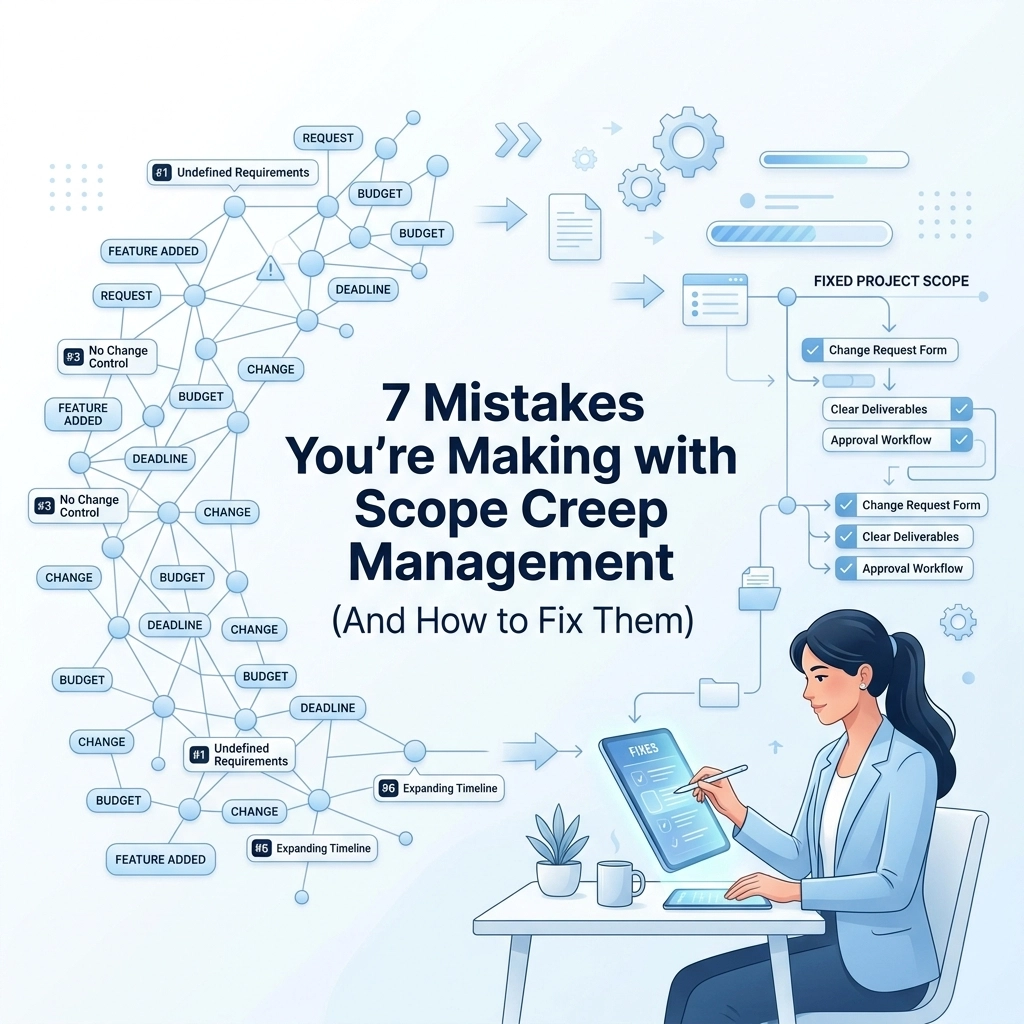
    7 Mistakes You’re Making with Scope Creep Management (And How to Fix Them)

    Scope Creep Management is the thin line between a profitable project and a professional nightmare. In the world of app development, a project that starts as a sleek MVP can quickly bloat into a monolithic beast that consumes your time, your sanity, and your revenue. If you are an independent contractor or a digital architect, failing to control the project boundaries is a death sentence for your margins.

    You aren't just building software; you are building a business. Every "small favor" or "quick addition" is a breach in your defense. To stay profitable, you must treat your project scope like a fortress. This starts with your Independent Contractor Agreements and ends with your daily management habits.

    Here are the seven most common mistakes professionals make with Scope Creep Management and the high-impact fixes to stop the bleed.

    1. Undefined Requirements are Technical Debt

    Poor requirement gathering is the primary entry point for scope creep. When you jump into development without a crystal-clear understanding of the stakeholder’s needs, you are essentially signing a blank check. Most freelancers rush the discovery phase because they want to start coding, but this impatience creates a vacuum that the client will eventually fill with "new ideas."

    The fix is simple but requires discipline. Before a single line of code is written, you need a comprehensive Statement of Work (SOW). This document should be as detailed as a blueprint. If a feature isn't explicitly listed, it doesn't exist. We often explore these structural foundations in our architectural deep dives at https://ghw-digital.com/ideas.html.

    Action-Benefit: Lockdown Discovery to Eliminate Ambiguity.
    By forcing stakeholders to finalize requirements early, you eliminate the "I thought it would do this" conversations that happen three months into the build.

    Architectural foundation illustrating structured scope creep management planning and discovery.

    2. Vague Scope Statements in Independent Contractor Agreements

    Your Independent Contractor Agreements are your strongest legal shield, yet many professionals use vague language that invites interpretation. Using phrases like "and other related tasks" or "general maintenance" is an invitation for scope creep to settle in and stay.

    To fix this, your scope statement must be exclusionary. Define what you will do, but also explicitly list what you will not do. If you’re building an iOS app, state that Android development is out of scope. If you are handling the backend, state that UI/UX design is a separate engagement. This level of precision protects your time. For more on how to structure these boundaries, check out our resources at https://ghw-digital.com/ideas.html.

    Action-Benefit: Hardcode Boundaries to Protect Your Time.
    Precision in your contract acts as a deterrent. When a client knows exactly where the fence is, they are less likely to try and move it.

    3. Operating Without a Formal Change Control Process

    One of the biggest mistakes in Scope Creep Management is saying "yes" in a Slack message. When a client asks for a small change and you agree instantly, you’ve just bypassed your own governance. Without a formal process to evaluate, price, and schedule changes, your project trajectory will inevitably drift.

    The fix is a strict Change Request Protocol. Every modification, no matter how small, must be documented. Evaluate the impact on the budget and the timeline. Use tools like Scope Guard Elite to track these shifts. If the change is accepted, it must be signed off by both parties as an amendment to the original agreement.

    Action-Benefit: Standardize Changes to Maintain Profitability.
    A formal process forces the client to weigh the value of their request against the cost, often filtering out unnecessary bloat before it hits your backlog.

    4. The Communication Vacuum

    Scope creep thrives in silence. When you don't communicate regularly with your stakeholders, they begin to imagine progress or features that haven't been discussed. Poor communication leads to misaligned expectations, and misaligned expectations lead to "corrective" requests that are actually scope expansions in disguise.

    Implement a cadence of high-transparency updates. Whether it’s a daily standup or a weekly demo, keep the client tethered to the reality of the build. Use these touchpoints to remind them of the current scope. We discuss the art of transparent communication frequently at https://ghw-digital.com/ideas.html.

    Action-Benefit: Radical Transparency to Align Expectations.
    Consistent updates prevent the "surprise" features that clients often try to inject late in the game. It keeps everyone looking at the same map.

    Connected spheres representing transparent communication for effective scope creep management.

    5. The Infinite Timeline Trap

    Allowing project timelines to stretch indefinitely is a recipe for Scope Creep Management failure. The longer a project stays open, the more likely the client, or even your own team, will think of "one more thing." Markets change, and stakeholders will want to pivot to meet them, often on your dime.

    The fix is modularity. Break your projects into smaller, fixed-term phases. Instead of a six-month build, execute three two-month sprints. Close each phase officially before moving to the next. This prevents the "drifting goalpost" syndrome. If you're looking for inspiration on modular project structures, visit https://ghw-digital.com/ideas.html.

    Action-Benefit: Phase Delivery to Prevent Goalpost Drifting.
    Closing phases creates psychological and legal finish lines that protect completed work from being reopened for "minor tweaks."

    6. Neglecting to Manage Stakeholder Emotions

    Scope creep isn't always a technical issue; often, it’s an emotional one. Stakeholders get excited, they get nervous, or they get pressure from their own bosses. If you don't manage these expectations from day one, you'll find yourself being pressured into "quick fixes" just to keep the peace.

    You must be the Digital Architect who says no. Frame your refusals around the health of the project. "Adding this now will compromise the stability of the core launch" is much more effective than "I don't have time." Protect your work by standing your ground. For strategic advice on handling stakeholder pressure, check out https://ghw-digital.com/ideas.html.

    Action-Benefit: Authoritative Leadership to Build Respect.
    Positioning yourself as the guardian of the project’s success makes it easier to turn down scope-busting requests without damaging the relationship.

    7. Passive Oversight and "Scope Seep"

    The final mistake is neglecting proactive oversight. Scope creep doesn't always happen in one giant explosion; often, it’s a series of "seeps", tiny, incremental additions that individually seem harmless but collectively sink the ship. If you aren't actively monitoring your progress against the SOW, you won't notice the seep until it’s too late.

    The fix is automated and proactive tracking. Use a system like Vow Guard Elite to keep your milestones in check. Conduct a weekly "scope audit" to ensure the work being done perfectly aligns with the Independent Contractor Agreements.

    Action-Benefit: Proactive Auditing to Stop Revenue Leaks.
    Regular audits catch the minor deviations before they become major liabilities, ensuring your margins remain intact.

    Shielded cube on a grid symbolizing proactive auditing to prevent scope creep management issues.

    Conclusion: Secure Your Perimeter

    Effective Scope Creep Management is not about being difficult; it is about being professional. It is about respecting your own expertise and the client's investment enough to deliver what was promised, on time and on budget. Every time you allow the scope to slide without a formal adjustment, you are devaluing your labor and risking the project’s integrity.

    Lock down your Independent Contractor Agreements, implement a change control process, and maintain radical transparency. Your profitability depends on your ability to say "no" to the noise and "yes" to the plan.

    Ready to architect a more resilient business? See how we handle complex digital structures at https://ghw-digital.com/ideas.html.


    Marblism Legal Shield
    This content is provided for informational purposes only and does not constitute legal or financial advice. GHW-Digital and its affiliates are not responsible for any actions taken based on this post. Always consult with a qualified professional regarding Independent Contractor Agreements and Scope Creep Management.

  • Scope creep prevention: The Potent Vital Weapon

    Scope creep prevention: The Potent Vital Weapon

    Scope creep prevention is the front line of defense for any modern project. In the high-stakes world of development and digital architecture, projects do not fail because of a lack of talent; they fail because boundaries bleed. When a client asks for a "quick addition" or a "minor tweak," they are rarely aware of the systemic impact on the project timeline and your bottom line. Without a potent mechanism to identify and halt these expansions, your profit margins evaporate.

    Scope creep kills margins. It turns a profitable partnership into a charitable donation of your time and resources. To maintain the integrity of your business, you must treat your project boundaries as a locked vault. Every addition is a withdrawal from your limited pool of time and energy. Protecting that vault requires more than just a firm handshake; it requires a vital technological shield.

    The High Stakes of Uncontrolled Growth

    When you ignore the necessity of scope creep prevention, you invite chaos into your workflow. Revenue leaks through the cracks of undocumented requests. A project that began with a clear objective slowly transforms into a shapeless monster that consumes team morale and misses every deadline. This is not a failure of communication; it is a failure of protocol.

    Most professionals struggle with the "yes" trap. We want to be helpful. We want to please the client. However, every unbilled hour spent on an out-of-scope request is an hour stolen from another paying project or your own personal recovery. Scope creep prevention is about fairness and respect, respect for your expertise and fairness to the agreement both parties signed at the start.

    Automated Comparison: The Vital Defensive Protocol

    The traditional method of managing scope involves manual cross-referencing of contracts. This is slow, prone to human error, and emotionally taxing. This is where Scope Sentry becomes your most potent asset. Instead of guessing whether a request fits within the original parameters, you employ a digital architect to verify the alignment.

    Automated contract comparison for scope creep prevention and request alignment verification.

    Upload and Analyze. By uploading your original contract into the Scope Sentry system, you establish a digital baseline. When a new request arrives via email or a project management tool, the system compares the request against the established scope. It removes the subjectivity from the conversation.

    Detecting the Shift. The software identifies exactly where the new request deviates from the agreed-upon deliverables. This is not about being difficult; it is about maintaining a professional standard. By having an automated system flag these shifts, you remove the personal friction from the negotiation. It is no longer "you" saying no; it is the protocol identifying an out-of-scope event.

    Precision Pricing for Project Integrity

    A major component of scope creep prevention is ensuring that every shift in project requirements is met with a corresponding shift in compensation. Many businesses fail because they fear the pricing conversation. They accept the extra work hoping to "sort it out later," but later never comes.

    Calculate the Impact. Scope Sentry does more than just flag a change; it helps you determine the fair market value for that change. By analyzing the complexity of the shift, the system suggests applicable pricing. This ensures that your business remains profitable and that the client understands the value of what they are asking for.

    Transparency as a Shield. When you present a price for a scope shift, you are communicating the value of your work. It creates a deterrent for unnecessary requests and ensures that only the most vital features are prioritized. This transparency builds trust. Clients respect a professional who knows their value and protects their boundaries with precision.

    Communication as a Strategic Asset

    The way you communicate a scope shift determines the future of the client relationship. If you sound defensive or uncertain, the client will push back. If you sound professional and automated, the client accepts the boundary. Scope creep prevention relies heavily on the "voice" you use to deliver the news.

    Digital communication icons representing professional voice tones for managing a project scope shift.

    Multiple Tones for Multiple Scenarios. Different clients require different approaches. Some need a firm, "just the facts" legalistic tone. Others respond better to a collaborative, solution-oriented voice. Scope Sentry provides a series of email templates in different voice tones to support your business.

    Removing the Emotional Burden. Writing "no" is hard. Writing "this will cost more" is even harder. By using pre-generated, professionally crafted emails, you remove the emotional labor from the process. You can select the tone that fits your relationship and hit send, knowing that the message is designed to protect your interests while maintaining the relationship. This is the vital edge needed to stay focused on production rather than negotiation.

    Establishing the Work Breakdown Structure

    To effectively implement scope creep prevention, you must start with a crystal-clear foundation. This begins with the Work Breakdown Structure (WBS). You cannot defend a boundary that hasn't been drawn. Your initial contract must be a masterpiece of clarity, outlining not just what you will do, but implicitly what you will not do.

    Define Project Requirements. Before the first line of code is written or the first design is rendered, every stakeholder must agree on the project's requirements. This documentation is your primary weapon. If it isn't in the document, it doesn't exist.

    Managed Change Control. Changes are inevitable. No project remains static from start to finish. However, there is a massive difference between uncontrolled additions and managed, controlled change. A formal change management plan defines the procedures that must be followed when a request is made. This protocol ensures that every modification is assessed for its impact on the schedule, budget, and resources.

    The Potent Advantage of Clear Boundaries

    Scope creep prevention is ultimately about alignment. When everyone knows where the walls are, they can work freely within the space. Confusion is the enemy of progress. By using tools like Scope Sentry, you provide your clients with a clear map of the project's territory.

    Defined project boundaries and clear roadmap layout for effective scope creep prevention.

    Respect Through Consistency. Clients often push boundaries because they are allowed to. Once you establish a reputation for rigorous scope management, the behavior of your clients will change. They will become more intentional with their requests. They will value your time because they see that you value it yourself.

    Protecting Team Morale. Nothing burns out a creative team faster than moving goalposts. When the finish line keeps receding, the "death march" begins. By locking in the scope, you protect your team's mental health and ensure they can deliver their best work on the features that actually matter.

    Implementing the Final Protocol

    To secure your competitive advantage, you must stop the bleed today. The transition from a passive recipient of requests to an active defender of scope is the most important evolution your business will undergo. GHW-Digital provides the tools necessary to make this transition seamless.

    Visit our apps page to see how our suite of tools can harden your business against the erosion of profit. Whether you are managing complex app development through Scope Guard Elite or protecting your personal assets, the principle remains the same: define, defend, and deliver.

    Scope creep prevention is not just a project management task; it is a vital survival strategy for the elite digital architect. Lock in your scope. Protect your profit. Secure your future.


    Mandatory Footer & Data Privacy Disclosure
    At GHW-Digital, we believe in blunt honesty. Our tools, including Scope Sentry and Scope Guard Elite, are designed to provide automated assistance in contract analysis and communication. However, we are not a law firm. The suggestions provided by our AI are for informational and organizational purposes only and do not constitute legal advice. We do not use "marketing tricks" or hidden trackers; we collect only the data necessary to provide our services and protect your project integrity. By using our site, you acknowledge that you have read our privacy policy and understand that the ultimate responsibility for contract enforcement remains with the user. We value your trust and operate with complete transparency. For more information, view our sitemap or return to our home page.

    Powered by GHW Digital (Company No: 16834250). This document is an automated draft for business organization purposes only. It does not constitute legal advice. GHW Digital accepts no liability for disputes, financial loss, or enforceability. Users must consult a qualified professional in their jurisdiction before signing.

  • SEO Metadata

    SEO Metadata

    • SEO Title: Scope Creep Management: The Elite Strategy to Stop Massive Margin Bleed
    • SEO Meta Description: Master scope creep management with these elite strategies. Learn how professional service contracts and software systems replace expensive consultants to protect your profits.
    • Focus Keyword: Scope Creep Management
    • URL Slug: scope-creep-management-elite-systems

    7 Mistakes You're Making with Scope Creep Management (And How Systems Replace Consultants)

    Scope Creep Management is the single most critical factor determining whether your project remains a profitable asset or becomes a financial black hole. In the world of app development and professional services, "just one small change" is the siren song of margin erosion. Most firms try to combat this by hiring expensive consultants to police their projects, but humans are fallible, expensive, and prone to "friendship bias."

    At GHW-Digital, we’ve seen how uncontrolled growth in project requirements can dismantle even the most promising startups. If you aren't guarding your boundaries with the same intensity you use to close deals, you aren't running a business; you're running a charity. To scale effectively, you need to move away from manual oversight and toward elite software systems that enforce Professional Service Contracts with clinical precision.

    1. Draft Vague Professional Service Contracts

    The first mistake begins long before a single line of code is written. If your Professional Service Contracts use broad, sweeping language like "provide cloud integration" or "enhance user experience," you have already lost. Vague language is an open invitation for clients to move the goalposts.

    Elite Scope Creep Management requires surgical precision in documentation. Every deliverable must be defined by what it is and, more importantly, what it is not. If you are building a firewall solution, your contract should explicitly state if it includes 24/7 monitoring, third-party integrations, or user training. Without these boundaries, the client assumes everything is included, and you end up working for free. For more insights on structuring your project ideas effectively, visit our Ideas Gallery.

    2. Rely on Expensive Consultants Over Automated Systems

    Many firms believe that hiring a project management consultant is the solution to "scope bloat." This is a costly misconception. Consultants are human; they get tired, they miss emails, and they often avoid uncomfortable conversations about money to maintain a "good relationship" with the client.

    Systems do not have these weaknesses. By implementing elite tools like Scope Guard Elite, you replace an expensive $300-an-hour consultant with a system that never sleeps. Software doesn't feel awkward when it tells a client that a new feature requires a budget adjustment, it simply presents the data. Systems provide a level of neutrality and consistency that no human consultant can match.

    Digital shield representing consistent scope creep management and automated project protection.

    3. Skip the Technical Discovery Phase

    Rushing into development to satisfy a client's "urgent" timeline is a recipe for disaster. When you skip a thorough technical discovery, you are essentially guessing. You cannot manage scope if you haven't fully mapped the terrain.

    Effective Scope Creep Management demands a deep dive into technical requirements, success metrics, and acceptance criteria before a contract is signed. This phase isn't a delay; it's a defensive maneuver. It allows you to identify potential hurdles that would otherwise surface mid-project as "unforeseen requirements" that eat your profit. We recommend checking out our app development strategies to see how discovery saves projects.

    4. Allow Fragmented Stakeholder Communication

    When project decisions are scattered across Slack, WhatsApp, email, and verbal mentions during lunch, you are bleeding information. Fragmented communication makes it impossible to track where a requirement changed or who authorized it.

    A centralized communication system is vital for Scope Creep Management. If it isn't documented in the system of record, it doesn't exist. This "source of truth" approach ensures that every stakeholder, including remote teams and the client’s C-suite, is looking at the same map. This prevents the "I thought we talked about this" defense that clients often use to push for free additions. You can find more on maintaining project integrity at GHW-Digital Ideas.

    5. Neglect a Formal Change Control Process

    Mistake number five is operating without a "gatekeeper." In many projects, change requests are handled ad hoc. A developer says "sure, I can add that button," and suddenly you’ve added forty hours of unscheduled QA work.

    You need a formal change management system. This process should dictate:

    • How a request is submitted.
    • Who must approve the technical impact.
    • How the budget and timeline are automatically updated.

    Using a tool like Scope Sentry allows you to automate these gatekeeping functions, ensuring that no change enters the production pipeline without being accounted for.

    Automated change control pipeline illustrating efficient scope creep management and project gatekeeping.

    6. Prioritize Speed Over Task Dependencies

    When you fail to understand the hierarchy of tasks, you fall into the trap of "non-standardized project management." Adding a seemingly small feature might seem harmless, but if that feature sits at the base of a task dependency chain, it can delay ten other milestones.

    Elite Scope Creep Management involves visualizing these dependencies. When a client asks for a change, a system-driven approach can immediately show them the cascade effect: "Adding Feature X delays Milestone Y by two weeks." This visual evidence is far more persuasive than a project manager’s verbal warning. To see how we structure these complex dependencies, explore our project frameworks.

    7. Falling Into the Overengineering Trap

    Sometimes the enemy is within. Technical teams often want to build the "perfect" solution rather than the "scoped" solution. Adding advanced encryption or audit logging that wasn't requested might seem like "going the extra mile," but it is actually a form of internal scope creep.

    Managing this requires aligning technical excellence with the stated requirements of your Professional Service Contracts. Your job is to deliver exactly what was promised to the highest standard, not to exceed the scope at your own expense. Systems like Vow Guard Elite help keep development teams focused on the agreed-upon deliverables, preventing "gold-plating" before it starts.

    How Systems Replace Consultants

    The shift from human-led oversight to system-driven Scope Creep Management is a competitive necessity. Consultants are a variable cost that increases with project complexity. Elite software is a fixed investment that scales infinitely.

    Software doesn't "forget" to document a change. It doesn't get intimidated by an aggressive client. It provides a transparent, data-backed history of every decision made during the project lifecycle. This transparency builds trust. When a client sees a system-generated report showing the impact of their requests, they respect your boundaries because the data is undeniable.

    Structured digital milestones illustrating transparent data-driven scope creep management for app projects.

    Action-Benefit: Secure Your Profit Margins

    • Lock in Boundaries: Use software to define the "Finished" state before work begins.
    • Automate Enforcement: Remove the emotional labor of saying "no" by letting the system handle change requests.
    • Track Real-Time Impact: Instantly see how a scope change affects your bottom line and delivery date.
    • Protect Your Developers: Prevent burnout by ensuring your team is only working on approved, high-priority tasks.

    By moving away from manual, consultant-heavy processes and toward elite automated systems, you aren't just managing projects; you are protecting your agency’s future. Stop letting your profit leak through the cracks of "small favors" and "vague promises."

    For more resources on how to protect your business and optimize your digital strategy, visit our main site or dive deep into our daily updates at ghw-digital.com/ideas.html.


    Marblism Legal Shield:
    This content is provided for informational purposes only and does not constitute legal or financial advice. GHW-Digital and its affiliates are not responsible for any project failures or financial losses resulting from the use of these strategies. Professional Service Contracts should be reviewed by qualified legal counsel in your jurisdiction. We value transparency and data integrity; for information on how we handle data, please refer to our Privacy Policy.

    Stop the bleed. Secure your competitive advantage. Implement a system, not a consultant.