Author: gohugtheworld

  • Freelancer legal protection: The Ultimate Framework for Serious Independent Experts

    Freelancer legal protection: The Ultimate Framework for Serious Independent Experts

    Freelancer legal protection is the invisible armor that separates struggling amateurs from high-earning, serious professionals. In the digital economy, your skills are your currency, but your contracts are your vault. Without a robust framework to defend your time, your intellectual property, and your bank account, you are not running a business: you are running a charity at the mercy of your clients' whims.

    The reality of the freelance world is often harsh. Scope creep destroys profit margins. Delayed feedback stretches weeks into months. Clients vanish before the final invoice is paid. For the serious independent expert, these are not just "annoyances"; they are systemic threats to your livelihood. To thrive, you need more than just a "fair" agreement. You need an ultimate protective shield that establishes total control from day one.

    The High Stakes of Independent Work

    The digital landscape is littered with the remains of agencies and freelancers who thought a handshake or a basic template was enough. They fell victim to the "just one more change" trap. They allowed clients to dictate terms. They worked without deposits.

    When you operate without comprehensive freelancer legal protection, you are effectively negotiating against yourself. You assume all the risk while the client reaps all the reward. If a project fails or a client becomes predatory, a generic boilerplate contract downloaded from a random blog will not save you. These documents are often designed to be "neutral," but in a power struggle between an independent contractor and a corporate entity, neutrality is a vulnerability.

    A protective blue shield representing robust freelancer legal protection for serious independent experts.

    Establishing a Serious Foundation for Freelancer legal protection

    A serious expert treats every project as a high-stakes partnership. This begins with a Master Service Agreement (MSA) that does not just "ask" for respect but commands it through structure. ScopeGuard Pro Elite was built to provide this exact scaffolding. It is not a simple generator; it is a drafting engine designed to bake professional boundaries into the very fabric of your client relationships.

    The ultimate framework for freelancer legal protection focuses on three core pillars:

    1. Defensive Boundaries: Defining exactly where your work ends and where additional billing begins.
    2. Financial Fortification: Securing deposits, kill fees, and late payment penalties.
    3. Asset Retention: Ensuring you own your work until the very moment the final penny hits your account.

    By using ScopeGuard Pro Elite, you transition from being a disposable vendor to a strategic partner. You present a 17-article framework that covers everything from data privacy to liability caps, signaling to the client that you are a serious professional who values their own expertise.

    Defining Boundaries with ScopeGuard Pro Elite

    The most common killer of digital projects is scope creep. It starts small: a minor tweak here, a quick addition there: and ends with you working for less than minimum wage. The ultimate framework for freelancer legal protection solves this through strict scope prevention and an exhaustive exclusions list.

    Our system prompts you to define not just what you will do, but explicitly what you will not do. If it isn't in the deliverables list, it is an exclusion. If the client wants it, it requires a formal Change Order. This shift in dynamic is crucial. It moves the conversation from "Can you just add this?" to "Here is the cost for that additional feature."

    Luminous boundary highlighting project deliverables to ensure strict freelancer legal protection and scope control.

    Intellectual Property as Your Ultimate Asset

    In the digital realm, your intellectual property (IP) is your most valuable asset. Many freelancers inadvertently sign away their rights before they are even paid. A serious framework for freelancer legal protection must include a multi-tiered IP structure.

    Under the ScopeGuard Pro framework, your pre-existing tools and methodologies remain yours. The bespoke work you create for the client only transfers ownership upon final payment in full. This provides you with the ultimate leverage. If a client attempts to withhold payment while using your work, they are in breach of copyright law. This is a far more powerful position than simply asking for what you are owed. You can learn more about how to structure these rights through resources like The Law Society to understand the weight of these clauses.

    Protecting Your Cash Flow through Freelancer legal protection

    Cash flow is the lifeblood of your business. Serious experts do not wait 90 days for payment. They do not chase invoices without recourse. A core component of your freelancer legal protection should be the invocation of statutory rights.

    ScopeGuard Pro Elite automatically includes language referencing the Late Payment of Commercial Debts (Interest) Act 1998. This allows you to claim interest at 8% above the Bank of England base rate, plus statutory compensation for debt recovery costs. When a client sees this level of detail in your contract, they realize that delaying your payment is a billable event for them. It changes the psychology of the transaction. You are no longer someone they can pay "when they get around to it."

    A blue sphere secured within a frame symbolizing financial freelancer legal protection and cash flow security.

    The Serious Expert’s Approach to Liability

    Every project carries risk. A server might go down, a piece of code might have a bug, or a marketing campaign might not perform as expected. Without a cap on your liability, a single mistake could lead to a lawsuit that wipes out your personal assets.

    Serious freelancer legal protection requires a strict limitation of liability. Your contract should cap your total exposure to the fees paid by the client. It should explicitly exclude indirect damages, lost profits, and claims of "goodwill." You are a service provider, not an insurance policy for the client's business risks. ScopeGuard Pro Elite drafts these protections into your MSA, ensuring that your business remains a separate entity from your personal life and that your exposure is always proportional to your fee.

    Why Templates Fail Where Frameworks Succeed

    The internet is full of "free" contract templates. For a serious independent expert, these are a trap. Templates are static; they don't adapt to the nuances of a UI/UX project versus a backend software build. They are often outdated or written for jurisdictions that don't apply to you.

    A framework, like the one offered by GHW-Digital, is dynamic. It uses a structured conversational wizard to gather project-specific details: timelines, milestones, and specific deliverables: and weaves them into a field-tested legal scaffolding. This result is a bespoke-feeling draft that is significantly more robust than any off-the-shelf boilerplate.

    Interlocking rings representing a multi-layered legal framework for ultimate freelancer legal protection.

    Implementing the Ultimate Professional Shield

    Securing your business shouldn't take weeks of back-and-forth with expensive solicitors just to get a starting point. While we always recommend a final review by a legal professional, having a high-quality, 17-article draft ready in minutes puts you in a position of strength.

    You enter the negotiation with the terms already set. You project an aura of professionalism that deters "nightmare" clients before they even start. If a client balks at a fair, structured contract that protects both parties, they are giving you a clear signal: they were planning on taking advantage of you. In this way, your freelancer legal protection acts as a filter, attracting serious clients and repelling the predators.

    Stop negotiating against yourself and start defending your margins. Your expertise is worth protecting. Your time is worth billing. Your business deserves a framework that actually works.

    Lock in your professional boundaries today. Secure your future with ScopeGuard Pro Elite.

    Special Offer: Use discount code BLOG20 for 20% off ScopeGuard Pro. Valid until April 1st, 2026.


    Powered by GHW Digital (Company No: 16834250). This document is an automated draft for business organization purposes only. It does not constitute legal advice. GHW Digital accepts no liability for disputes, financial loss, or enforceability. Users must consult a qualified professional in their jurisdiction before signing.
  • Change order form: The Crucial Tool for Unstoppable Project Success

    Change order form: The Crucial Tool for Unstoppable Project Success

    Change order form protocols are the only thing standing between your agency’s profit margins and the slow, agonizing death known as scope creep. In the digital agency world, we have all been there. You sign a contract for a website build or an app development project. Everyone is smiling. Two weeks later, the client "just has one quick idea." Then another. Before you know it, you are building three features for the price of one, and your hourly rate has plummeted below minimum wage.

    This is not just a minor inconvenience. It is a fundamental threat to your business survival. To achieve unstoppable project success, you must treat every deviation from the original scope as a formal business transaction. You are not being "difficult"; you are being professional. You are protecting the integrity of the project and the health of your company.

    The anatomy of a professional change order form

    A change order form is not a suggestion; it is a binding amendment to your Master Service Agreement. When a client asks for something outside the initial scope, the conversation should immediately pivot to the documentation. This shifts the dynamic from an emotional request to a logical business decision.

    A professional change order form displayed on a modern tablet in a clean agency workspace.
    Alt Text: A digital professional reviewing a professional change order form on a tablet to ensure project accuracy.

    Every effective change order form must include several non-negotiable elements to ensure it provides the protection you need:

    • Detailed Description of Change: You must be hyper-specific. What exactly is being added or modified? Vague language is the enemy of profit.
    • Revised Project Cost: This is the most critical part. Whether it is an extra £500 or £5,000, the cost must be explicitly stated and agreed upon before work begins.
    • Schedule Impact: Does this new feature push the launch date back by a week? Documentation must reflect the new timeline to prevent "late delivery" penalties.
    • Signatures: No signature, no work. Both parties must sign to acknowledge the new terms.

    By using ScopeGuard Pro Elite, you ensure that your initial contracts already have the "Change Order" mechanism baked into the DNA of the agreement. You aren't inventing a process on the fly; you are simply following the elite framework you established on day one.

    Why a change order form creates unstoppable project success

    The primary reason projects fail is not a lack of talent; it is a lack of boundaries. When you implement a change order form for every single modification, you create a culture of respect. The client learns very quickly that your time has a specific, documented value. According to the Project Management Institute, disciplined change management is a top predictor of project health and stakeholder satisfaction.

    A diverse professional team celebrating unstoppable project success inside a modern office boardroom.
    Alt Text: An unstoppable project team celebrating a successful launch thanks to disciplined change order form usage.

    When you stop "throwing in" extra work for free, three things happen:

    1. Margins Are Protected: You get paid for every hour you work. This is the foundation of a scalable business.
    2. Resources Are Optimized: Your developers and designers aren't being pulled away from billable tasks to handle "favors."
    3. Client Psychology Shifts: The client starts to self-filter. They only ask for what they truly need because they know there is a cost associated with their requests.

    This creates a win-win scenario. The project stays on track, and you remain profitable. This is the essence of unstoppable project success.

    Stop working for free with a change order form

    We see it every day at GHW-Digital. Brilliant developers are exhausted because they are effectively working for free on the "back half" of every project. They fear that if they say "no" or ask for more money, the client will get angry or withhold the final payment.

    This fear stems from a weak legal foundation. If your contract doesn't explicitly define how changes are handled, you are at the mercy of the client's mood. However, when you use a change order form backed by a robust Master Service Agreement, you are standing on solid ground. You aren't "asking" for more money; you are simply executing the agreed-upon process for scope adjustments.

    If a client refuses to sign a change order form for additional work, it is a massive red flag. It means they never intended to pay for the extra value they are requesting. In this case, the form has done its job, it has exposed a predatory client before you wasted dozens of hours on unbillable labor.

    Action-Benefit: Lock in your profit margins

    Using a change order form allows you to pivot from a "service provider" to a "strategic partner." Partners discuss value and costs; servants just do what they are told.

    • Action: Immediately pause any request that falls outside the initial scope.
    • Benefit: You demonstrate elite professionalism and prevent revenue leakage.

    A digital pen signing a change order form to finalize a professional project agreement.
    Alt Text: A close-up of a digital signature on a change order form representing a locked-in project agreement.

    Think of your agency like a high-end restaurant. If a customer orders a steak and then asks for a side of lobster, the waiter doesn't just "throw it in" for free. They record the change, update the bill, and ensure the kitchen can handle the request. Your digital services are no different. Whether you are building a custom app found on our apps page or providing high-level strategy, every "side of lobster" requires a documented change.

    The legal weight of your documentation

    In many jurisdictions, including under the Late Payment of Commercial Debts (Interest) Act 1998, having a clear, signed audit trail of work performed is vital for recovering fees. A change order form acts as that audit trail. If a dispute ever reaches a solicitor, having a stack of signed change orders makes your case nearly bulletproof.

    ScopeGuard Pro Elite was built specifically to handle these high-stakes scenarios. It doesn't just give you a generic template; it provides a structured framework that anticipates the need for changes. It ensures that your Freelance contract is a living document that grows with the project rather than a static piece of paper that becomes irrelevant the moment the first "quick change" is requested.

    Implementing the change order protocol

    To make this work, you must be consistent. You cannot use a change order form for some clients and not others. It must be your standard operating procedure.

    1. Identify the Gap: As soon as a request comes in, compare it to the original Statement of Work.
    2. Educate the Client: Say, "That sounds like a great addition. I’ll draft the change order form now so we can get that added to the sprint and keep the budget updated."
    3. Draft and Send: Use your ScopeGuard Pro infrastructure to generate the necessary documentation quickly.
    4. Wait for Approval: Do not start the work until the digital ink is dry.

    This discipline is what separates the boutiques that thrive from the freelancers who burn out. It is the ultimate shield for your time and your sanity.

    A minimalist professional workspace with a laptop prepared for a change order form approval.
    Alt Text: A professional workspace with a laptop showing a change order form ready for client approval.

    Final thoughts on unstoppable project success

    Your business is a vehicle for your freedom, not a prison of unbillable hours. Every time you allow scope creep without a change order form, you are writing a check from your own personal bank account to your client. Stop doing that.

    Assert your value. Protect your team. Use professional tools like ScopeGuard Pro Elite to establish the boundaries that lead to unstoppable project success. You have the talent; now give yourself the protection you deserve.

    Start drafting with ScopeGuard Pro Elite today and turn every "quick request" into a billable win.

    Special Offer: Use discount code BLOG20 for 20% off ScopeGuard Pro. Valid until April 1st, 2026.


    Marbalism Legal Shield: Data & Privacy Transparency

    At GHW-Digital, we believe in blunt honesty. When you use ScopeGuard Pro Elite, your project data is processed securely through our enterprise-grade infrastructure. We do not sell your data, and we do not use your proprietary project details to train public AI models. Your intellectual property remains yours. Our tool is a framework for your professional protection, and we handle your information with the same level of integrity we expect you to demand from your clients. For full details, please review our Privacy Policy.

    Disclaimer: ScopeGuard Pro is a drafting support tool, not a law firm. While our proprietary clause framework is built on field-tested legal scaffolding, we are not your attorneys. Always have a qualified solicitor or attorney review your final drafts to ensure they are enforceable in your specific jurisdiction. We provide the framework; you and your legal counsel provide the teeth.

  • Invoice terms: The Vital Strategy for Superior Financial Protection

    Invoice terms: The Vital Strategy for Superior Financial Protection

    Invoice terms represent the difference between a thriving digital agency and a business on the brink of collapse. In the fast-paced world of app development and digital consulting, your cash flow is your oxygen. Yet, thousands of talented professionals allow their oxygen supply to be throttled by vague agreements and polite "reminders." Your business is not a revolving credit facility for your clients. It is a professional entity that requires a vital strategy for superior financial protection.

    When you allow a client to dictate the pace of payment, you lose control of your operations. You become a victim of their internal bureaucracy, their cash flow hiccups, and their lack of respect for your time. To survive and scale, you must implement a structured, non-negotiable framework that treats your compensation as a priority, not an afterthought.

    The Psychology of Invoice terms in Client Relationships

    The moment you present your agreement is the moment you establish the power dynamic of the project. Weak, boilerplate language signals to the client that your boundaries are flexible. If your documentation lacks specific consequences for late payment, you are essentially telling the client that paying you is optional.

    Strategic invoice terms do more than just get you paid; they command respect. When a client sees a professionally drafted Master Service Agreement (MSA) that explicitly references statutory laws and interest rates, their perception of you shifts. You are no longer a "disposable freelancer" to be paid whenever the mood strikes. You are an elite professional with a sophisticated legal framework protecting your interests.

    A professional reviewing structured invoice terms on a digital tablet for superior financial protection.
    Alt: A professional digital agency owner reviewing structured invoice terms for superior financial protection.

    Strategic Invoice terms to Combat Late Payments

    Late payments are a systemic infection in the digital industry. According to the Small Business Commissioner's Prompt Payment Code, late payments are a primary cause of business failure. You cannot afford to be "nice" about your money. You need a mechanism that enforces compliance automatically.

    ScopeGuard Pro Elite takes the guesswork out of financial defense by embedding the Late Payment of Commercial Debts (Interest) Act 1998 directly into your contract drafts. This isn't just a friendly suggestion; it is an invocation of the law. By specifying interest at 8% above the Bank of England base rate, plus statutory compensation and legal cost recovery, you create a financial deterrent against client negligence.

    When your invoice terms are this explicit, clients understand that delaying your payment will cost them significantly more in the long run. This transparency eliminates the "we forgot" or "it's in the system" excuses. The system is the contract, and the contract has teeth.

    Protecting IP Through Strict Invoice terms

    One of the most dangerous mistakes a digital professional can make is transferring Intellectual Property (IP) rights before the final invoice is settled. If the client owns the code, the design, or the strategy before they have paid for it, you have zero leverage.

    Superior financial protection requires a "Pay-to-Play" IP structure. ScopeGuard Pro drafts a three-tier framework where:

    • Pre-existing IP remains yours.
    • Client Content remains theirs.
    • Bespoke Deliverables only transfer ownership once the final payment is cleared in full.

    By linking your invoice terms directly to the transfer of rights, you ensure that the client is incentivized to close the project and settle the bill. Until that final transaction hits your bank account, you retain the ultimate leverage: ownership of the work.

    Automating Invoice terms with ScopeGuard Pro Elite

    Manual drafting is prone to error and emotional softening. You might feel "awkward" adding a late fee or a kill fee when you're talking to a client you like. ScopeGuard Pro Elite removes the emotion from the equation. It provides a field-tested, 17-article framework that acts as your silent partner in negotiations.

    The tool’s structured conversational wizard ensures that every vital detail, from non-refundable deposits to client delay liabilities, is captured and codified. If a client stalls the project, your invoice terms shift the cost of those delays back to them. Timeline overruns caused by a lack of feedback or missing content become billable events. This protects your margins from being eroded by "project drag."

    A protective digital shield securing business cash flow and invoice terms for digital agencies.
    Alt: The ScopeGuard Pro Elite dashboard generating superior invoice terms for an app development project.

    The Vital Role of Kill Fees and Deposits

    A project that starts without a non-refundable deposit is a project that invites abuse. You are committing resources, time, and opportunity costs the moment you say "yes." Your invoice terms must reflect this commitment.

    ScopeGuard Pro Elite helps you establish clear Kill Fee provisions. If a client decides to pivot, take the work in-house, or cancel the project mid-stream, they are still obligated to compensate you for the work performed and the space you cleared in your schedule. This is not about being "punitive"; it is about being professional. You are protecting your business assets from the volatility of a client’s internal decisions.

    Superior Financial Protection via Liability Caps

    Financial protection isn't just about what comes into your bank account; it’s about what stays there. Without a limitation of liability clause, you are exposing your personal and business assets to disproportionate legal risk. A single "lost profit" claim from a disgruntled client could ruin years of hard work.

    By implementing invoice terms that cap your total liability to the fees paid and exclude indirect damages, you create a safety net for your business. ScopeGuard Pro Elite ensures these clauses are structured to be defensible, providing you with the peace of mind to innovate without the fear of catastrophic litigation.

    Finalizing Your Financial Defense

    Stop negotiating against yourself. Stop accepting "Net 60" or "Net 90" terms from multi-million pound corporations while you struggle to pay your team. It is time to assert your professionalism from the very first interaction.

    Implementing superior invoice terms is the most immediate way to increase the value of your business and the quality of your client base. Clients who respect your terms are the clients you want to work with. Those who push back against fair, structured payment protocols are the ones who will inevitably cause you the most grief.

    Lock in your scope. Defend your margins. Ensure your hard work results in actual profit, not just a growing list of accounts receivable.

    Start drafting with ScopeGuard Pro Elite today.

    Special Offer: Use discount code BLOG20 for 20% off ScopeGuard Pro. Valid until April 1st, 2026.


    Marbalism Legal Shield – GHW-Digital
    Disclaimer: ScopeGuard Pro is a contract drafting support tool, not a law firm. All generated documents are structured drafts intended to provide a position of strength for your business. As with any commercial agreement, the enforceability of specific clauses depends on your jurisdiction. We strongly recommend having a qualified solicitor or attorney review your final document before it is signed or relied upon. Our tool provides the framework; your legal professional provides the final sign-off.

    Go back to GHW-Digital Home | Explore ScopeGuard Pro Elite | View our App Development Services

  • Scope of work template: The Powerful Weapon against Predatory Client Behavior

    Scope of work template: The Powerful Weapon against Predatory Client Behavior

    Scope of work template implementation is the primary defensive maneuver every digital professional must master to survive in a landscape filled with predatory client behavior. For too long, freelancers and boutique agencies have entered project engagements with nothing but a "gentleman’s agreement" or a loosely worded email. This lack of structure is an open invitation for scope creep to dismantle your profitability and erode your mental health.

    In the digital services industry, predatory behavior doesn't always look like an overt threat. More often, it looks like a client asking for "just one more small tweak" at 9:00 PM on a Friday. It looks like a project that was supposed to last four weeks stretching into four months because the client is "still gathering feedback." Without a structured framework, you are not a business partner; you are a subsidised resource for the client's internal inefficiencies. You need a weapon to fight back.

    Defining the Battleground: Why Your Current Contracts Fail

    Most generic contracts focus on the "what if" of a legal catastrophe but completely ignore the "what is" of daily project management. They are reactive rather than proactive. A standard boilerplate agreement might tell you what happens if you get sued, but it won’t tell your client that adding a new API integration halfway through a sprint is going to cost them an extra £2,000.

    Predatory clients rely on ambiguity. They thrive in the grey areas of your agreement. When a deliverable isn't explicitly defined down to the version number or the specific browser compatibility, the client has the leverage to demand infinite revisions. A professional scope of work template removes the grey. It sets the hard boundaries required to keep a project on track and profitable.

    A professional scope of work template blueprint with a fountain pen, symbolizing clear project boundaries.

    Explicit Deliverables: Locking in the Objective

    The core of any scope of work template must be an exhaustive list of deliverables. This is not the place for vague language like "website development" or "social media management." Predatory clients will interpret "website development" as "unlimited pages, custom animations, and a full e-commerce backend" even if you only quoted for a five-page brochure site.

    To protect yourself, your deliverables must be granular. Specify the number of pages. Specify the number of revision rounds. Specify the file formats. If you are a UI/UX designer, state exactly how many wireframes are included. If you are a software engineer, define the specific features and user stories that are in scope. By being hyper-specific, you create a document that acts as an objective truth. When the client asks for something outside that list, you don't have to be the "bad guy": the contract does the talking for you.

    Defining Exclusions: The Power of Saying No Upfront

    One of the most powerful sections of a high-end scope of work template is the exclusions list. This is where you explicitly state what you are not doing. Most freelancers feel uncomfortable listing what they won't do, fearing it makes them look unhelpful. In reality, listing exclusions projects an aura of extreme professionalism. It shows that you have a deep understanding of the project's boundaries.

    If you are building a website, exclude SEO copywriting unless it's a paid line item. If you are developing an app, exclude third-party API costs or ongoing server maintenance. By defining these boundaries on day one, you prevent the "assumed inclusion" trap that predatory clients use to squeeze extra work out of you. This is the hallmark of the ScopeGuard Pro Elite system: it focuses as much on what is outside the fence as what is inside it.

    Financial Defense: Milestones and Kill Fees

    A predatory client’s greatest leverage is the final payment. They know that if they withhold the last 25% of the fee, they can force you to perform weeks of additional, out-of-scope labor just to get paid. A robust scope of work template dismantles this leverage by implementing a strict milestone payment structure.

    Never work without a non-refundable deposit. This ensures the client has "skin in the game" and covers your initial overhead. Furthermore, you must include a "Kill Fee." If a client decides to pivot, take the work in-house, or simply disappears for three weeks, they should be contractually obligated to pay for the work completed up to that point. This prevents you from being left holding the bag for a project that fails through no fault of your own.

    Minimalist glowing milestones representing financial security and progress within a scope of work template.

    The Change Order Protocol: Converting Creep into Cash

    Scope creep only happens when you allow it to happen for free. In a professional engagement, there is no such thing as "just one more thing." There are only "Change Orders." Your scope of work template should include a formal process for handling requests that fall outside the original agreement.

    When a client asks for a new feature, your response should be: "That’s a great idea, it’s currently out of scope according to our MSA, so I’ll draft a Change Order and a price for that additional work." This shifts the dynamic from a negotiation to a transaction. Predatory clients hate Change Orders because they require them to pay for their indecision. Professional clients, however, respect them because they reflect a structured, business-minded approach.

    Late Payment Mechanisms: Invoking the Law

    Many freelancers are unaware that they are protected by specific legislation regarding late payments. A powerful scope of work template doesn't just ask nicely for payment; it invokes the law by name. In the UK, for instance, the Late Payment of Commercial Debts (Interest) Act 1998 allows you to charge interest at 8% above the Bank of England base rate, plus statutory compensation for debt recovery costs.

    Including this language in your draft signals to the client’s accounts department that you are not a hobbyist. You are a professional entity that understands its rights. This often ensures your invoice moves to the top of the pile while other, less protected freelancers wait months for their checks to clear.

    IP Ownership: The Ultimate Leverage

    The most significant mistake a digital professional can make is transferring Intellectual Property (IP) rights before the final invoice is paid. Your scope of work template must clearly state that all rights, titles, and interests in the deliverables remain with you until you have received payment in full.

    This is your ultimate insurance policy. If a client refuses to pay the final milestone but tries to launch the website or app regardless, they are committing copyright infringement. This gives you: and your legal counsel: massive leverage to resolve the dispute quickly. The Law Society frequently highlights the importance of clear IP clauses in commercial contracts to avoid lengthy litigation.

    A sleek digital key representing intellectual property ownership and legal leverage in a freelancer contract.

    Client Delay Liability: Reclaiming Your Time

    Predatory behavior often manifests as silence. A client who takes three weeks to provide feedback on a design is effectively holding your schedule hostage. You can’t finish the project, and you can’t easily take on new work because you’re waiting for them to move.

    A sophisticated scope of work template includes a "Client Delay" clause. This clause states that if the client fails to provide necessary feedback or assets within a specified timeframe (e.g., 48 hours), the project timeline is automatically extended, and a "Restart Fee" or "Holding Fee" may apply. This puts the cost of the client’s disorganization back onto them, rather than forcing you to absorb the loss.

    ScopeGuard Pro: The Elite Drafting Partner

    Creating this level of protection from scratch is a daunting task. Most freelancers don't have the time to research 17 articles of legal scaffolding or the budget to hire a solicitor for every new project. This is why we built ScopeGuard Pro.

    ScopeGuard Pro is not a static document; it is an advanced drafting tool. It uses a proprietary framework of field-tested clauses designed specifically for the digital industry. You provide the project details through a structured wizard, and the engine populates a professional draft that protects your cash flow, your IP, and your time. It’s about starting every project from a position of strength.

    Assert Your Professionalism Today

    The era of being a "disposable freelancer" is over. To scale your agency or your independent practice, you must stop negotiating against yourself. You must stop hoping for "nice" clients and start building systems that protect you from the "bad" ones.

    A scope of work template is more than just a list of tasks; it is a declaration of your value. It tells the client that you respect your own time and expertise enough to defend it. When you present a professionally structured, 17-article Master Service Agreement, you change the power dynamic of the entire relationship. You are no longer a vendor; you are an essential partner with clear boundaries.

    Stop allowing scope creep to bleed your business dry. Use a professional tool to lock in your deliverables and secure your profit margins.

    Start drafting with ScopeGuard Pro Elite today.

    Special Offer: Use discount code BLOG20 for 20% off ScopeGuard Pro. Valid until April 1st, 2026.


    Marbalism Legal Shield & Data Integrity Notice
    ScopeGuard Pro is a contract drafting support tool, not a law firm. All generated documents are structured drafts intended to serve as a starting point for professional negotiation. We strongly recommend that all final contracts are reviewed by a qualified solicitor or attorney in your specific jurisdiction to ensure compliance with local laws. Your data is processed securely via enterprise-grade infrastructure; we never sell your project details or personal information to third parties. Professionalism begins with protection.

  • Late payment clause: The Urgent Legal Mechanism for Guaranteed Cash Flow

    Late payment clause: The Urgent Legal Mechanism for Guaranteed Cash Flow

    Late payment clause integration is the single most effective way to ensure your agency or freelance business never becomes an interest-free bank for your clients. In the high-stakes world of digital development and creative services, cash flow is the lifeblood of your operation. Yet, many professionals treat payment terms as a suggestion rather than a strict legal requirement. This lack of boundary-setting creates a culture of "pay whenever," which erodes your margins and threatens your business survival.

    When you deploy a robust late payment clause through ScopeGuard Pro Elite, you aren't just asking for money; you are invoking a powerful legal framework designed to protect the vulnerable from the predatory. You transition from a "disposable freelancer" to a professional partner who commands respect and timely compensation.

    The Urgent Reality of Delayed Revenue

    Late payments are not a minor inconvenience; they are a systemic failure that destroys boutique agencies. Every day an invoice remains unpaid is a day your capital is working for someone else’s business instead of your own. You have overheads, software licenses, and team salaries to pay. When a client delays a payment, they are effectively forcing you to subsidize their growth with your personal or business savings.

    A professional late payment clause ends this cycle of abuse. It sets the expectation from day one: your time has a specific value, and that value is tied to a specific date. By establishing clear consequences for delay, you eliminate the ambiguity that clients often exploit to push your invoice to the bottom of their pile.

    Minimalist workspace symbolizing financial control through a clear late payment clause.

    Invoking the Late Payment of Commercial Debts Act 1998

    Most independent contractors are unaware of the massive legal leverage they already possess under UK law. The Late Payment of Commercial Debts (Interest) Act 1998 was created specifically to protect small businesses from the "bullying" tactics of larger corporate entities.

    Your late payment clause should explicitly reference this Act. By doing so, you are not just making a polite request; you are stating that you understand your statutory rights. This Act allows you to:

    • Charge interest at a rate of 8% above the Bank of England base rate.
    • Claim fixed "statutory compensation" for every overdue invoice.
    • Recover the reasonable costs of debt recovery.

    ScopeGuard Pro Elite automates the inclusion of this language. Instead of trying to play lawyer, you use a tool that populates our field-tested framework with the exact wording needed to make a client’s internal finance team sit up and take notice.

    Guaranteed Cash Flow Through Financial Deterrents

    The goal of a late payment clause isn't actually to collect interest; it is to ensure the interest never has to be charged in the first place. It acts as a powerful deterrent. When a client sees that an overdue invoice will automatically trigger an 8% interest penalty plus legal recovery costs, your invoice suddenly moves to the top of the "must pay" list.

    According to the Federation of Small Businesses (FSB), late payments result in thousands of business closures every year. You cannot afford to be part of that statistic. By using ScopeGuard Pro, you lock in a structure where the cost of a delay is shifted entirely onto the client. If they choose to stall, they pay for the privilege. This is the only way to achieve a level of guaranteed cash flow in a volatile market.

    Professionalism and the Action-Benefit of Boundaried Contracts

    Setting boundaries isn't "mean": it’s professional. A client who respects your business will respect your terms. A client who balks at a late payment clause is a client who likely intended to pay you late (or not at all) from the beginning. In this sense, your contract acts as a filter, weeding out the high-risk, low-value clients before they can drain your resources.

    Secure Your Deposits: ScopeGuard Pro Elite ensures that your initial engagement begins with a non-refundable deposit. This protects your initial "ramp-up" time and ensures the client has skin in the game.

    Enforce Your Timeline: Our tool drafts clauses that shift the financial burden of client-side delays back to the client. If they take three weeks to provide feedback, your late payment clause and timeline protections ensure you aren't the one paying for their internal bureaucracy.

    Protective glass partition illustrating a late payment clause defense for digital agencies.

    How ScopeGuard Pro Elite Automates Your Defense

    Drafting a contract from a blank page is a recipe for disaster. You will miss things. You will use weak language. You will leave doors open for scope creep and payment delays. ScopeGuard Pro Elite replaces the "boilerplate" mess with a high-performance 17-article Master Service Agreement.

    1. Strict Triggering: The tool defines exactly when a payment is considered "late" (e.g., 14 days from the date of the invoice), leaving no room for "I didn't see the email" excuses.
    2. Statutory Citations: It automatically includes the reference to the Late Payment of Commercial Debts Act 1998, giving your draft immediate authority.
    3. Tiered Interest: The late payment clause within the framework allows for tiered responses: reminders followed by formal interest accrual.
    4. IP Leverage: Most importantly, the ScopeGuard Pro framework establishes that Intellectual Property rights only transfer upon final payment in full. This means if they don't pay, they don't own the work. That is the ultimate leverage for any developer or designer.

    Stopping the "Just One More Thing" Revenue Leak

    Payment delays often go hand-in-hand with scope creep. A client might withhold a final payment because they want a "quick change" that wasn't in the original brief. Without a strong late payment clause and a defined change-order process, you are often forced to do the extra work just to get paid for the work you've already completed.

    ScopeGuard Pro Elite ends this hostage-taking. By separating deliverables into clear phases and tying payments to those phases with rigid late-payment penalties, you isolate the "extra" requests from the "already earned" revenue. You protect your time, your mental health, and your bottom line.

    Abstract legal blueprint representing a late payment clause framework for freelancers.

    Assert Your Authority and Protect Your Margins

    The digital industry is notorious for treating independent contractors like disposable assets. It is time to change that dynamic. By deploying a professional late payment clause, you signal to your clients that you are a sophisticated business operator. You aren't just a "coder" or a "designer"; you are a professional partner who understands the law and values their own contribution.

    Stop negotiating against yourself. Stop apologizing for wanting to be paid on time. Use ScopeGuard Pro Elite to build a defensive wall around your revenue. Your lawyer gives your contract teeth, but ScopeGuard Pro gives you the expert framework to start from a position of absolute strength.

    Final Thoughts on Financial Sovereignty

    In the end, a late payment clause is about more than just money: it’s about sovereignty. It’s about the right to run a predictable, profitable business without being at the mercy of a client’s disorganized finance department. It is an urgent legal mechanism that provides the relief of knowing your cash flow is protected by the full weight of commercial law.

    Secure your project. Defend your time. Guarantee your cash flow.


    Special Offer: Use discount code BLOG20 for 20% off ScopeGuard Pro. Valid until April 1st, 2026.


    Marbalism Legal Shield
    Powered by GHW Digital (Company No: 16834250). This document is an automated draft for business organization purposes only. It does not constitute legal advice. GHW Digital accepts no liability for disputes, financial loss, or enforceability. Users must consult a qualified professional in their jurisdiction before signing.

    Start drafting with ScopeGuard Pro Elite today.

  • Freelance contract template: The Elite Protocol for Total Business Autonomy

    Freelance contract template: The Elite Protocol for Total Business Autonomy

    Freelance contract template usage is often the first step toward professional suicide for independent digital experts. Most professionals treat their contract as a formality, a boring PDF they downloaded from a generic "legal for creators" blog. They assume that because the document looks official, it offers protection. This is a dangerous illusion. A generic freelance contract template is designed to be "fair," but in the world of high-stakes digital agency work, "fair" is a synonym for vulnerable.

    When you use a boilerplate agreement, you are essentially bringing a paper shield to a sword fight. Corporate clients have internal legal teams whose entire job is to minimize their risk and maximize their leverage. If your agreement doesn't explicitly account for the unique, shifting nature of digital deliverables, you aren't just working; you are gambling with your livelihood.

    Total business autonomy requires a shift in mindset. You are not a disposable resource; you are a high-value consultant. To command that respect, your documentation must reflect an elite level of preparation and authority.

    Why your current freelance contract template is failing you

    Standard templates are built for generalities. They try to cover everything from wedding photography to lawn care, which means they cover nothing effectively for a software engineer or a UI/UX designer. These generic documents fail because they do not address the specific "leakage points" of a digital project: the subjective feedback loops, the shifting browser requirements, and the "just one more thing" culture that destroys profit margins.

    Scope creep kills margins. It is a silent epidemic in the agency world. It starts with a small request that isn't quite in the brief but seems easy enough to do. Without a structured framework to push back, you say "yes." Then comes the next request. Before you know it, you are working for less than minimum wage on a project that should have been finished months ago. A standard freelance contract template rarely has the mechanical teeth to stop this.

    A precise digital scan of project boundaries using a professional freelance contract template.
    Alt: A digital professional reviewing a complex freelance contract template to ensure project boundaries.

    Furthermore, these templates often lack a robust mechanism for handling client-side delays. If a client takes three weeks to provide feedback, your entire production schedule is derailed. Most templates offer no recourse for this. You are expected to absorb the cost of their inefficiency. That ends today.

    The elite protocol: Beyond the standard freelance contract template

    To achieve total autonomy, you must move beyond the concept of a "template" and toward a "protocol." The ScopeGuard Pro Elite system is designed to provide this. It isn't just a document; it’s a proprietary clause framework built on enterprise-grade infrastructure.

    Instead of filling in blanks, you are constructing a 17-article Master Service Agreement that acts as a professional guardian. This protocol is designed to project an aura of absolute professionalism from the first second. When a client sees a contract that references the Late Payment of Commercial Debts (Interest) Act 1998, their perception of you changes instantly. You are no longer a "freelancer" they can push around; you are a business owner with a legal framework.

    Action-Benefit: Lock in your scope

    The first pillar of the elite protocol is Strict Scope Prevention. Your document should not just list what you will do; it must explicitly list what you will not do. ScopeGuard Pro drafts an exhaustive exclusions list. This transforms "Can you just add this?" into a billable Change Order. By defining the boundaries of the project with surgical precision, you protect your time and ensure that every extra minute of work results in extra revenue.

    Action-Benefit: Secure your cash flow

    Cash flow is the lifeblood of your business. A weak freelance contract template might mention payment terms, but it rarely enforces them. The elite protocol includes Non-Refundable Deposits and Kill Fee Provisions. If a client decides to "pivot" or cancel the project mid-way through, you don't lose out. You are compensated for the opportunity cost of the time you blocked out for them.

    A blue pillar chart representing financial security and profit protection via a freelance contract template.
    Alt: Ensuring financial security through a robust freelance contract template and late payment clauses.

    Furthermore, we invoke the law by name. By including statutory interest rates: often 8% above the Bank of England base rate: you create a financial disincentive for the client to "forget" your invoice. This isn't about being aggressive; it’s about being professional. You are not a bank; you do not provide interest-free loans to your clients.

    Implementing the freelance contract template for total autonomy

    Total autonomy means you control the engagement. One of the most critical aspects of this is Intellectual Property (IP) ownership. Many digital professionals accidentally sign away their rights before they’ve even been paid.

    The ScopeGuard Pro protocol utilizes a Three-Tier IP Structure.

    1. Pre-existing IP: You retain ownership of your internal tools, code libraries, and frameworks.
    2. Client Content: The client retains rights to what they provide you.
    3. Bespoke Deliverables: Rights transfer to the client only upon final payment in full.

    This creates ultimate leverage. If the client doesn't pay, they don't own the work. They cannot legally use the code, the design, or the copy. This is the ultimate shield against non-payment.

    Client Delay Liability

    In the elite protocol, client delays have a price tag. If your project timeline is 4 weeks, but the client takes 2 weeks to send content, the project shouldn't just "slide." The cost of holding that resource open should be shifted back to the client. By making timeline overruns billable, you train your clients to be better partners. They respect your time because there is a documented consequence for wasting it.

    Precise project structure and timeline protection using a specialized freelance contract template.
    Alt: Protecting project timelines with a specialized freelance contract template for digital agencies.

    Limitation of Liability

    You must protect your personal assets. A professional framework caps your total liability to the fees paid by the client. It excludes indirect damages and "lost profits." Without this, a single bug in a software project could theoretically lead to a lawsuit that exceeds the value of your entire business. The elite protocol ensures your exposure is proportionate to your compensation.

    Finalizing your freelance contract template structure

    The transition from a "freelancer" to an "agency professional" happens the moment you stop negotiating against yourself. When you present a structured, 17-article agreement, you are setting the terms of the relationship. You are telling the client: "This is how I work, this is how I am paid, and this is how we handle disagreements."

    This level of clarity actually makes clients feel more secure. Professional organizations are used to contracts. They find comfort in clearly defined boundaries. It is only the predatory clients who balk at a professional agreement: and those are exactly the clients you want to filter out before the project begins.

    Reaching for an elite freelance contract template to establish professional control and autonomy.
    Alt: A professional digital agency owner using ScopeGuard Pro to generate a freelance contract template.

    Using the ScopeGuard Pro Elite system allows you to generate these drafts in minutes. You work through a conversational wizard, input your specifics, and the system populates our field-tested framework. It adapts the structure to your needs, ensuring you start every project from a position of absolute strength.

    Take control of your professional destiny

    The days of working for free and chasing invoices are over. You have the talent; now you need the framework to protect it. Don't settle for a generic freelance contract template that leaves you exposed. Upgrade to a system that commands respect and defends your margins.

    Stop the "just one more thing" cycle today. Secure your IP. Enforce your payment terms. Establish your authority.

    Start drafting with ScopeGuard Pro Elite today and lock in your professional autonomy.

    Exclusive Offer

    As part of our commitment to the Modern Independent Professional, we’re offering a limited-time incentive to upgrade your protection.

    Use discount code BLOG20 for 20% off ScopeGuard Pro. Valid until April 1st, 2026.

    Take control of your business autonomy today.


    Marbalism Legal Shield

    ScopeGuard Pro is a professional contract drafting support tool. All generated documents are structured drafts to help you start from a position of strength: not off-the-shelf boilerplate. As with any business contract, we recommend having a solicitor or attorney review the final document before you rely on it commercially. ScopeGuard Pro gives you the framework; your solicitor gives it teeth.

    For more information on our other protection tools, visit our App Development section or view our Sitemap.

  • Statement of work template: The Critical Asset for Absolute Client Control

    Statement of work template: The Critical Asset for Absolute Client Control

    Statement of work template usage is the single most important factor in determining whether a digital project remains profitable or descends into a chaotic, margin-draining nightmare. For the elite freelancer or boutique agency owner, the Statement of Work (SOW) is not just a piece of administrative paperwork. It is a strategic weapon. It is the boundary line that separates a professional engagement from a frantic cycle of unpaid labor. When you lack a structured framework, you are essentially inviting the client to rewrite your contract every single week.

    In the fast-paced world of app development and UI/UX design, "scope creep" is often treated as an inevitable weather pattern. It isn't. It is a failure of documentation. If you aren't using a professional Statement of work template to lock in your deliverables, you are leaving your business wide open to predatory behavior and administrative drift. At GHW-Digital, we’ve seen how quickly a four-week sprint can turn into a four-month marathon because the initial boundaries were porous. You need a system that commands respect from day one.

    The Massive Risk of Undefined Boundaries

    Every digital professional has been there: the project starts with high energy and a vague handshake. Then, three weeks in, the client asks for "just one more small change." Because you haven't established a rigid Statement of work template, you say yes. Then comes another request. Suddenly, your hourly rate has plummeted, your team is burned out, and the client is frustrated because the "timeline" (which was never properly defined) is slipping.

    This is why a structured approach is critical. Without absolute control over the project parameters, you aren't a business owner; you’re a high-stakes gambler betting your time against a client's whims. You need to stop negotiating against yourself. The ScopeGuard Pro Elite system was built specifically to solve this epidemic. It moves you away from generic, "fair-to-everyone" boilerplate and into a position of absolute strength.

    A professional boundary representing a Statement of work template protecting digital project scope and margins.
    Alt: A professional using a Statement of work template to define project boundaries.

    Statement of work template: The Shield Against Scope Creep

    A high-performance Statement of work template does more than list what you will do; its most vital function is listing what you won't do. This is the "Exclusions List," and it is the backbone of the ScopeGuard Pro framework. By explicitly defining the edge of the project, you transform "Could you just add this?" from an awkward social pressure into a formal, billable Change Order.

    When you utilize an elite Statement of work template, you are establishing a professional environment. You are signaling to the client that your time has a specific, protected value. This isn't about being "difficult": it's about being sustainable. According to industry insights from The Law Society, clear contractual definitions are the primary deterrent against commercial litigation and payment disputes. By being precise now, you avoid the courtroom later.

    Lock in Deliverables with an Elite Statement of work template

    The core of any successful project is the deliverables list. However, generic templates often fail here because they are too broad. An elite Statement of work template breaks down every phase of the project into granular, measurable outcomes.

    • Phase 1: Discovery & Wireframing. Explicitly state the number of revisions included.
    • Phase 2: Development. Define the specific tech stack and browser compatibility.
    • Phase 3: Testing & Handover. Outline exactly what "done" looks like.

    If the client wants to move the goalposts, they have to pay for the extra distance. This is how you protect your profit margins. Using a structured Statement of work template ensures that both parties are looking at the same map. There is no room for "I thought that was included" when the document clearly states it isn't.

    Enforcing Absolute Control Through Milestones

    Control is maintained through the rhythm of the project. A professional Statement of work template integrates payment milestones directly with deliverable approvals. This creates a "pay-as-you-go" architecture that ensures your cash flow remains healthy throughout the engagement.

    If a client delays feedback or stalls on providing content, your SOW should shift that liability back onto them. In the ScopeGuard Pro Elite framework, client delays aren't just an annoyance: they are a breach of the agreed-upon timeline that can trigger billable administrative fees. You are not a bank, and you should not be financing your client's indecision.

    Modern workspace illustrating a Statement of work template securing intellectual property and digital project rights.
    Alt: A digital agency owner reviewing a Statement of work template for a new project.

    Intellectual Property and Your Professional Safety

    One of the most dangerous areas for freelancers is the transfer of Intellectual Property (IP). Many generic contracts transfer all rights the moment you start typing code. An elite Statement of work template uses a three-tier IP structure.

    1. Pre-existing IP: You keep what you already owned before the project.
    2. Third-Party IP: Clearly identifying what belongs to Google, Adobe, or other providers.
    3. Bespoke Deliverables: These only transfer to the client after the final invoice is paid in full.

    This provides you with the ultimate leverage. If the client refuses to pay, they don't own the work. It’s that simple. Protecting your IP is a vital part of maintaining absolute client control. You can learn more about standard commercial protections via GOV.UK Intellectual Property guidance.

    Why ScopeGuard Pro Elite is the Ultimate Solution

    Drafting a 17-article Master Service Agreement from scratch is a recipe for disaster. You aren't a lawyer, and you shouldn't try to be. But you also shouldn't rely on a £5 template you found on a random blog. This is where ScopeGuard Pro Elite changes the game.

    Our system doesn't just give you a static Statement of work template. It provides a conversational wizard that extracts the specific pain points of your project and populates a field-tested, professional framework. It includes clauses for:

    • Late Payment Interest: Invoking the Late Payment of Commercial Debts Act.
    • Kill Fees: Ensuring you get paid even if the project is cancelled.
    • Non-Solicitation: Preventing clients from poaching your best talent.

    When you send a ScopeGuard-generated draft, you aren't sending a "request." You are sending a professional standard. It projects an aura of authority that makes clients think twice before trying to push your boundaries.

    Stop Negotiating Against Yourself

    The era of "doing favors" that destroy your business must end. Every time you work an unbilled hour, you are effectively paying the client for the privilege of working for them. It is an unsustainable, toxic cycle that drives talented people out of the industry.

    By implementing a rigorous Statement of work template via ScopeGuard Pro Elite, you are taking back control. You are defining the terms of your success and ensuring that your expertise is respected. This is about more than just money; it's about your mental health and the long-term viability of your agency.

    Final Thoughts on Professional Protection

    The difference between a stressed freelancer and a successful agency owner is the quality of their boundaries. A professional Statement of work template is the physical manifestation of those boundaries. Don't leave your livelihood to chance or "good vibes."

    Lock in your scope. Defend your margins. Assert your professionalism from the very first interaction.

    Start drafting with ScopeGuard Pro Elite today and secure your professional future.

    Special Offer: Use discount code BLOG20 for 20% off ScopeGuard Pro

    Use discount code BLOG20 for 20% off ScopeGuard Pro. Valid until April 1st, 2026.


    Marbalism Legal Shield – Ethical Transparency Notice
    ScopeGuard Pro Elite is a contract drafting support tool, not a law firm. All documents generated are structured drafts intended to provide a professional starting point. We strongly recommend that you have a qualified solicitor or attorney review your final document to ensure it meets the specific legal requirements of your jurisdiction and project type. Your data is processed securely and is never sold to third parties. We believe in total protection through professional verification.

  • Independent contractor agreement: The Essential Systemic Foundation for Massive Professional Growth

    Independent contractor agreement: The Essential Systemic Foundation for Massive Professional Growth

    Independent contractor agreement frameworks are the difference between a struggling freelancer and a high-growth digital agency. If you are operating without a rigorous, professional structure, you aren't running a business; you're managing a series of expensive accidents. To achieve massive professional growth, you must stop treating your contracts as an afterthought and start treating them as the essential systemic foundation of your entire operation.

    At GHW-Digital, we have seen talented developers, designers, and consultants burn out not because they lacked skill, but because they lacked boundaries. The "nightmare project" is a rite of passage that doesn't have to happen. It starts with a loosely defined scope and ends with you working for less than minimum wage while a client demands "just one more revision." This is where ScopeGuard Pro Elite changes the game.

    Why an Independent contractor agreement is Your Business Engine

    A well-drafted independent contractor agreement does more than provide legal cover; it establishes the psychological landscape of the project. It signals to the client that they are working with an elite professional who values their time and expertise. This shift in perception is crucial for scaling. When you present a structured, 17-article Master Service Agreement (MSA), you are no longer a disposable gig worker. You are a strategic partner.

    Growth requires predictability. You cannot scale a business if your cash flow is at the mercy of a client’s internal approval delays or if your profit margins are being bled dry by unbilled feature requests. Systemic growth is built on the ability to say "no" to scope creep and "yes" to billable change orders. By using a structured drafting tool like ScopeGuard Pro, you lock in your deliverables and protect your most valuable asset: your time.

    Modern architectural foundation symbolizing a robust independent contractor agreement for business growth.

    The Anatomy of a Robust Independent contractor agreement

    Most off-the-shelf templates are dangerous because they attempt to be "fair" in a way that leaves the contractor vulnerable. An elite independent contractor agreement should be skewed toward protecting the creator’s livelihood. According to Entrepreneurial best practices, clarity in the initial agreement is the number one predictor of project success.

    Here is what a professional-grade framework must include to ensure massive success:

    • Strict Scope Prevention: Define what you aren't doing as clearly as what you are. Every ScopeGuard Pro draft includes an exhaustive exclusions list.
    • Non-Refundable Deposits: Establishing that your time is booked and non-refundable from day one creates immediate financial stability.
    • Three-Tier IP Structure: Distinguish between your pre-existing tools, client content, and final deliverables. Rights should only transfer upon final payment in full.
    • Late Payment Interest: Don't just ask for payment; invoke the law. Referencing the Late Payment of Commercial Debts (Interest) Act 1998 signals that you are legally literate and will not be ignored.

    Eliminating the Epidemic of Scope Creep

    Scope creep is a systemic failure of the contract. When a client asks for a "quick tweak," they are testing your boundaries. Without a robust independent contractor agreement, you likely feel pressured to comply to maintain the relationship. This is a trap.

    ScopeGuard Pro Elite transforms these awkward conversations into professional transactions. When the contract explicitly defines the "Change Order" process, you don't have to be the "bad guy." The contract is the authority. You simply point to the agreed-upon framework and provide an estimate for the additional work. This protects your margins and ensures that every hour worked is an hour paid.

    A clear glass barrier defining project boundaries within an independent contractor agreement framework.

    Protecting Your Intellectual Property and Leverage

    In the digital world, your code, designs, and strategies are your wealth. A weak independent contractor agreement often grants the client full ownership the moment you start typing. This is a massive strategic error.

    Your contract must act as a shield for your intellectual property. Our framework ensures that the client only receives the "keys to the kingdom" once the final invoice is cleared. Until that moment, you retain the leverage. This is essential for protecting yourself against clients who might attempt to take your work in-house mid-project or vanish before the final milestone. By establishing clear IP boundaries, you command respect and secure your financial interests.

    Turning Client Delays into Billable Events

    One of the most common ways freelancers lose money is through "project stall." You’ve cleared your schedule for a four-week sprint, but the client takes three weeks to provide feedback or content. Suddenly, your schedule is a mess, and you’re losing money on the opportunity cost of other work.

    A systemic independent contractor agreement handles this through Client Delay Liability clauses. If the client stalls, the cost of that delay is shifted back to them. Whether it’s a daily "holding fee" or a shift in the final deadline with associated costs, your contract should ensure that you aren't the one paying for the client's lack of organization.

    Futuristic hourglass turning billable hours into profit using a professional independent contractor agreement.

    Limitation of Liability: Protecting Your Personal Assets

    Professional growth is impossible if one bad project can bankrupt your entire company. High-tier agencies understand that they must cap their total liability. A professional independent contractor agreement should limit your exposure to the fees paid by the client and explicitly exclude indirect damages or lost profits.

    ScopeGuard Pro Elite includes language designed to protect your business and personal assets from disproportionate legal claims. While enforceability varies by jurisdiction, starting from a position of limited liability is a vital defense mechanism for any serious professional.

    How ScopeGuard Pro Elite Automates Your Foundation

    Drafting a bespoke contract from a blank page is a recipe for errors and skipped clauses. ScopeGuard Pro Elite uses a proprietary clause framework built on enterprise-grade infrastructure. It isn't just a generator; it’s an expert drafting partner.

    1. The Briefing: You provide the specific details of your project, deliverables, and payment terms through a structured wizard.
    2. The Drafting Engine: Your inputs are processed against our field-tested legal scaffolding. This prevents "hallucinations" and ensures the core structural integrity of the 17-article MSA remains intact.
    3. Verification & Delivery: Access is secured via a unique License Key, giving you a professionally formatted Markdown or PDF draft in seconds.

    This process allows you to move from "lead" to "protected project" with the speed and precision of a much larger agency. It removes the friction of legal drafting while providing a level of protection that boilerplate templates simply cannot match.

    Professionalism is the Ultimate Competitive Advantage

    The market is crowded with "freelancers." To stand out and achieve massive growth, you must position yourself as an Elite Professional. When you deliver a contract that covers non-solicitation, force majeure, and specific dispute resolution protocols, you demonstrate a level of sophistication that justifies higher rates.

    An independent contractor agreement generated through ScopeGuard Pro Elite tells the client: "I am a professional, I have a system, and I respect my business enough to protect it." That respect is infectious. Clients who see you respect your own boundaries are far more likely to respect them as well.

    Stop Negotiating Against Yourself

    Every time you accept a project without a robust contract, you are negotiating against your own future. You are betting that the client will be "nice," that the scope won't change, and that the check will arrive on time. Hope is not a business strategy.

    Take control of your professional destiny. Use ScopeGuard Pro Elite to build the systemic foundation your business deserves. Lock in your scope, defend your margins, and prepare for the massive growth that comes with true professional autonomy.

    Marbalism Legal Shield: This document is a structured draft for professional guidance. We strongly advise that you have a qualified solicitor or attorney review your final contract before execution to ensure compliance with your local jurisdiction.

    Secure digital keycard representing the legal protection of a ScopeGuard Pro independent contractor agreement.

    Ready to protect your business? Start drafting with ScopeGuard Pro Elite today and secure your professional future.

    Special Offer: Lock In Elite Protection for Less

    Use discount code BLOG20 for 20% off ScopeGuard Pro. Valid until April 1st, 2026.

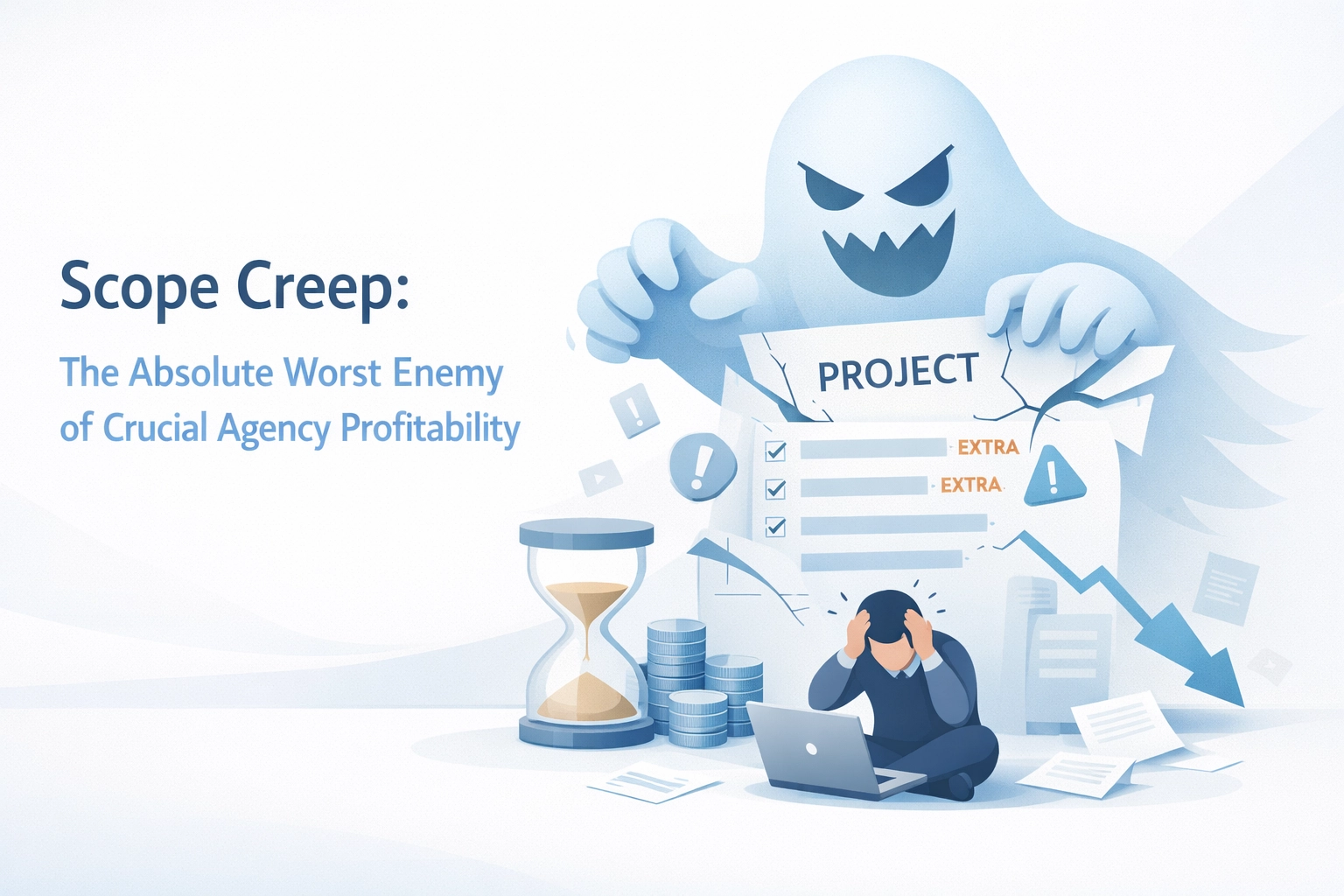
  • Scope creep: The Absolute Worst Enemy of Crucial Agency Profitability

    Scope creep: The Absolute Worst Enemy of Crucial Agency Profitability

    Scope creep is an epidemic that destroys professional boundaries, guts profit margins, and drives elite digital professionals toward burnout. In the world of app development and digital agency work, it rarely arrives with a bang. Instead, it is a slow, silent erosion of your time. It begins with a "quick favor" or a "minor tweak" and ends with a four-week project ballooning into a four-month nightmare. For boutique agencies and independent contractors, this isn't just a project management issue, it is a financial crisis.

    When you allow the boundaries of a project to blur, you are effectively paying the client to work for them. Every unbilled hour spent on an "extra" feature is an hour stolen from a paying project or your personal life. At GHW-Digital, we have seen brilliant developers and designers lose their passion because they were trapped in a cycle of endless, uncompensated revisions. The reality is simple: if you don’t define the edges of your work with absolute precision, the client will define them for you, usually to your detriment.

    The Financial Impact of Scope creep

    Unchecked project expansion is the primary reason why high-revenue agencies still struggle with cash flow. According to the Project Management Institute, over 50% of projects experience some form of expansion beyond the original plan. For an agency operating on fixed-price contracts, this is catastrophic. Your profitability is calculated based on a specific allocation of resources over a specific timeframe. When the client demands "just one more page" or a "slight change in the UI logic," and you agree without a formal adjustment, your hourly rate plummets.

    Imagine a project quoted at £10,000 based on 100 hours of work. That is a healthy £100 per hour. However, when scope creep adds another 50 hours of unbilled work, your effective rate drops to £66. You are still paying your team, your overhead, and your taxes on the original 100-hour estimate. The extra 50 hours represent pure loss. This "leaking revenue" is the absolute worst enemy of agency growth because it remains invisible on the surface while rotting the bottom line from within.

    A minimalist hourglass leaking sand symbolizing how scope creep causes silent profit loss for creative agencies.

    Why Your Current Templates Are Failing You

    Most freelancers and small agencies rely on boilerplate contracts downloaded from generic "legal-lite" websites. These documents are designed to be "fair" and "accessible," which is often code for "vague." A contract that lacks a specific exclusions list is an invitation for abuse. If your agreement only states what you will do, it leaves an infinite vacuum regarding what you won't do.

    Generic contracts often fail to address the nuances of digital work, such as browser compatibility, third-party API changes, or the subjective nature of "design feedback." Without a structured framework, you are forced to negotiate every minor change from a position of weakness. You feel like the "difficult" one for asking to be paid for extra work. This psychological pressure is a tactic used by predatory clients to extract free labor. You need a system that shifts the burden of professionalism back onto the client.

    Eliminating Scope creep with ScopeGuard Pro Elite

    The solution is not to "be more assertive" in meetings; the solution is to bake protection into the very foundation of the engagement. This is why we developed ScopeGuard Pro Elite. This tool is not a generic generator; it is a sophisticated drafting partner that builds a 17-article Master Service Agreement (MSA) specifically designed to stop project bloat before the first line of code is written.

    Our framework doesn't just list deliverables; it creates a defensive perimeter around your time. By utilizing a structured, field-tested legal scaffolding, you project an aura of elite professionalism that commands respect. Clients are less likely to push boundaries when they see a contract that explicitly details how those boundaries are protected.

    Strong white pillars forming a secure perimeter to prevent scope creep and protect agency professional boundaries.

    Precise Exclusions: Defining the "No"

    One of the most powerful features of the ScopeGuard Pro framework is the Strict Scope Prevention clause. Most professionals make the mistake of only defining the "In-Scope" items. ScopeGuard Pro forces you to define the "Exclusions." By explicitly stating that items like "SEO migration," "custom iconography," or "IE11 compatibility" are not included, you transform a potentially awkward conversation into a simple reference to the signed agreement.

    When a client asks for something outside the initial brief, you don't have to say "no." You say, "That’s a great idea; as per Article 1 of our agreement, that falls under the Exclusions list. I’ll send over a Change Order so we can get that added to the roadmap." This moves the conversation from a conflict of personality to a standard business procedure. It protects your profitability while maintaining the relationship.

    Change Order Protocols: Turning Requests Into Revenue

    A project that grows isn't necessarily a bad thing, provided that growth is funded. Scope creep only kills profitability when the work is free. ScopeGuard Pro Elite drafts specific language that mandates a formal Change Order process. This ensures that any deviation from the original Statement of Work requires a written description of the change, an adjustment to the timeline, and: most importantly: an additional fee.

    By establishing this protocol on Day 1, you train the client to value your time. They quickly realize that "quick favors" have a price tag. Often, you will find that the "urgent" features suddenly become unnecessary when the client is asked to pay for them. This is the ultimate filter for separating serious partners from those looking for a handout.

    Client Delay Liability: Protecting Your Schedule

    Revenue isn't just lost through extra work; it's lost through stalled work. When a client takes three weeks to provide feedback or delays sending essential assets, they are effectively holding your production capacity hostage. You cannot easily fill that gap with another project because you are "on call" for the current one.

    ScopeGuard Pro includes Client Delay Liability clauses. These shift the financial burden of stalling back onto the client. If the project is delayed due to client inaction, the draft allows for timeline extensions and, in some cases, "restart fees" or adjusted milestones. This ensures that your agency's schedule is respected as a professional asset, not a flexible suggestion.

    A blue shield protecting a project timeline from client delays and scope creep to maintain agency profitability.

    Late Payment Mechanisms: The Legal Shield

    Profitability is meaningless if the cash never hits your bank account. Many agencies face a form of "terminal scope creep" where a client holds the final payment hostage until a new, unbilled feature is added. They use your final invoice as leverage.

    ScopeGuard Pro Elite drafts include explicit references to the Late Payment of Commercial Debts (Interest) Act 1998. By invoking the law by name and including statutory compensation and legal cost recovery provisions, you signal to the client's internal legal or finance team that you are not a disposable freelancer. You are a professional entity protected by a structured framework. This significantly reduces the "wait time" for invoices and protects your cash flow from predatory withholding tactics.

    Secure Your Margins Today

    The difference between a struggling boutique agency and a thriving, elite firm often comes down to the quality of their boundaries. You cannot build a sustainable business on the shifting sands of client whims. You need a rock-solid foundation that allows you to do your best work without the constant fear of being exploited.

    As noted in recent business analysis by Harvard Business Review, clear contractual boundaries lead to higher client satisfaction because they eliminate the ambiguity that causes friction. When everyone knows exactly what is being delivered, when, and for how much, the focus stays on the quality of the work rather than the "negotiation" of the scope.

    Stop working for free. Stop letting "one more thing" eat your profit. Utilize the power of ScopeGuard Pro Elite to draft a contract that works as hard as you do. Protect your time, defend your margins, and reclaim your professional autonomy.


    Marbalism Legal Shield & Privacy Commitment
    At GHW-Digital, we believe in radical transparency. ScopeGuard Pro is a drafting support tool, not a law firm. The documents generated are structured drafts intended to provide a high-level professional starting point. We always recommend that you have a qualified solicitor or attorney review your final contract to ensure it complies with your specific local jurisdiction and business needs. Your data is handled with enterprise-grade security; we do not sell your project details to third parties. We provide the framework; you provide the expertise. Together, we protect the future of digital work.

    Lock in your profit. Start drafting with ScopeGuard Pro Elite today.

    Special Offer: Use discount code BLOG20 for 20% off ScopeGuard Pro. Valid until April 1st, 2026.

    Powered by GHW Digital (Company No: 16834250). This document is an automated draft for business organization purposes only. It does not constitute legal advice. GHW Digital accepts no liability for disputes, financial loss, or enforceability. Users must consult a qualified professional in their jurisdiction before signing.

  • Freelance contract: The Ultimate Protective Shield for Elite Digital Professionals

    Freelance contract: The Ultimate Protective Shield for Elite Digital Professionals

    Freelance contract drafting is the line in the sand between a struggling creative and a high-performance business owner. In the digital economy, your skills are your currency, but without a rigid framework to protect them, you are effectively working for free. For too long, software engineers, UI/UX designers, and copywriters have relied on "handshake deals" or flimsy, downloaded templates that offer the legal protection of a paper shield.

    ScopeGuard Pro Elite was built to end this era of client abuse. We understand the "just one more thing" culture that erodes profit margins and destroys mental health. You aren't just a service provider; you are an elite professional. It is time your legal documentation reflected that status. By utilizing a structured, 17-article Master Service Agreement framework, you move from being a disposable freelancer to a respected partner who commands authority from day one.

    Why Every Freelance contract Must Prevent Scope Creep

    Scope creep is an epidemic. It starts with a small request: a minor color change, an extra page, or a "quick" feature: and ends with a project that is 300% over budget and four months behind schedule. Without a professional Freelance contract, you have no mechanism to stop the bleed. You become a victim of your own desire to please the client.

    A robust agreement does more than just list what you will do; it explicitly defines what you will not do. ScopeGuard Pro Elite enables you to draft exhaustive exclusions lists. When the client asks for that "one more thing," you don't have to feel awkward or confrontational. You simply point to the contract. The request becomes a formal, billable Change Order. This shift in dynamic is crucial for maintaining a healthy business relationship and ensuring that your time: your most valuable asset: is respected and paid for in full.

    Professional freelance contract on a desk preventing scope creep and client chaos.
    Alt Text: A professional Freelance contract preventing scope creep in a digital agency setting.

    Establishing Authority with an Elite Freelance contract Framework

    Most freelancers are intimidated by large corporate legal teams. When you enter a negotiation without a high-tier document, you are at the mercy of their terms. You are often expected to start work without a deposit, accept payment terms of 60 days or more, and hand over all Intellectual Property (IP) rights before a single invoice is cleared.

    By presenting a comprehensive, professional Freelance contract via ScopeGuard Pro Elite, you project an aura of established professionalism. You are signaling that you have systems, boundaries, and legal backing. This isn't about being "difficult"; it is about being an elite professional who understands business risks. A structured agreement ensures you are not just another line item in a client's budget, but a strategic asset with clear protections.

    The 17-Article Freelance contract Advantage

    The core of the ScopeGuard Pro Elite system is our proprietary 17-article Master Service Agreement. Unlike generic boilerplate that tries to please everyone, this framework is built specifically for the pain points of digital work.

    1. Strict Scope Prevention
    Every draft includes a definitive list of deliverables and an equally important list of exclusions. This transforms "favors" into "revenue opportunities."

    2. Kill Fee & Non-Refundable Deposit
    Cash flow is the lifeblood of your business. Our framework mandates non-refundable deposits and "Kill Fees" to ensure that if a client walks away mid-project, you are still compensated for your time and the opportunity cost of the slot you held for them.

    3. Three-Tier Intellectual Property Structure
    Retain leverage until the final penny is paid. Our structure distinguishes between your pre-existing IP and the bespoke deliverables. Full rights transfer only upon final payment.

    4. Late Payment Interest
    Stop chasing invoices. Our drafts explicitly reference the Late Payment of Commercial Debts (Interest) Act 1998, allowing you to claim interest at 8% above the base rate. This turns your late invoices into a legal liability the client cannot ignore.

    5. Client Delay Liability
    If a client stalls by not providing feedback or assets, they shouldn't be allowed to ruin your schedule. This clause shifts the cost of delays back to the client, making timeline overruns billable.

    Protective freelance contract shield securing intellectual property and digital assets.
    Alt Text: Using a professional Freelance contract to protect intellectual property rights.

    Securing Your Cash Flow with a Freelance contract

    When you use a professional Freelance contract from ScopeGuard Pro, you are invoking the same protections used by major corporations. One of the most overlooked aspects of freelance work is the right to get paid on time. Many independent professionals are unaware that the law is actually on their side.

    Beyond just the 8% interest rate, a high-tier contract includes provisions for statutory compensation and the recovery of legal costs. This means that if you have to hire a solicitor to collect a debt, the client: not you: is responsible for those fees. This single clause often acts as a massive deterrent against late payments, as clients realize that ignoring your invoice will result in an exponentially higher bill. You can find more details on how the Law Society views written contracts to understand the weight these documents carry in a court of law.

    Protection Beyond the Project

    An elite professional looks at the long-term health of their business. ScopeGuard Pro Elite includes a 12-month Non-Solicitation clause. This prevents clients from headhunting your team members or contractors to bypass your fees. It ensures that the human capital you have spent time and money building remains your competitive advantage.

    Furthermore, our framework includes a robust Limitation of Liability. Without this, a small error in a line of code or a missed deadline could theoretically expose your personal assets to a massive lawsuit. By capping your liability to the fees paid, you protect your future and your family from disproportionate legal exposure.

    Elite professional reviewing a structured freelance contract to limit business liability.
    Alt Text: Digital professional reviewing a Freelance contract generated by ScopeGuard Pro Elite.

    How the ScopeGuard Pro Elite System Works

    We have removed the friction from legal drafting. You don't need to spend £2,000 on a solicitor just to get a starting draft. Our system is designed for speed and precision.

    1. The Briefing: You answer a series of specific questions about your project, deliverables, and payment milestones.
    2. The Drafting Engine: Our backend processes your data against the 17-article framework, ensuring no hallucinations and complete structural integrity.
    3. Verification: Enter your unique License Key to unlock your document instantly.
    4. The Unveiling: Receive a professionally formatted Markdown or PDF draft that you can review and send to your legal counsel for final sign-off.

    This process takes minutes, not weeks. It allows you to move at the speed of business while maintaining the security of an elite firm. You can see how this integrates with our other app development services to provide a full-spectrum solution for digital builders.

    The Investment in Your Professional Future

    Calculate the cost of your last "bad" project. Think about the hours spent on unpaid revisions, the stress of a ghosting client, and the anxiety of an empty bank account because an invoice was 30 days late. Those costs far outweigh the investment in a professional tool.

    Investing in a high-tier Freelance contract is an investment in your mental health and your business’s scalability. ScopeGuard Pro Elite provides the framework; you provide the talent. Together, they form an impenetrable shield against the chaos of the freelance world.

    Stop negotiating against yourself. Stop being the "cheap" option that clients think they can push around. Assert your value, define your boundaries, and secure your margins today.

    Elite business growth supported by a solid freelance contract foundation and framework.
    Alt Text: The elite path to business growth using a professional Freelance contract.

    Ready to take control of your professional destiny? Explore the ScopeGuard Pro Elite framework and start protecting your work today.

    Special Offer: Use discount code BLOG20 for 20% off ScopeGuard Pro. Valid until April 1st, 2026.


    Marbalism Legal Shield

    The documents generated by ScopeGuard Pro Elite are structured drafts intended to support your professional drafting process. They do not constitute legal advice. GHW-Digital and Marbalism recommend that all final contracts be reviewed by a qualified solicitor or attorney in your specific jurisdiction before being relied upon commercially. Enforceability of specific clauses (such as liability caps, interest rates, or kill fees) varies by region. Use this tool as your expert drafting partner, but always ensure your legal professional provides the final seal of approval.