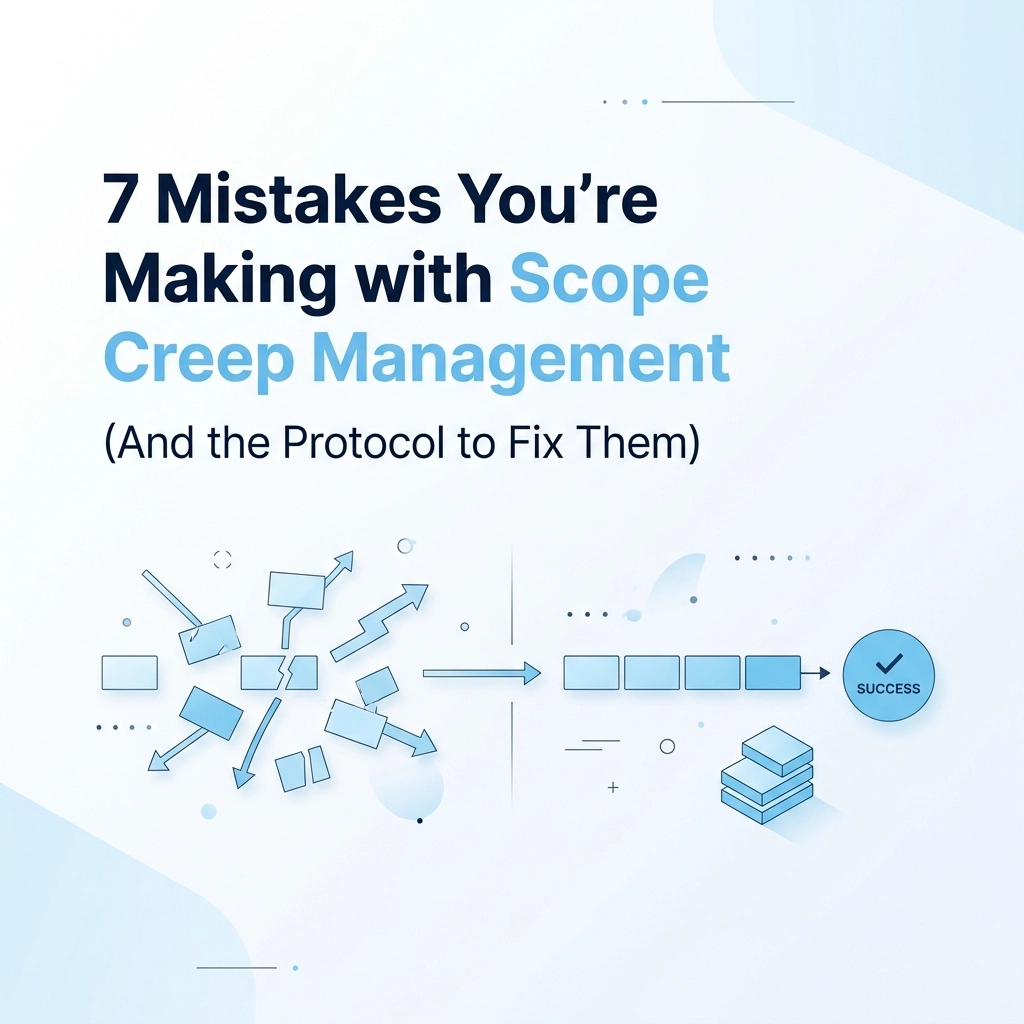
Scope creep management is the thin line between a profitable project and a slow-motion disaster. As a digital architect, your job isn’t just to build; it’s to defend the integrity of the structure you’ve designed. Every "small favor" or "quick tweak" requested by a client without a formal process is a crack in your foundation. If you aren’t actively guarding your boundaries, you aren't just losing time, you're leaking revenue and compromising the quality of your output.
At GHW-Digital, we see this constantly in the app development world. Freelancers and agencies start with a vision, but without a rigid protocol, they end up working for free. Protecting your time requires more than just a polite "no." It requires a systemic approach involving clear Independent Contractor Agreements and a mindset that treats project scope as a sacred blueprint.
1. Starting Without a Defined Scope Baseline
The most common mistake in Scope Creep Management is the absence of a clear starting point. You cannot manage what you haven't defined. If your initial project documentation is vague, the client will naturally assume that "everything is included."
A minimalist approach to this is creating a Work Breakdown Structure (WBS). Don't just list features; map the architecture of the entire experience. When you don't have a baseline, you have no leverage when the client asks for an extra dashboard or a third-party integration that wasn't in the original budget.
The Protocol: Baseline Lockdown
Before a single line of code is written, document the "In-Scope" and "Out-of-Scope" items. Use a Scope Guard Elite approach: if it’s not on the list, it doesn’t exist. For more inspiration on how to structure these early phases, check out our ideas page.

2. Weak Independent Contractor Agreements
Your contract is your primary shield. Many independent contractors rely on generic templates that focus on payment terms but neglect the mechanics of change. If your Independent Contractor Agreements don't explicitly outline how changes are handled, you are essentially giving the client a blank check on your time.
A professional agreement should define what constitutes a "change request" and how that request affects the timeline and the final invoice. Without these legal boundaries, you are at the mercy of the client’s shifting priorities.
The Protocol: The Legal Shield
Ensure every contract includes a specific clause on scope variance. Specify a percentage of allowed variance (usually 0%) before a formal Change Order is required. You can see how we handle these high-level protections at Vow Guard Elite.
3. The "Yes-Man" Syndrome in Scope Creep Management
We all want to please the client. However, saying "yes" to every request without evaluating the impact is a fatal flaw in Scope Creep Management. Every addition has a ripple effect. A "simple" UI change might require a database migration or an update to the API documentation.
When you agree to additions without a price tag or a timeline extension, you are devaluing your expertise. You are telling the client that your planning was either wrong or that your time isn't worth the extra cost.
The Protocol: Immediate Impact Analysis
Every time a client says, "Can we just add…?", your response must be: "Let me evaluate how that impacts our current architecture and timeline." Stop the immediate "yes." Pause, calculate, and present the cost. This is how you maintain a professional brand tone.
4. Failing to Involve Stakeholders Early
Scope creep often happens because the person who signed the contract isn't the same person giving the feedback during the build. If the "Digital Architect" isn't aligned with the actual users or the ultimate decision-makers, "ghost requirements" will appear halfway through development.
Insufficient stakeholder involvement is a silent killer. You might build exactly what was asked for, only to find out that the CMO wanted something entirely different.
The Protocol: The Alignment Sync
Establish a weekly or bi-weekly sync that focuses solely on scope alignment. Use these meetings to demo current progress against the original roadmap found on our ideas repository. Transparency is the best defense against late-stage pivots.

5. Operating Without a Formal Change Control Process
If a client sends a request via Slack, and you implement it, you’ve failed at Scope Creep Management. Informal requests are the breeding ground for project drift. A formal Change Control Process (CCP) acts as a filter, ensuring only necessary and funded changes make it into the build.
Without a process, you lose the ability to track why the project is over budget or past its deadline. You need a paper trail to protect your professional reputation.
The Protocol: The Change Order Gate
Implement a rule: No change is worked on until a Change Order is signed. This document should detail the new requirement, the cost of implementation, and the updated delivery date. This isn't being difficult; it's being a Scope Sentry.
6. Ignoring the "Small" Stuff
The most dangerous form of scope creep isn't the massive feature request; it's the accumulation of tiny tweaks. "Can we change the hex code?" "Can we move this button two pixels to the right?" "Can we add one more field to the contact form?"
Individually, they take five minutes. Collectively, they destroy your sprint velocity. Over time, these small tasks eat your profit margin and push back the launch date.
The Protocol: The Minor Tweak Threshold
Group small requests into "Optimization Sprints" or charge for them as a block of hours. Never treat them as freebies. According to industry standards from the Project Management Institute, unmanaged small changes are the top reason for project failure. Keep your focus on the app's core functionality instead of getting lost in the weeds.
7. Lack of Automated Tracking and Visuals
Managing scope with just a spreadsheet and your memory is a recipe for disaster. As a digital architect, you need to visualize the project's health. When you can't see the variance between your planned work and actual work, scope creep remains invisible until it’s too late to fix.
Manual tracking is prone to human error and emotional bias. You might feel like you're on track, but the data might show a 20% drift in resource allocation.
The Protocol: Data-Driven Defense
Use project management tools that offer visual scope modeling. Tools that generate burn-down charts or variance reports are essential for modern Scope Creep Management. If you're looking for new ways to automate your workflow, browse our latest architectural ideas.

The Digital Architect’s Creed
Managing a project isn't about being a "nice guy." It's about being a guardian of quality. When you allow scope creep to run wild, you aren't helping the client; you are delivering a bloated, delayed, and over-budget product. By implementing strict Independent Contractor Agreements and a no-nonsense protocol, you ensure that every project you touch is a monument to efficiency and precision.
Stop letting your margins leak away. Tighten your protocols, lock in your scope, and treat your time with the respect it deserves. For more strategies on how to streamline your development process and protect your business, stay tuned to our daily updates.
Marblism Legal Shield
This content is provided for informational and educational purposes by GHW-Digital. While we focus on building robust systems for app development and project management, we are not a law firm. The mentions of Independent Contractor Agreements and legal protocols should not be taken as legal advice. We strongly recommend that all freelancers and agencies have their specific contracts reviewed by a qualified legal professional to ensure they comply with local regulations and offer maximum protection. Your data and privacy are handled with the utmost respect; for more details, view our privacy policy.
Leave a Reply