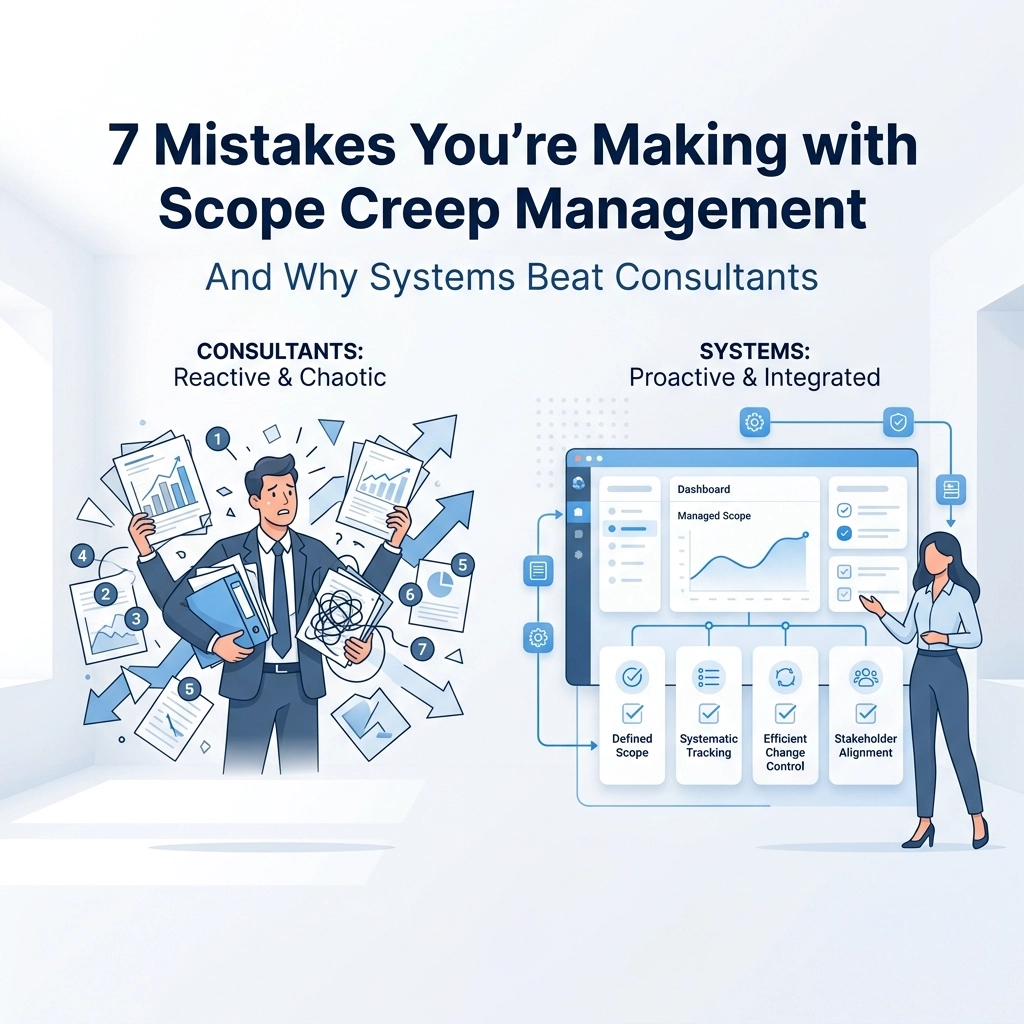
Scope Creep Management is the difference between a profitable agency and a failing one. In the world of app development, revenue doesn't leak; it pours out through unbilled "quick favors" and vague project boundaries. Most founders believe that hiring a high-priced consultant is the answer to stabilizing their project margins. They are wrong.
Consultants sell hours. Systems sell results. When you rely on a human to police your project boundaries, you are relying on an expensive, fallible, and often emotional middleman. To truly protect your bottom line, you must transition from manual oversight to automated enforcement through elite software tools and ironclad Professional Service Contracts.
1. Using Vague Professional Service Contracts
The first mistake in Scope Creep Management starts before a single line of code is written. If your contract uses words like "reasonable revisions" or "standard support," you have already lost. Vague language is an invitation for clients to push boundaries.
Elite software development requires precision. Your contracts must define exactly what is included and, more importantly, what is not. A system like Vow Guard Elite ensures that every deliverable is mapped to a specific contractual obligation. When the boundaries are binary, either it’s in the contract or it’s a paid add-on, the emotional friction of saying "no" disappears.
2. Emotional Boundary Setting vs. Systematic Logic
Many project managers treat scope changes as a negotiation. They worry about "hurting the relationship" or appearing inflexible. This is a fatal error. Scope Creep Management is not a personality contest; it is a mathematical necessity.
Humans are susceptible to social pressure. Software is not. By utilizing tools like Scope Sentry, you remove the human element from the initial "no." When a client requests a feature that sits outside the initial discovery, the system flags it automatically. It isn't personal; it's the logic of the system. This preserves the relationship by positioning the software, not the person, as the arbiter of the truth.

3. The "Quick Win" Fallacy
"It will only take five minutes." This is the most dangerous sentence in app development. Five minutes of coding leads to five hours of testing, deployment, and future maintenance.
Mistakenly allowing "quick wins" without documentation is how projects die by a thousand cuts. Every change, no matter how small, must be funneled through a centralized validation system. We recommend our clients use the GHW-Digital Ideas Portal to log every request. This creates a paper trail and forces the client to see the cumulative weight of their "small" requests. According to the Project Management Institute, undocumented changes are the leading cause of project failure globally.
4. Relying on Manual Tracking Lag
If you are waiting for a weekly status report to identify scope creep, you are already seven days behind. Manual tracking by consultants is inherently lagging. They have to review logs, talk to developers, and then compile a report. By the time you see the "creep," the budget is spent.
Elite Scope Creep Management requires real-time data. You need a dashboard that visualizes progress against the initial roadmap every hour. Systems like Scope Guard Elite provide this "Shield" by locking in the roadmap. If the development trajectory deviates by even 2%, the system alerts the stakeholders immediately.
5. Failing to Centralize Idea Validation
Clients are full of ideas. Some are great; most are distractions. A common mistake is allowing these ideas to be discussed in Slack, email, or over the phone without a central repository.
To maintain control, you must direct all client "brainstorms" to a structured environment. Link your clients to https://ghw-digital.com/ideas.html as the only valid place to submit new features. This forces the client to think through the "why" before they bother your dev team with the "what." It acts as a natural filter, separating high-value pivots from low-value noise.

6. Hiring Consultants Instead of Deploying Systems
Consultants are the "manual transmission" of business growth. They are expensive, require constant management, and eventually leave, taking their knowledge with them.
Systems are the "autopilot." A software-led approach to Scope Creep Management creates a repeatable, scalable defense mechanism. While a consultant might catch a scope leak because they had a "good feeling" that day, a system catches it because the data doesn't align with the Professional Service Contracts. Systems don't get tired, they don't take vacations, and they don't feel awkward talking about money.
Action-Benefit: Deploy Systems to Reclaim 20% of Lost Margins.
- Lock in Deliverables: Ensure every hour billed is an hour planned.
- Track Deviations: Identify "feature creep" before it becomes a "pivot."
- Automate Enforcement: Let the software handle the budget alerts.
7. Ignoring the Cumulative Data of Scope Creep Management
The final mistake is treating every project as a silo. If you don't analyze why scope creep happened on Project A, you will repeat the same mistake on Project B.
Consultants rarely provide the deep-dive analytics needed to change your organizational behavior. You need a system that aggregates data across all your apps and projects. By analyzing the patterns of "creep," you can refine your initial Professional Service Contracts to be even tighter for the next client. This is how you move from a reactive "firefighting" mode to a proactive "fortress" mode.
Why Systems Are Your Only Real Defense
In the high-stakes environment of modern app development, "trust" is not a management strategy. You cannot trust that a client won't ask for more, and you cannot trust that a consultant will always be there to stop them.
You can, however, trust the code.
By integrating elite tools into your workflow, you create a barrier that protects your developers from distraction and your bank account from depletion. Whether you are browsing our sitemap for new solutions or implementing a new privacy protocol, the focus must always remain on systemic integrity over human intuition.

Lock In Your Project Boundaries Today
Stop letting your profit bleed out through unmanaged changes. Consultants are a temporary bandage; systems are a permanent cure. It is time to treat your project boundaries with the same level of technical rigor as your source code.
Visit GHW-Digital Ideas to see how we help elite teams transform their project intake process. Secure your margins, protect your time, and let the systems do the heavy lifting.
Marblism Legal Shield
Notice: This content is protected under the Marblism Legal Shield. Any unauthorized reproduction, distribution, or digital scraping of this material is strictly prohibited. GHW-Digital and its partners maintain full intellectual property rights over the systems and methodologies described herein. For more information on our data protection and usage policies, please visit our Privacy Page. All rights reserved.
Current Date: Friday, 17 of April 2026
Author: Martin Hughes, Owner, GHW-Digital
Leave a Reply