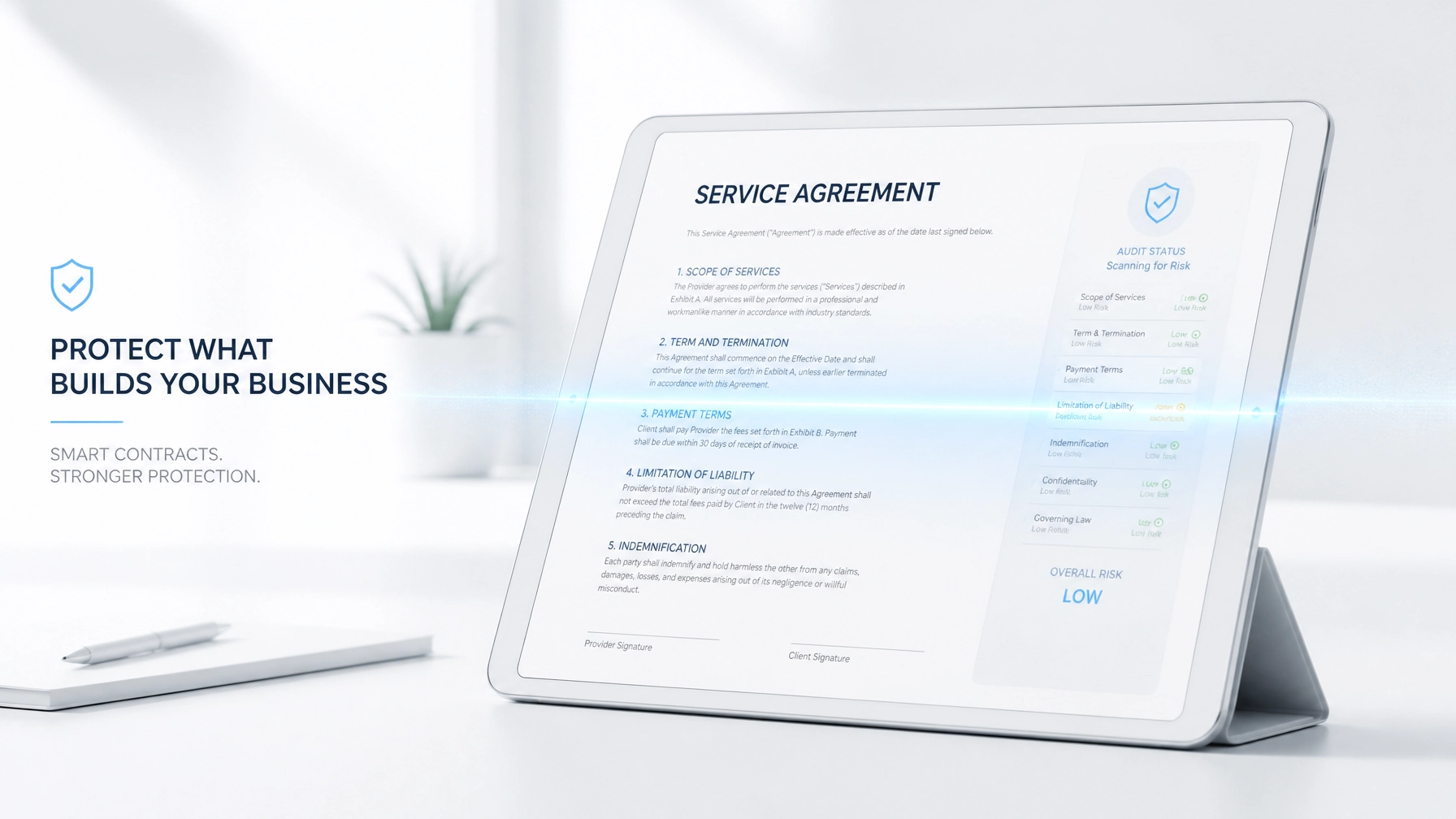
Professional Service Contracts are the foundation of your independent business, but if they are drafted poorly, they are also a high-stakes liability. In the current regulatory landscape, tax authorities and labor boards are no longer looking for simple paperwork errors; they are hunting for "disguised employment." An audit isn't just a nuisance; it’s a predatory strike on your profit margins and professional autonomy.
If you are operating as a freelancer or agency owner, you are likely an expert at your craft. However, being a great developer or designer doesn't make you a legal architect. Most professionals use "hand-me-down" templates that are riddled with red flags. These documents don't protect you; they provide a roadmap for auditors to reclassify your status, leading to back taxes, massive penalties, and the destruction of your leverage.
At GHW Digital, we build Autonomous Digital Assets that replace the need for $300-an-hour consultants. We believe in systemizing protection. Here are the 5 critical red flags in your Professional Service Contracts that could trigger a devastating misclassification audit.
1. The Behavioral Control Protocol: Methods Over Results
The first thing an auditor looks for in Professional Service Contracts is who has the "right to control." If your contract dictates how the work is done rather than defining the result, you have effectively signed an employment agreement.
The Red Flag: Clauses that mandate specific working hours (e.g., 9 AM to 5 PM), require attendance at internal non-project meetings, or force you to follow the client’s internal HR manuals.
The Protection Strategy: Lock in deliverables. Your contract must be a protocol for results. It should specify the "what" and the "when," but never the "how." A watertight asset focuses on milestones. If the client is supervising your daily process, you aren't a consultant; you're a temp. Ensure your ScopeGuard Elite protocol defines success by the output, not the hours spent in a chair.

2. Resource Provision: The Equipment Trap
A hallmark of a true independent professional is that they provide their own leverage. In the eyes of the law, a business owner brings their own tools to the job.
The Red Flag: A clause stating the client will provide a laptop, software licenses, or office space. While this seems "convenient," it is a massive signal of dependency.
The Protection Strategy: Maintain your infrastructure. Your Professional Service Contracts should explicitly state that the contractor is responsible for all equipment, insurance, and professional certifications. According to IRS guidelines on worker classification, the financial investment made by the worker is a primary factor in determining independence. If you are using their tools, you are part of their machine. Use your own stack to maintain your status as an elite asset.
3. Stifled Autonomy: Exclusivity and Non-Compete Overreach
Independent professionals thrive on the ability to leverage their skills across the entire freelance community. When a client tries to "own" your time, they are treating you like staff.
The Red Flag: Broad exclusivity clauses that prevent you from taking other clients or non-compete agreements that are so wide they effectively "lock you in" to one revenue stream.
The Protection Strategy: Protect your mobility. Ensure your contracts allow you to perform services for other entities simultaneously. A true professional service agreement is a non-exclusive protocol. You are a service provider, not an asset owned by the client. If a contract restricts your right to grow your business, it is a bad contract. You can find more strategies for maintaining business autonomy on our ideas page.

4. Payment Rhythms: The Salary Disguise
How you get paid is just as important as how much you get paid. Auditors look for "salary-like" behavior: predictable, recurring payments that aren't tied to specific project completion.
The Red Flag: Weekly or bi-weekly payments that mirror the client’s internal payroll cycle, especially if those payments are guaranteed regardless of whether a milestone was reached.
The Protection Strategy: Invoice by milestone. Professional Service Contracts should be built on a "Value-for-Value" exchange. This means billing based on deliverables, project phases, or specific outcomes. This creates a clear trail of business-to-business transactions. Avoid being "on the clock" unless it is strictly necessary for the scope. Real businesses invoice for work completed, not for time survived.
5. Core Business Integration: The 'Staff' Illusion
Are you a "Digital Architect" coming in to solve a specific problem, or are you just another cog in the daily operations? If your role is indistinguishable from that of an employee, you are at risk.
The Red Flag: Having a company email address, appearing on the internal org chart, or being managed by the same supervisor who manages regular staff.
The Protection Strategy: Define boundaries. Your Professional Service Contracts must establish you as an external entity. You are a consultant providing a specialized service, not an integrated member of the daily staff. As noted in the HMRC's IR35 guidance, being "part and parcel" of the organization is a major trigger for reclassification. Keep your communication channels professional and your integration minimal.
Leverage Elite Software Over Expensive Consultants
The days of paying a lawyer thousands of dollars to review a standard agreement are over. Those lawyers often provide generic advice that doesn't account for the speed of the modern freelance community. GHW Digital provides a different path.
We build Autonomous Digital Assets: tools that act as active consultants. They don't just give you a template; they interview you, detect these 5 red flags in real-time, and generate custom-engineered solutions. Our ScopeGuard Elite system is designed to stop scope creep and audit triggers before they start.
Stop leaving your business vulnerable to administrative chaos and legal exposure. You are an expert in your field; use an expert system to protect your profit.
Stop the leak. Secure your leverage.
Explore our Asset Library and protect your business today.
Powered by GHW Digital (Company No: 16834250). This document is an automated draft for business organization purposes only. It does not constitute legal advice. GHW Digital accepts no liability for disputes, financial loss, or enforceability. Users must consult a qualified professional in their jurisdiction before signing.
Leave a Reply