Professional Service Contracts fail in two predictable ways: moving goalposts and leaking revenue. Clients ask for “just one more thing.” Providers deliver “just a quick tweak.” Nobody tracks the drift. Then the relationship breaks under stress.
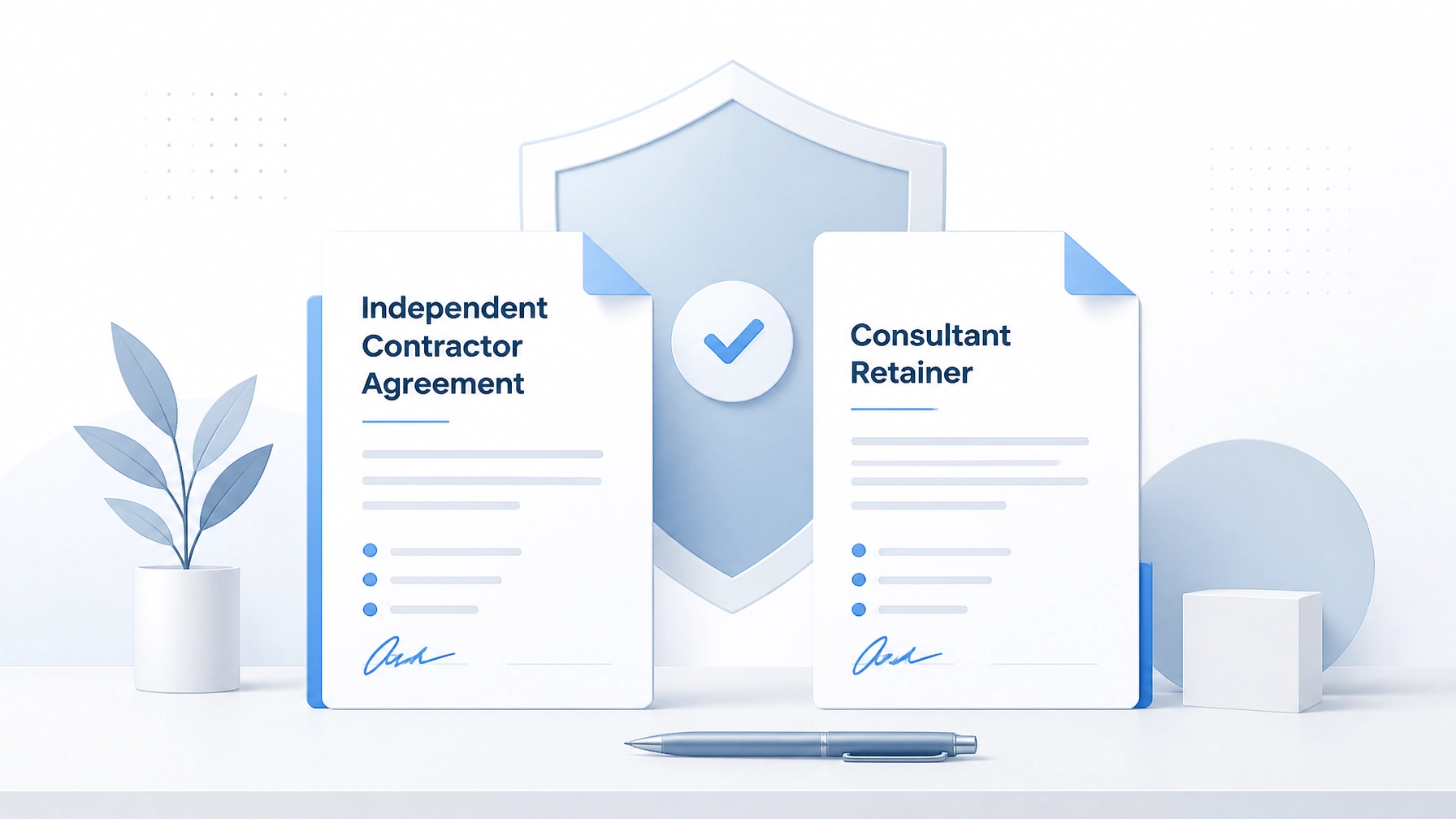
So let’s settle the core question: Independent Contractor Agreement vs Consultant Retainer : which is better for client protection?
The no-nonsense answer is this: neither wins alone. The strongest protection strategy is a base Independent Contractor Agreement with retainer terms packaged as a schedule: so you get clear legal boundaries and predictable access.
This article is built for modern independent professionals, agency owners, and consultants who want Professional Service Contracts that hold up under pressure: without paying an expensive consultant to “review your doc” and still missing the real risk.
Why “client protection” is the wrong phrase (but the right problem)
Protection is not a vibe. It’s a protocol.
In Professional Service Contracts, “protection” really means:
- Scope stays locked (no free extra deliverables).
- Payment stays reliable (no awkward chasing).
- IP and confidentiality are explicit (no grey zones).
- Termination is clean (no hostage situations).
- Liability is controlled (no catastrophic exposure).
Whether you call it an Independent Contractor Agreement or a Consultant Retainer, your protection depends on what the document forces both sides to do.
Independent Contractor Agreement: Define the relationship, stop classification chaos

Professional Service Contracts often start with the wrong foundation: a payment plan without a relationship framework. That’s how you get disputes about ownership, deliverables, and responsibility.
Professional Service Contracts: Use an Independent Contractor Agreement to lock the foundation
An Independent Contractor Agreement (ICA) is designed to define:
- who the provider is (not an employee),
- what they’re responsible for,
- what the client gets,
- and what happens when things go wrong.
Action–Benefit: Declare status → Reduce tax and employment misclassification risk
A standard protection strategy is to explicitly document independent contractor status and responsibility for taxes and benefits. This reduces the “you’re basically an employee” argument later.
Action–Benefit: Assign IP properly → Stop ownership disputes
A common protection strategy is to set IP ownership (assignment or licence) in writing: especially for creative, software, strategy, and content work.
Action–Benefit: Build confidentiality in → Keep sensitive info contained
Professional Service Contracts should always make confidentiality a default, not a handshake promise.
Action–Benefit: Cap liability → Prevent one project from becoming a financial event
Limitations of liability and clear exclusions (like consequential loss) are how serious operators avoid open-ended exposure.
Where the ICA can fail: it can still be vague on availability and ongoing support. If the client expects “on-call” access, the ICA alone can leave you exposed to constant interruptions and undefined turnaround pressure.
Consultant Retainer: Reserve capacity, but don’t let it blur the boundary

A Consultant Retainer is less about “relationship status” and more about commercial structure: recurring fees that reserve access to your time.
Professional Service Contracts: Use a retainer to control access and cashflow
Retainers come in two common models:
- Pay-for-work retainer: client prepays and the fee is applied against hours/tasks performed.
- Pay-for-access retainer: client pays to reserve your availability whether they use it all or not.
Action–Benefit: Reserve time → Stop last-minute chaos
A retainer can justify priority response times and planned capacity. That’s a real operational advantage.
Action–Benefit: Stabilise revenue → Reduce feast/famine cycles
A retainer smooths income, which improves delivery quality and reduces pressure to accept misaligned work.
Where the retainer can fail: it can become a blank cheque if you don’t define:
- what “support” includes,
- response times,
- monthly reporting,
- rollover rules,
- and what happens on termination.
Retainers are often sold as “simple.” In reality, they’re high-risk if your Professional Service Contracts don’t specify the mechanics.
Independent Contractor Agreement vs Consultant Retainer: which is better?
Here’s the clean comparison, focused on protection: not theory.
Professional Service Contracts: Choose the ICA when the work is deliverable-based
Use an Independent Contractor Agreement-first model when:
- the scope is clear,
- success is measurable,
- you can define acceptance criteria,
- you want payments tied to milestones.
This structure is naturally resistant to scope creep if your change process is strict.
Professional Service Contracts: Choose a retainer when access is the product
Use a retainer-first model when:
- work volume is unpredictable,
- the client needs ongoing expertise,
- interruptions are expected,
- continuity matters more than a fixed deliverable list.
But the retainer needs a boundary system or you’ll be working “always on.”
The elite structure: “Contract Stack” beats “one contract”

High-performing operators don’t rely on a single doc. They use a stack.
Professional Service Contracts: Stack documents → Increase clarity without bloating
Base agreement (ICA) + Statement of Work + Retainer Schedule + Change Order Protocol
Action–Benefit: Separate the legal core → Keep terms stable across projects
Your base Independent Contractor Agreement holds the critical protections (IP, confidentiality, liability, dispute handling).
Action–Benefit: Keep scope modular → Update deliverables without rewriting the world
Your Statement of Work defines deliverables, timelines, and acceptance criteria.
Action–Benefit: Put recurring terms where they belong → Stop retainer confusion
Your Retainer Schedule defines hours, response times, reporting, rollover, and overage rates.
Action–Benefit: Formalise change → Turn “quick tweaks” into paid work
Your Change Order Protocol defines how scope changes, how pricing is recalculated, and when work pauses pending approval.
This is how Professional Service Contracts stay enforceable and usable.
Clause-level protection: what to include so your contract actually defends you
If you want client protection (and provider protection), your Professional Service Contracts should include these non-negotiables.
Professional Service Contracts: Define scope → Stop the moving goalposts
- In-scope deliverables list
- Out-of-scope examples
- Acceptance criteria (what “done” means)
- Revision limits (or revision rules)
Professional Service Contracts: Control payments → Stop revenue leakage
- Payment schedule (milestones or monthly)
- Late fee/interest language (where appropriate)
- Payment-before-delivery gates (common protection strategy)
- Clear “pause work” right when invoices go overdue
Professional Service Contracts: Build retainer mechanics → Stop unlimited access
If you use a retainer, specify:
- what is included (e.g., advisory calls, reviews, minor edits)
- response times and channels
- hours cap and tracking method
- rollover (expires, carries, or converts to credit)
- overage rates and pre-approval requirements
- termination notice + what happens to unused prepaid fees
Professional Service Contracts: Lock IP and confidentiality → Stop asset disputes
- Work product ownership: assignment or licence
- Pre-existing IP carve-out (templates, libraries, frameworks)
- Confidentiality obligations + permitted disclosures
- Subcontractor confidentiality flow-downs (if you use subcontractors)
Professional Service Contracts: Limit liability → Stop one project destroying your year
Common protection strategies include:
- liability caps (e.g., fees paid over a period)
- exclusion of indirect/consequential damages
- warranty disclaimers aligned to the service type
- clear “no guarantee of outcomes” language for advisory work
For general reference on retainer mechanics and common pitfalls, see resources like Teamwork’s overview of retainer agreements: https://www.teamwork.com/blog/retainer-agreement/ and HoneyBook’s breakdown of consulting retainers: https://www.honeybook.com/blog/consulting-retainer
The real shift: elite software tools replace expensive consultants

Most people don’t need “a consultant.” They need a system.
Expensive reviews often fail because they’re not operational. A human can mark up a doc, but they rarely:
- interview you for risk signals,
- map your delivery workflow,
- detect scope creep triggers,
- and generate a coherent contract stack that matches how you actually work.
That’s where Autonomous Digital Assets come in.
At GHW Digital, we build intelligent self-help tools that behave like active contract architects. They don’t just hand you a template. They guide you through a structured intake, detect risk, and output a custom draft aligned with your workflow.
If you want to see what we’re building: and vote on what comes next: go to our Ideas Board (we monitor it daily):
https://ghw-digital.com/ideas.html
You can also explore our apps hub here:
https://ghw-digital.com/apps.html
And if you’re tightening your boundaries around scope and deliverables, start with our freelancer-focused contract engine:
https://ghw-digital.com/scope-guard-elite.html
Decision protocol: pick the right structure in one pass
Use this simple filter:
If the client is buying a result
Choose an Independent Contractor Agreement + SOW (retainer optional).
If the client is buying access to you
Choose an Independent Contractor Agreement + Retainer Schedule (with strict reporting and boundaries).
If you’re not sure
Assume the safest default: ICA as the base, then add a Retainer Schedule only when the client truly needs reserved capacity.
That’s how you keep Professional Service Contracts clean, enforceable, and aligned with reality.
Stop letting “informal” agreements drain your margins
Scope creep is not a personality problem. It’s a contract architecture problem.
If your work is professional, your protection has to be professional too. Use Professional Service Contracts that lock scope, control access, and enforce payment: without needing an expensive consultant to translate common sense into legal structure.
Go to the GHW Digital Ideas Board and vote for the next Autonomous Digital Asset you want protecting your business:
https://ghw-digital.com/ideas.html
Data & privacy (blunt and simple)
GHW Digital tools process inputs in real-time to generate outputs. We don’t permanently store user contract details as a business model. We build self-help software; not advisory services. Privacy policy: https://ghw-digital.com/privacy.html
Powered by GHW Digital (Company No: 16834250). This document is an automated draft for business organization purposes only. It does not constitute legal advice. GHW Digital accepts no liability for disputes, financial loss, or enforceability. Users must consult a qualified professional in their jurisdiction before signing.
Leave a Reply