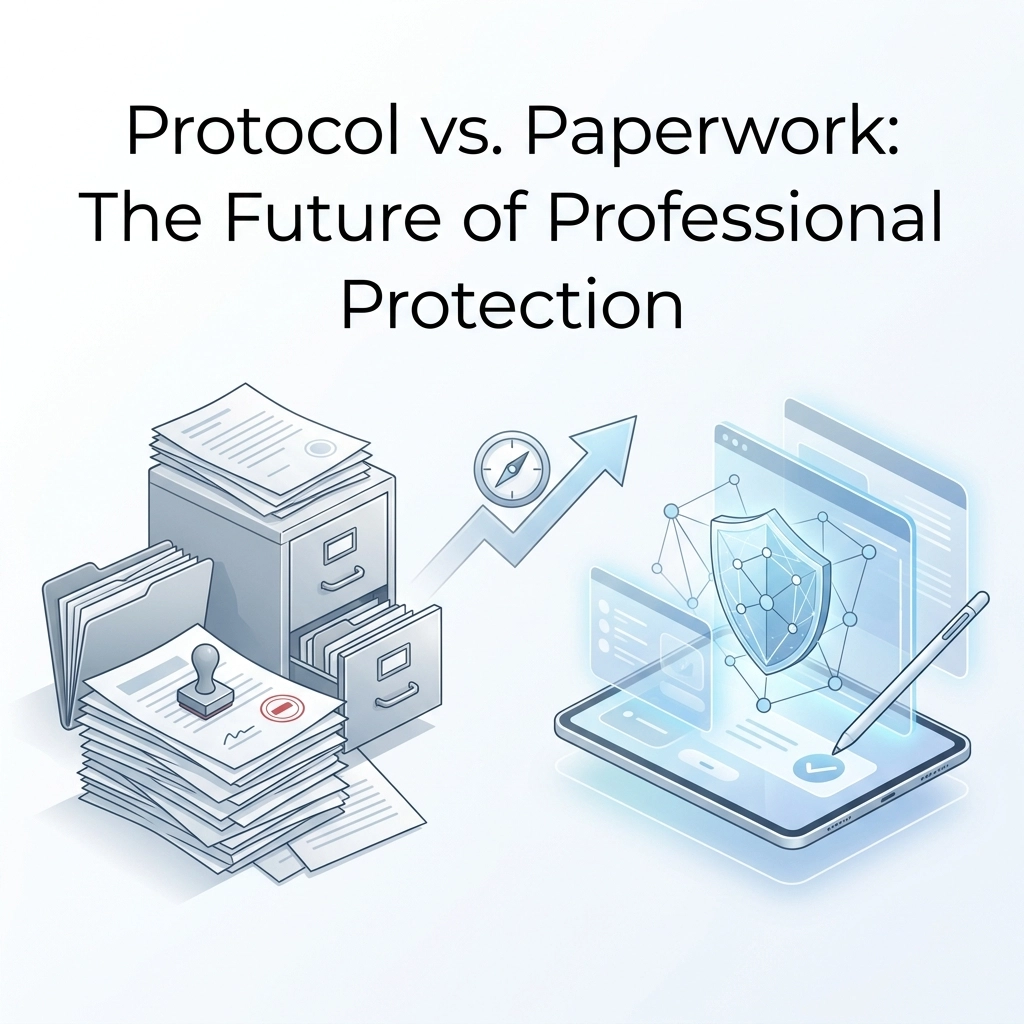
SEO Title: Protocol vs. Paperwork: The Ultimate Shield for Elite Professional Protection
SEO Meta Description: Protocol vs. Paperwork represents the critical shift from static documents to autonomous digital protection. Learn how GHW-Digital secures your assets and eliminates scope creep.
URL Slug: protocol-vs-paperwork-professional-protection
Protocol vs. Paperwork is the line in the sand between those who thrive in the digital economy and those who are buried by it. In the world of high-stakes app development and digital architecture, a signed piece of paper is a relic. It is a passive observer of its own violation. When a project begins to bleed resources or a client pushes for "just one more feature," a contract doesn't stop the clock. It doesn't lock the code. It doesn't protect your margin.
Paperwork is a post-mortem tool. Protocol is a living shield. At GHW-Digital, we have moved past the era of the filing cabinet and into the era of the autonomous digital asset. We don't just write agreements; we build systems that enforce them.
The Death of the Filing Cabinet
The traditional approach to professional protection is reactive. You spend weeks negotiating a contract, both parties sign, and then the document is filed away, never to be seen again until a dispute arises. By the time you are pulling that PDF out of a folder to prove a point, you have already lost. The relationship is strained, the budget is blown, and the "protection" you thought you had is merely a ticket to an expensive legal battle.
Paperwork is static. It is a snapshot of an intention taken at a single point in time. In the fast-moving world of app development, an intention from three months ago is useless. You need a mechanism that evolves with the project. You need a protocol.

Protocol vs. Paperwork: Defining the Shift
To understand the future, we have to define what we mean by a protocol. In computing, a protocol is a set of rules governing the exchange or transmission of data between devices. It is self-executing. If the data doesn't meet the protocol standards, the transmission fails. There is no argument, no "well, I thought you meant this," and no scope creep.
When we apply this to professional protection, Protocol vs. Paperwork becomes a choice between automated enforcement and manual pleading.
- Paperwork: Requires a human to notice a breach, a human to point it out, and a human to enforce a penalty.
- Protocol: Detects the breach in real-time and prevents it from happening or triggers an immediate, pre-agreed response.
This shift moves the burden of protection from your legal team to your infrastructure. It transforms your professional boundaries from a set of suggestions into a hard-coded reality.
Autonomous Digital Assets: The Logic Gate of Business
The core of this new protection is the autonomous digital asset. Imagine a project scope that isn't just a list in a document, but a logic gate in a project management system. This is what we call Scope Sentry.
When a digital asset is autonomous, it carries its own rules of engagement. It knows who can touch it, how it can be modified, and what the cost of that modification is. If a client attempts to move a goalpost, the protocol calculates the impact immediately. The system doesn't wait for a month-end invoice to surprise the client; it updates the "Vow" in real-time.

Protect Time: The Architect’s Only Currency
As digital architects, our only real currency is time. Paperwork leaks time. It leaks it through administrative overhead, through "clarification" meetings, and through the friction of enforcement. A protocol-driven approach plugs these leaks.
Lock In Your Boundaries: Use tools that act as a Scope Guard Elite. When your boundaries are hard-coded, you don't have to be the "bad guy." The system is the arbiter. This maintains the professional relationship by removing the emotional weight of saying "no." The "no" was agreed upon the moment the protocol was initiated.
Calculate Value in Real-Time: In the old model, you’d work an extra 10 hours and try to bill for it later. In the new model, the protocol identifies the extra work and adjusts the project parameters before a single line of code is written. According to research on project management overhead, administrative friction accounts for up to 20% of project loss. Protocols eliminate that friction.
The Shield Mentality: Us vs. The Problem
We view our software not as a productivity tool, but as a defensive mechanism. Every feature we build at GHW-Digital is designed to be a shield for your profit and a guardian for your focus.
The industry problem is clear: scope creep kills margins. The solution isn't better paperwork; it's better protocols. We believe in a minimalist approach to professional protection. You don't need a 50-page contract. You need five solid protocols that are impossible to bypass.

Action-Benefit: How Protocols Transform Work
- Automated Alignment: Pair specific functions with tangible results. Instead of "checking in" on a project, use a protocol that provides a live dashboard of "Contract vs. Reality."
- Triggered Alerts: When a project reaches 80% of its allocated resources, the protocol should trigger a mandatory review, not just an email notification.
- Smart Vows: Use Vow Guard Elite to ensure that every promise made is a promise tracked. This isn't about micromanagement; it's about alignment.
Why Paperwork Fails the Modern Professional
Paperwork relies on memory and good faith. In a high-pressure environment, memory fails and good faith is tested by budget constraints. Protocol vs. Paperwork is the difference between a fence and a sign that says "Please don't walk on the grass."
One is an obstacle; the other is a request. In business, requests are ignored. Obstacles are respected. By turning your professional agreements into protocols, you are building a fence around your business that protects both you and your client from the chaos of ambiguity.

The Digital Architect's Perspective
From where I sit at GHW-Digital, the future is clear. We are moving toward a "Code as Law" environment in professional services. This doesn't mean we don't trust our clients; it means we respect the project enough to give it a rigid structure.
An autonomous digital asset is a secure asset. It is an asset that cannot be devalued by mission creep or administrative negligence. This is the ultimate form of professional protection. It is precise, it is tireless, and it is absolute.
Securing the Competitive Advantage
In the next few years, the market will split. On one side, you will have firms still chasing signatures and arguing over "what was meant" in clause 4.2. On the other side, you will have elite professionals whose work is governed by autonomous protocols. These professionals will have higher margins, lower stress, and better client relationships because expectations are managed by code, not by conversations.
Stop relying on the "gentleman's agreement." Stop hoping that the paperwork will hold up when the pressure is on. It won't.
Secure Your Future Now
The transition from paperwork to protocol is not a luxury; it is a necessity for survival in a digital-first economy. You need to lock in your margins and protect your time with the same intensity that you bring to your craft.
Stop the leakage. Secure your boundaries. Embrace the protocol.
Explore how we are building the future of professional protection at GHW-Digital.
Powered by GHW Digital (Company No: 16834250). This document is an automated draft for business organization purposes only. It does not constitute legal advice. GHW Digital accepts no liability for disputes, financial loss, or enforceability. Users must consult a qualified professional in their jurisdiction before signing.
Leave a Reply