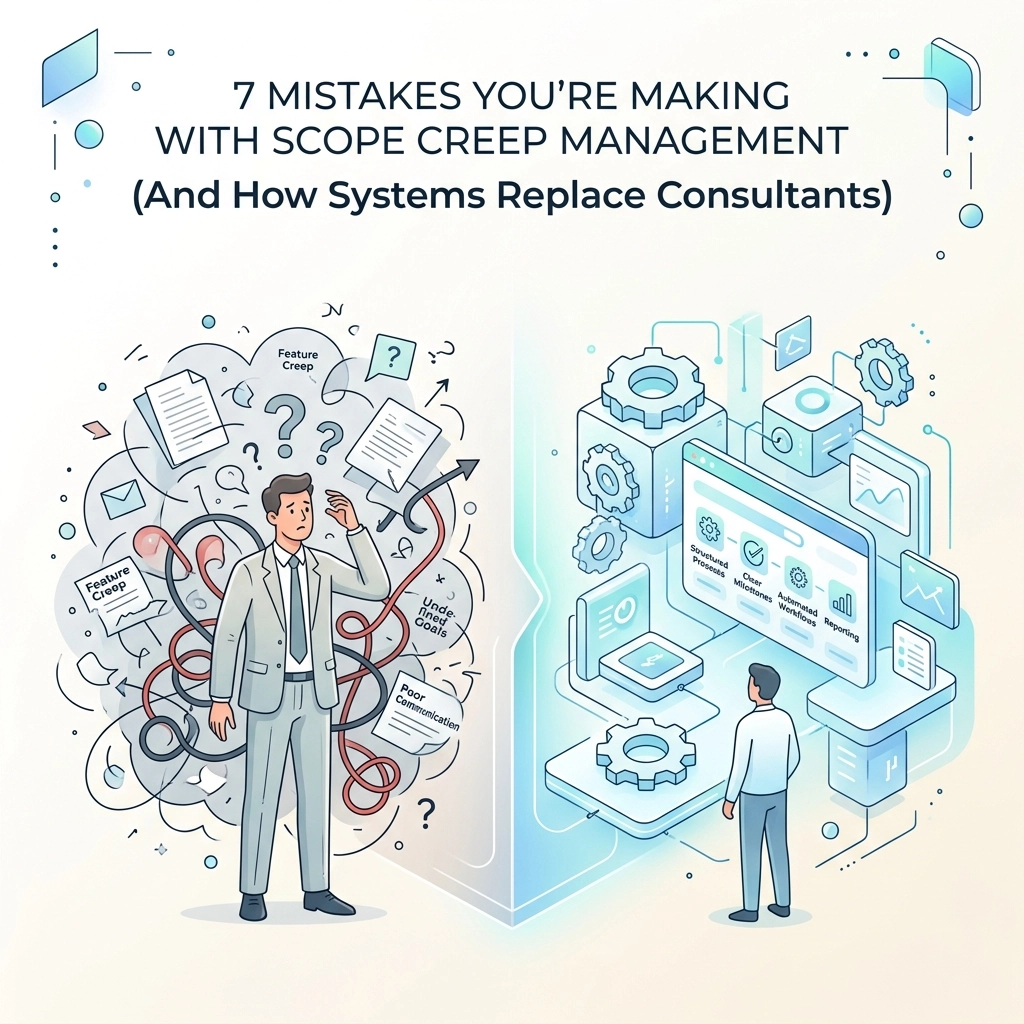
Scope Creep Management is the difference between a profitable agency and a sinking ship. If you’re running a professional services firm or an app development shop like we do at GHW-Digital, you’ve felt the burn. You start with a clear plan, and three months later, you’re building features that weren’t in the contract, your developers are burned out, and your profit margin has evaporated.
Most owners think the solution is to hire an expensive consultant to "fix the process." They’ll charge you $300 an hour to tell you what you already know: you aren't holding the line. But here’s the truth, you don't need a consultant. You need a system. Elite software tools are now replacing the need for high-priced oversight by baking the rules directly into your workflow.
If you want to see how we brainstorm these solutions, check out our latest concepts and ideas.
1. Relying on Weak Professional Service Contracts
The first mistake happens before the project even kicks off. If your Professional Service Contracts are vague, you’ve already lost. A "handshake agreement" or a loosely defined scope is an invitation for the client to ask for "just one more thing."
Elite systems like Vow Guard Elite replace the need for a legal consultant to review every change. By using standardized, airtight contract modules that link directly to your project management tool, you create a digital "Legal Shield." When the scope shifts, the contract should shift automatically. If it’s not in the code of the contract, it’s not in the project.
2. The "Quick Favor" Culture
We’ve all been there. A client sends a Slack message asking for a minor UI tweak. You think, "It’ll take ten minutes," and you tell the dev to just do it. That ten-minute task ripples through the QA process, affects the documentation, and suddenly, you’ve lost half a day.
This is a failure of Scope Creep Management. You aren't being "nice"; you're being unprofessional. You are teaching the client that your boundaries are negotiable. Instead of a project manager having an awkward conversation, a system like Scope Sentry acts as the neutral arbiter. It flags these "quick favors" as out-of-scope immediately, forcing a formal change request before a single line of code is written.

3. Letting Consultants Manage the "Human Element"
Consultants love to talk about "stakeholder alignment" and "emotional intelligence." While those are great buzzwords, they don't stop the leak. A consultant might hold a weekly meeting to discuss scope, but by then, the damage is done.
Systems replace consultants by providing real-time data. You don't need a human to tell you that a project is over hours; you need a dashboard that locks the task list when the budget is hit. At GHW-Digital, we believe in software-led defense. When the system says no, it isn't personal, it's math. This keeps the relationship with the client healthy because the "bad guy" is the protocol, not the person.
4. Manual Change Request Tracking
If you are tracking changes in an Excel sheet or a Word doc, you are failing at Scope Creep Management. Manual tracking is prone to human error, forgetfulness, and "lost" emails.
When you use an elite tool like Scope Guard Elite, every change is logged, timestamped, and tied to a price increase. This creates a transparent audit trail. When the client sees the cost of their "minor" changes piling up in a live dashboard, they naturally start to self-regulate. They stop asking for fluff because they can see the impact on their bottom line in real-time.
5. Separating Sales from Delivery
This is a classic. The sales team promises the world to close the deal, and the delivery team is left holding the bag. Without a unified system, the "Scope of Work" is just a document that sits in a folder while the developers work from a different set of assumptions.
By integrating your sales pipeline with your delivery systems, something we discuss frequently on our ideas page, you ensure that what is sold is exactly what is built. There is no "interpretation" of the contract. The system imports the contract requirements directly into the task backlog. If it wasn't in the sales proposal, it doesn't exist in the dev environment.

6. Underestimating the Cost of Context Switching
Scope creep isn't just about the extra hours; it's about the "mental tax." Every time a developer has to stop working on a core feature to address a scope-creep request, they lose focus. Research from the Project Management Institute suggests that context switching can kill productivity by up to 40%.
Consultants often miss this because they aren't in the code. They see a "small change" and think it's fine. A system-driven approach understands dependencies. If a change affects five other modules, the system flags the risk. This level of technical oversight is something a generalist consultant simply cannot provide.
7. Failing to Monetize Added Value
The biggest mistake in Scope Creep Management isn't just letting the scope grow, it's doing it for free. Most agencies are afraid that if they charge for every change, the client will leave.
The opposite is true. Clients respect professionals who value their time. If you provide a "bonus" feature, the system should still track it as a line item with a 100% discount. This shows the client the value they are receiving. However, for 90% of requests, the system should facilitate an "Upsell" rather than a "Favor." This turns a margin-killer into a revenue-generator. Explore more on how to build these revenue-focused apps at our app development section.

Why Systems Beat Consultants Every Time
Consultants are expensive, inconsistent, and temporary. Once they leave, your team usually slides back into old habits. A system is permanent. It is a 24/7 guardian of your profitability.
- Consistency: A system doesn't have "off days." It applies the same rules to every project, every time.
- Scalability: You can't hire a consultant for every $10k project. You can, however, run every project through a standardized software gate.
- Cost: A subscription to an elite tool costs a fraction of a consultant’s monthly retainer.
- Data: Systems collect data over time, allowing you to see patterns in which clients or project types are prone to creep.
If you’re serious about protecting your margins, stop looking for a "process guru" and start looking for a "process engine." You can see the types of engines we’re building right now over at GHW-Digital Ideas.
Action-Benefit: Lock Down Your Next Project
Don't wait for the next project to go off the rails. Implement these three steps immediately:
- Hard-Code Your Boundaries: Use Vow Guard Elite to ensure your contracts are technically and legally sound from day one.
- Automate Change Approval: Remove the human awkwardness. Let the system handle the "No."
- Audit Your Last Project: Go to our ideas page, find a framework that fits, and compare your last project's "estimated vs. actual" hours. The gap is your scope creep.
Scope Creep Management isn't about being mean to clients; it's about being fair to your business. If you don't value your time, why should they? Protect your team, secure your profit, and let the systems do the heavy lifting.
Marblism Legal Shield
GHW-Digital and its associated tools (Scope Guard Elite, Vow Guard Elite, Scope Sentry) provide technological frameworks for project oversight. We are not a law firm. Our "Legal Shield" refers to the systemic protection provided by clear documentation and automated workflows. Please consult with a qualified legal professional for specific contract language in your jurisdiction. Your data privacy is our priority; all system-tracked metrics are encrypted and handled in accordance with our privacy policy.
Leave a Reply