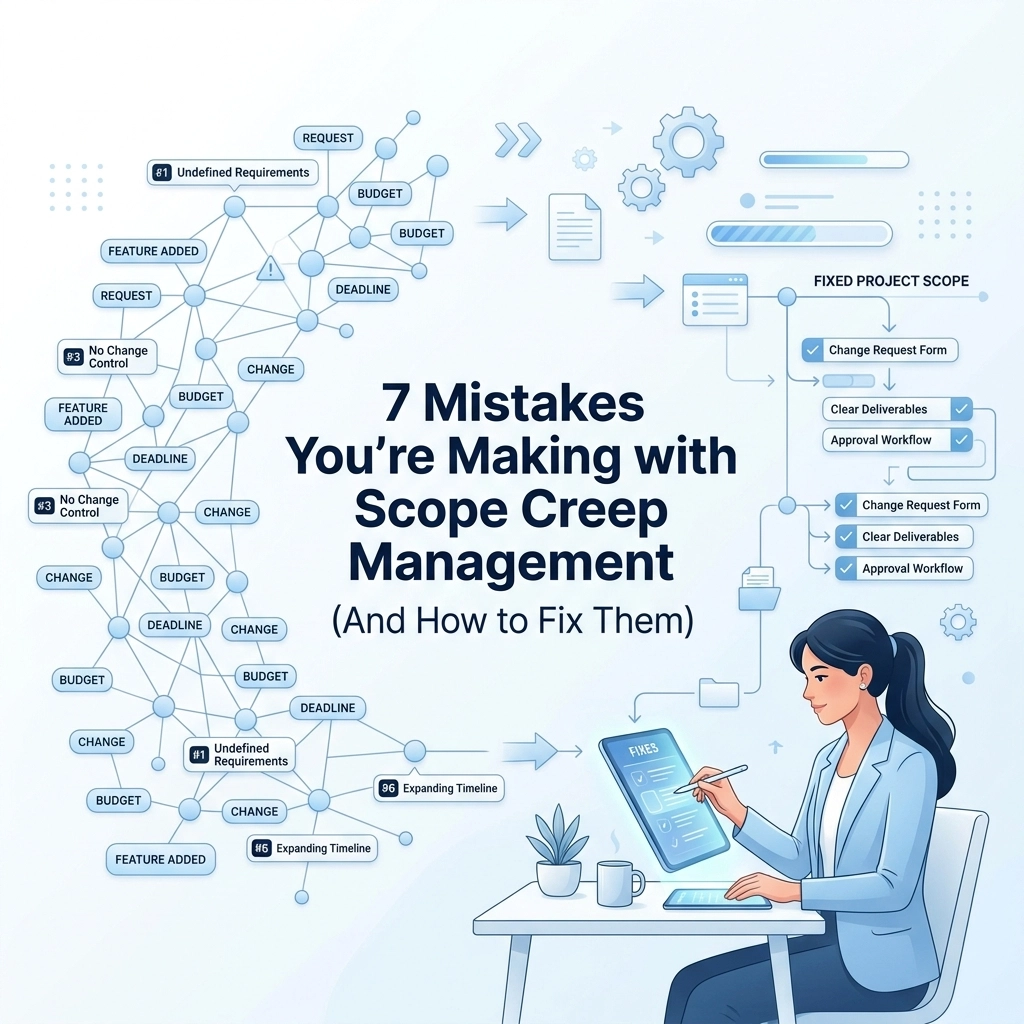
Scope Creep Management is the thin line between a profitable project and a professional nightmare. In the world of app development, a project that starts as a sleek MVP can quickly bloat into a monolithic beast that consumes your time, your sanity, and your revenue. If you are an independent contractor or a digital architect, failing to control the project boundaries is a death sentence for your margins.
You aren't just building software; you are building a business. Every "small favor" or "quick addition" is a breach in your defense. To stay profitable, you must treat your project scope like a fortress. This starts with your Independent Contractor Agreements and ends with your daily management habits.
Here are the seven most common mistakes professionals make with Scope Creep Management and the high-impact fixes to stop the bleed.
1. Undefined Requirements are Technical Debt
Poor requirement gathering is the primary entry point for scope creep. When you jump into development without a crystal-clear understanding of the stakeholder’s needs, you are essentially signing a blank check. Most freelancers rush the discovery phase because they want to start coding, but this impatience creates a vacuum that the client will eventually fill with "new ideas."
The fix is simple but requires discipline. Before a single line of code is written, you need a comprehensive Statement of Work (SOW). This document should be as detailed as a blueprint. If a feature isn't explicitly listed, it doesn't exist. We often explore these structural foundations in our architectural deep dives at https://ghw-digital.com/ideas.html.
Action-Benefit: Lockdown Discovery to Eliminate Ambiguity.
By forcing stakeholders to finalize requirements early, you eliminate the "I thought it would do this" conversations that happen three months into the build.

2. Vague Scope Statements in Independent Contractor Agreements
Your Independent Contractor Agreements are your strongest legal shield, yet many professionals use vague language that invites interpretation. Using phrases like "and other related tasks" or "general maintenance" is an invitation for scope creep to settle in and stay.
To fix this, your scope statement must be exclusionary. Define what you will do, but also explicitly list what you will not do. If you’re building an iOS app, state that Android development is out of scope. If you are handling the backend, state that UI/UX design is a separate engagement. This level of precision protects your time. For more on how to structure these boundaries, check out our resources at https://ghw-digital.com/ideas.html.
Action-Benefit: Hardcode Boundaries to Protect Your Time.
Precision in your contract acts as a deterrent. When a client knows exactly where the fence is, they are less likely to try and move it.
3. Operating Without a Formal Change Control Process
One of the biggest mistakes in Scope Creep Management is saying "yes" in a Slack message. When a client asks for a small change and you agree instantly, you’ve just bypassed your own governance. Without a formal process to evaluate, price, and schedule changes, your project trajectory will inevitably drift.
The fix is a strict Change Request Protocol. Every modification, no matter how small, must be documented. Evaluate the impact on the budget and the timeline. Use tools like Scope Guard Elite to track these shifts. If the change is accepted, it must be signed off by both parties as an amendment to the original agreement.
Action-Benefit: Standardize Changes to Maintain Profitability.
A formal process forces the client to weigh the value of their request against the cost, often filtering out unnecessary bloat before it hits your backlog.
4. The Communication Vacuum
Scope creep thrives in silence. When you don't communicate regularly with your stakeholders, they begin to imagine progress or features that haven't been discussed. Poor communication leads to misaligned expectations, and misaligned expectations lead to "corrective" requests that are actually scope expansions in disguise.
Implement a cadence of high-transparency updates. Whether it’s a daily standup or a weekly demo, keep the client tethered to the reality of the build. Use these touchpoints to remind them of the current scope. We discuss the art of transparent communication frequently at https://ghw-digital.com/ideas.html.
Action-Benefit: Radical Transparency to Align Expectations.
Consistent updates prevent the "surprise" features that clients often try to inject late in the game. It keeps everyone looking at the same map.

5. The Infinite Timeline Trap
Allowing project timelines to stretch indefinitely is a recipe for Scope Creep Management failure. The longer a project stays open, the more likely the client, or even your own team, will think of "one more thing." Markets change, and stakeholders will want to pivot to meet them, often on your dime.
The fix is modularity. Break your projects into smaller, fixed-term phases. Instead of a six-month build, execute three two-month sprints. Close each phase officially before moving to the next. This prevents the "drifting goalpost" syndrome. If you're looking for inspiration on modular project structures, visit https://ghw-digital.com/ideas.html.
Action-Benefit: Phase Delivery to Prevent Goalpost Drifting.
Closing phases creates psychological and legal finish lines that protect completed work from being reopened for "minor tweaks."
6. Neglecting to Manage Stakeholder Emotions
Scope creep isn't always a technical issue; often, it’s an emotional one. Stakeholders get excited, they get nervous, or they get pressure from their own bosses. If you don't manage these expectations from day one, you'll find yourself being pressured into "quick fixes" just to keep the peace.
You must be the Digital Architect who says no. Frame your refusals around the health of the project. "Adding this now will compromise the stability of the core launch" is much more effective than "I don't have time." Protect your work by standing your ground. For strategic advice on handling stakeholder pressure, check out https://ghw-digital.com/ideas.html.
Action-Benefit: Authoritative Leadership to Build Respect.
Positioning yourself as the guardian of the project’s success makes it easier to turn down scope-busting requests without damaging the relationship.
7. Passive Oversight and "Scope Seep"
The final mistake is neglecting proactive oversight. Scope creep doesn't always happen in one giant explosion; often, it’s a series of "seeps", tiny, incremental additions that individually seem harmless but collectively sink the ship. If you aren't actively monitoring your progress against the SOW, you won't notice the seep until it’s too late.
The fix is automated and proactive tracking. Use a system like Vow Guard Elite to keep your milestones in check. Conduct a weekly "scope audit" to ensure the work being done perfectly aligns with the Independent Contractor Agreements.
Action-Benefit: Proactive Auditing to Stop Revenue Leaks.
Regular audits catch the minor deviations before they become major liabilities, ensuring your margins remain intact.

Conclusion: Secure Your Perimeter
Effective Scope Creep Management is not about being difficult; it is about being professional. It is about respecting your own expertise and the client's investment enough to deliver what was promised, on time and on budget. Every time you allow the scope to slide without a formal adjustment, you are devaluing your labor and risking the project’s integrity.
Lock down your Independent Contractor Agreements, implement a change control process, and maintain radical transparency. Your profitability depends on your ability to say "no" to the noise and "yes" to the plan.
Ready to architect a more resilient business? See how we handle complex digital structures at https://ghw-digital.com/ideas.html.
Marblism Legal Shield
This content is provided for informational purposes only and does not constitute legal or financial advice. GHW-Digital and its affiliates are not responsible for any actions taken based on this post. Always consult with a qualified professional regarding Independent Contractor Agreements and Scope Creep Management.
Leave a Reply