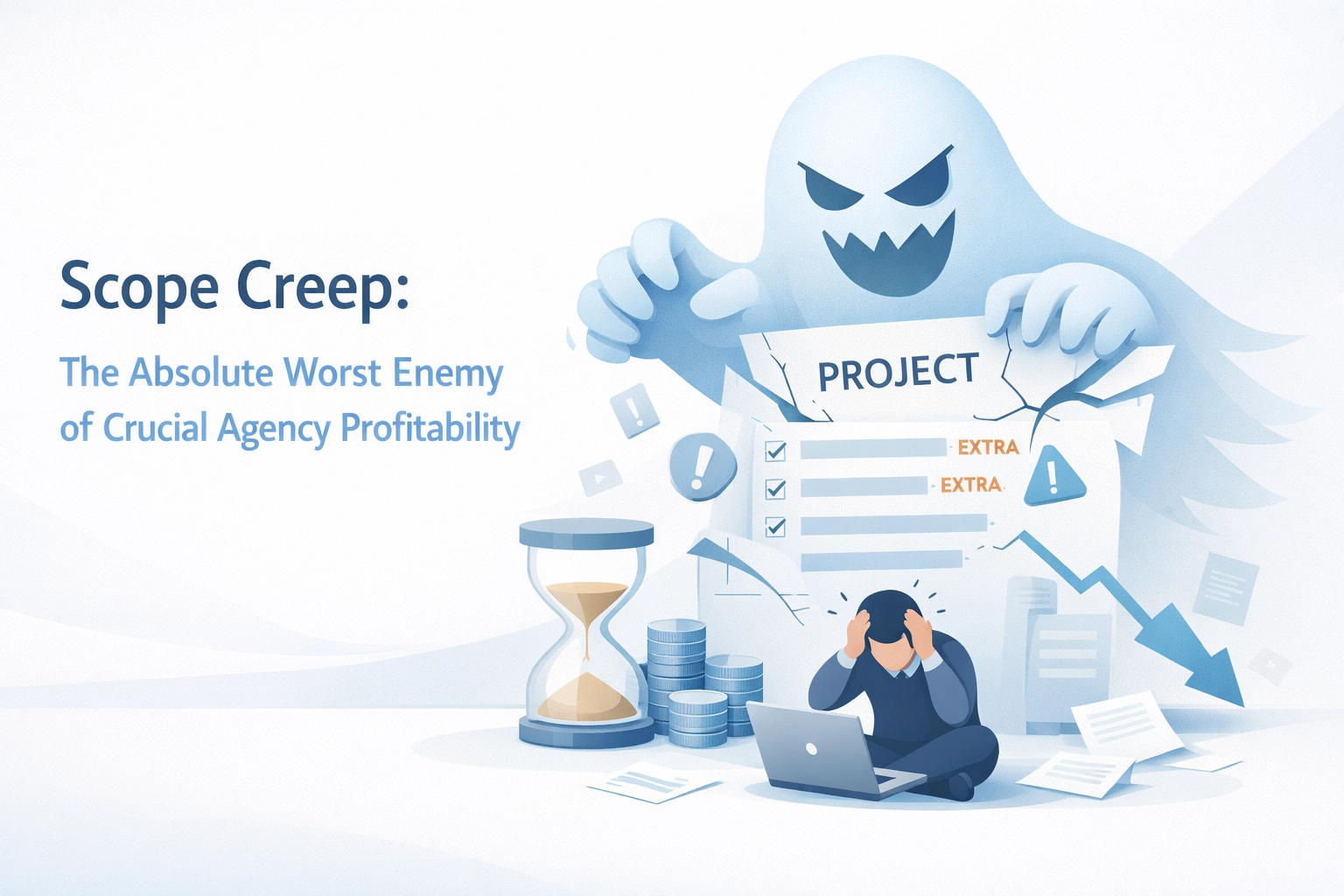
Scope creep is an epidemic that destroys professional boundaries, guts profit margins, and drives elite digital professionals toward burnout. In the world of app development and digital agency work, it rarely arrives with a bang. Instead, it is a slow, silent erosion of your time. It begins with a "quick favor" or a "minor tweak" and ends with a four-week project ballooning into a four-month nightmare. For boutique agencies and independent contractors, this isn't just a project management issue, it is a financial crisis.
When you allow the boundaries of a project to blur, you are effectively paying the client to work for them. Every unbilled hour spent on an "extra" feature is an hour stolen from a paying project or your personal life. At GHW-Digital, we have seen brilliant developers and designers lose their passion because they were trapped in a cycle of endless, uncompensated revisions. The reality is simple: if you don’t define the edges of your work with absolute precision, the client will define them for you, usually to your detriment.
The Financial Impact of Scope creep
Unchecked project expansion is the primary reason why high-revenue agencies still struggle with cash flow. According to the Project Management Institute, over 50% of projects experience some form of expansion beyond the original plan. For an agency operating on fixed-price contracts, this is catastrophic. Your profitability is calculated based on a specific allocation of resources over a specific timeframe. When the client demands "just one more page" or a "slight change in the UI logic," and you agree without a formal adjustment, your hourly rate plummets.
Imagine a project quoted at £10,000 based on 100 hours of work. That is a healthy £100 per hour. However, when scope creep adds another 50 hours of unbilled work, your effective rate drops to £66. You are still paying your team, your overhead, and your taxes on the original 100-hour estimate. The extra 50 hours represent pure loss. This "leaking revenue" is the absolute worst enemy of agency growth because it remains invisible on the surface while rotting the bottom line from within.

Why Your Current Templates Are Failing You
Most freelancers and small agencies rely on boilerplate contracts downloaded from generic "legal-lite" websites. These documents are designed to be "fair" and "accessible," which is often code for "vague." A contract that lacks a specific exclusions list is an invitation for abuse. If your agreement only states what you will do, it leaves an infinite vacuum regarding what you won't do.
Generic contracts often fail to address the nuances of digital work, such as browser compatibility, third-party API changes, or the subjective nature of "design feedback." Without a structured framework, you are forced to negotiate every minor change from a position of weakness. You feel like the "difficult" one for asking to be paid for extra work. This psychological pressure is a tactic used by predatory clients to extract free labor. You need a system that shifts the burden of professionalism back onto the client.
Eliminating Scope creep with ScopeGuard Pro Elite
The solution is not to "be more assertive" in meetings; the solution is to bake protection into the very foundation of the engagement. This is why we developed ScopeGuard Pro Elite. This tool is not a generic generator; it is a sophisticated drafting partner that builds a 17-article Master Service Agreement (MSA) specifically designed to stop project bloat before the first line of code is written.
Our framework doesn't just list deliverables; it creates a defensive perimeter around your time. By utilizing a structured, field-tested legal scaffolding, you project an aura of elite professionalism that commands respect. Clients are less likely to push boundaries when they see a contract that explicitly details how those boundaries are protected.

Precise Exclusions: Defining the "No"
One of the most powerful features of the ScopeGuard Pro framework is the Strict Scope Prevention clause. Most professionals make the mistake of only defining the "In-Scope" items. ScopeGuard Pro forces you to define the "Exclusions." By explicitly stating that items like "SEO migration," "custom iconography," or "IE11 compatibility" are not included, you transform a potentially awkward conversation into a simple reference to the signed agreement.
When a client asks for something outside the initial brief, you don't have to say "no." You say, "That’s a great idea; as per Article 1 of our agreement, that falls under the Exclusions list. I’ll send over a Change Order so we can get that added to the roadmap." This moves the conversation from a conflict of personality to a standard business procedure. It protects your profitability while maintaining the relationship.
Change Order Protocols: Turning Requests Into Revenue
A project that grows isn't necessarily a bad thing, provided that growth is funded. Scope creep only kills profitability when the work is free. ScopeGuard Pro Elite drafts specific language that mandates a formal Change Order process. This ensures that any deviation from the original Statement of Work requires a written description of the change, an adjustment to the timeline, and: most importantly: an additional fee.
By establishing this protocol on Day 1, you train the client to value your time. They quickly realize that "quick favors" have a price tag. Often, you will find that the "urgent" features suddenly become unnecessary when the client is asked to pay for them. This is the ultimate filter for separating serious partners from those looking for a handout.
Client Delay Liability: Protecting Your Schedule
Revenue isn't just lost through extra work; it's lost through stalled work. When a client takes three weeks to provide feedback or delays sending essential assets, they are effectively holding your production capacity hostage. You cannot easily fill that gap with another project because you are "on call" for the current one.
ScopeGuard Pro includes Client Delay Liability clauses. These shift the financial burden of stalling back onto the client. If the project is delayed due to client inaction, the draft allows for timeline extensions and, in some cases, "restart fees" or adjusted milestones. This ensures that your agency's schedule is respected as a professional asset, not a flexible suggestion.

Late Payment Mechanisms: The Legal Shield
Profitability is meaningless if the cash never hits your bank account. Many agencies face a form of "terminal scope creep" where a client holds the final payment hostage until a new, unbilled feature is added. They use your final invoice as leverage.
ScopeGuard Pro Elite drafts include explicit references to the Late Payment of Commercial Debts (Interest) Act 1998. By invoking the law by name and including statutory compensation and legal cost recovery provisions, you signal to the client's internal legal or finance team that you are not a disposable freelancer. You are a professional entity protected by a structured framework. This significantly reduces the "wait time" for invoices and protects your cash flow from predatory withholding tactics.
Secure Your Margins Today
The difference between a struggling boutique agency and a thriving, elite firm often comes down to the quality of their boundaries. You cannot build a sustainable business on the shifting sands of client whims. You need a rock-solid foundation that allows you to do your best work without the constant fear of being exploited.
As noted in recent business analysis by Harvard Business Review, clear contractual boundaries lead to higher client satisfaction because they eliminate the ambiguity that causes friction. When everyone knows exactly what is being delivered, when, and for how much, the focus stays on the quality of the work rather than the "negotiation" of the scope.
Stop working for free. Stop letting "one more thing" eat your profit. Utilize the power of ScopeGuard Pro Elite to draft a contract that works as hard as you do. Protect your time, defend your margins, and reclaim your professional autonomy.
Marbalism Legal Shield & Privacy Commitment
At GHW-Digital, we believe in radical transparency. ScopeGuard Pro is a drafting support tool, not a law firm. The documents generated are structured drafts intended to provide a high-level professional starting point. We always recommend that you have a qualified solicitor or attorney review your final contract to ensure it complies with your specific local jurisdiction and business needs. Your data is handled with enterprise-grade security; we do not sell your project details to third parties. We provide the framework; you provide the expertise. Together, we protect the future of digital work.
Lock in your profit. Start drafting with ScopeGuard Pro Elite today.
Special Offer: Use discount code BLOG20 for 20% off ScopeGuard Pro. Valid until April 1st, 2026.
Powered by GHW Digital (Company No: 16834250). This document is an automated draft for business organization purposes only. It does not constitute legal advice. GHW Digital accepts no liability for disputes, financial loss, or enforceability. Users must consult a qualified professional in their jurisdiction before signing.
Leave a Reply