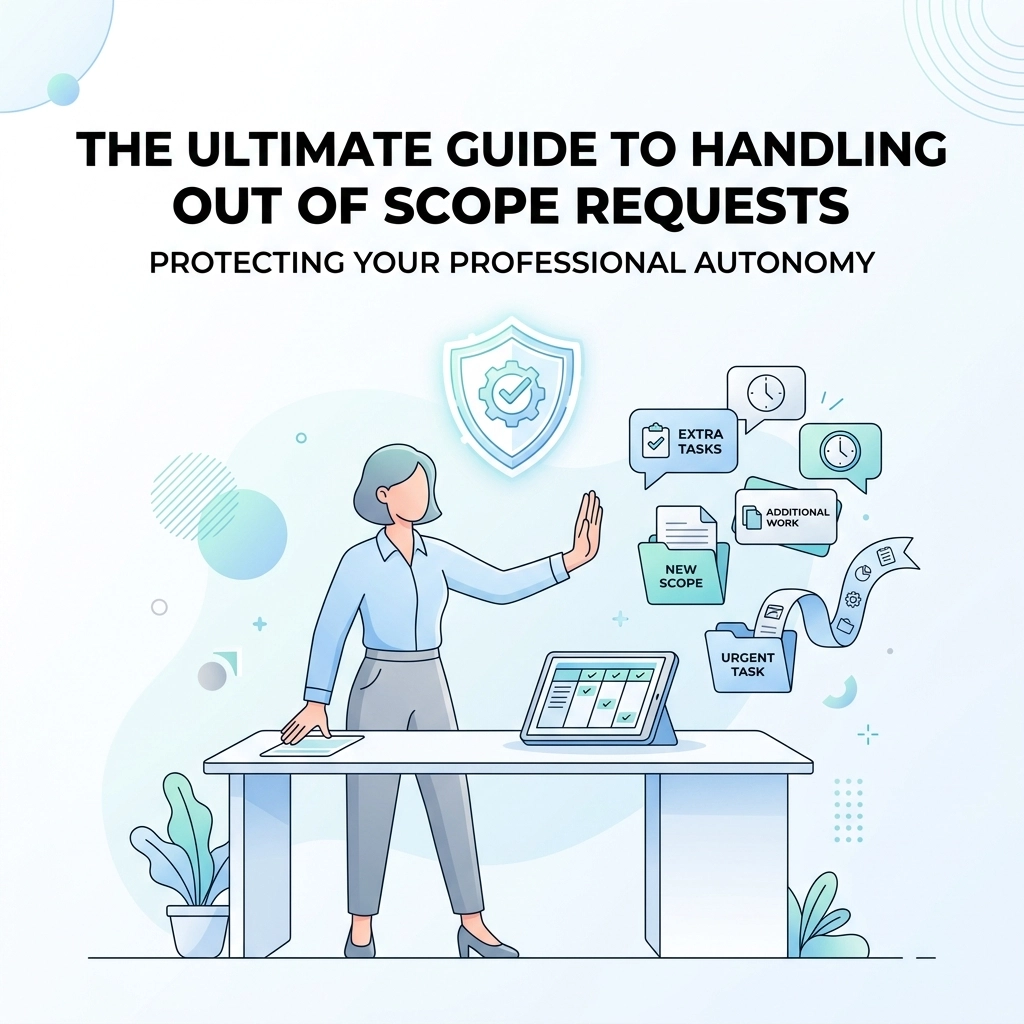
Scope Creep Management is the difference between a thriving app development business and a slow, agonizing burnout. In the world of high-stakes software engineering and design, the "quick favor" is a silent killer. It starts as a minor color change and ends as a complete overhaul of the database architecture. If you don’t control the boundary, the boundary controls you.
At GHW-Digital, we approach every project as Digital Architects. We don’t just build apps; we design systems. When you build a skyscraper, you don’t decide to add an extra ten floors halfway through without renegotiating the foundation. Software is no different. Protecting your professional autonomy requires a rigid adherence to the original blueprint. This guide is your tactical manual for identifying, confronting, and neutralizing out-of-scope requests before they bleed your margins dry.
The Architecture of Scope Creep Management
Every independent contractor has felt that sinking feeling when an email arrives with the phrase, "While you're at it…" This is the first crack in the dam. Without active Scope Creep Management, your project’s profitability will leak until there’s nothing left but resentment.

Scope creep occurs when the requirements of a project expand beyond the initial agreement without a corresponding increase in budget or time. It is a failure of communication and a failure of documentation. To combat this, you must treat your Independent Contractor Agreements as living documents that serve as a shield. If a request isn't in the agreement, it doesn't exist in the current reality of the project.
Identify the Shift – Recognize the Puncture
Before you can manage a request, you must categorize it. Not all requests are equal. Some are genuine pivots, while others are "feature bloat" disguised as necessity.
- Internal Expansions: These are small additions to existing features that seem harmless but accumulate quickly.
- External Disruptions: These are entirely new features or integrations that were never mentioned in the discovery phase.
- Strategic Pivots: These happen when a client realizes their original idea won't work and wants to change direction entirely.
Identifying these shifts early is the first step in effective Scope Creep Management. You can find more strategies for identifying project shifts at GHW-Digital Ideas.
Use Change Orders – Calculate Real Costs
The moment a request falls outside the lines, the conversation must shift from "can we do this" to "how does this affect the resources." A change order is not an act of aggression; it is an act of clarity. It identifies the new request, calculates the impact on the timeline, and adjusts the budget accordingly.
Calculate the Impact – Secure the Timeline
Every hour spent on an out-of-scope feature is an hour stolen from the original delivery date. Use tools like Scope Sentry to visualize these shifts for your clients. When they see the launch date moving in real-time, they often reconsider the necessity of the "extra" feature.
Track the Resources – Protect the Margin
Profitability relies on a fixed ratio of labor to capital. When labor increases without capital, the project enters a death spiral. Scope Creep Management ensures that every hour of work is accounted for and billed. You are not a charity; you are a professional providing a high-value service.

Draft Solid Agreements – Protect Your Time
Your defense starts long before the first line of code is written. Your Independent Contractor Agreements must be airtight. A minimalist agreement that lacks detail is an invitation for trouble. You need to specify exactly what is included and, more importantly, what is excluded.
- Deliverables: List them with granular detail. Instead of "Mobile App," write "User authentication, profile management, and payment integration."
- Revisions: Define the number of allowed revisions. Anything beyond that is a billable event.
- Communication: State how and when you will communicate. Constant Slack messages at 11 PM are out of scope.
We recommend checking out the latest industry standards on GHW-Digital Ideas for drafting modern, minimalist contracts that prioritize speed and clarity.
Mastering Scope Creep Management Through Communication
Handling a client who wants more for less requires a stern but professional stance. You don't need to be emotional; you need to be factual. Use "Action-Benefit" statements to explain why boundaries are necessary.
Frame the Boundary – Ensure Quality
Instead of saying "I won't do that," say "To maintain the quality and security of the core features we agreed upon, we need to treat this new request as a separate phase or a change order." This positions you as the guardian of their project's success, not an obstacle.
Ask Clarifying Questions – Expose the Scope
When a client asks for something extra, ask: "How does this align with the primary objective we set in the initial scope?" This forces the client to justify the request and often leads them to realize it's unnecessary.
For more templates on professional communication, visit our resource hub at GHW-Digital Ideas.

The Digital Architect’s Toolbox
To maintain a minimalist and efficient workflow, you need the right tools. We’ve developed a suite of products at GHW-Digital specifically designed for Scope Creep Management.
- Scope Guard Elite: This is your primary defense mechanism. It allows you to lock in project parameters and automatically flags requests that deviate from the plan. Check it out here: Scope Guard Elite.
- Scope Sentry: A monitoring tool that tracks project velocity and alerts you when "minor" changes start to snowball into major delays.
- Vow Guard Elite: Ensuring that your contracts are signed and stored with cryptographic integrity, making the original scope indisputable.
Using these tools signals to your clients that you are serious about your professional boundaries. It creates an environment of mutual respect and alignment. According to Forbes, professional boundaries are the foundation of long-term business relationships.
Independent Contractor Agreements as a Foundation
Your agreement is the blueprint. If the blueprint is vague, the house will be crooked. Effective Scope Creep Management begins with a contract that respects both parties. It should include a specific section on "Change Management." This section should outline exactly how out-of-scope requests will be handled, the hourly rate for extra work, and the approval process for timeline extensions.
Don't leave room for "interpretation." Interpretation is where profits go to die. Be the architect who knows every measurement. You can find more minimalist contract templates and ideas at GHW-Digital Ideas.

The Cost of Saying Yes
Every time you agree to an out-of-scope request for free, you are training your client to disrespect your time. You are setting a precedent that your boundaries are negotiable. In the long run, this devalues your expertise and the entire app development category.
Protect Your Reputation – Deliver on Promise
By sticking to the scope, you ensure that the original project is delivered on time and at the highest quality. A project that is "feature-rich" but three months late and over budget is a failure. Scope Creep Management is about delivering on your promises.
Lock In Your Success – Stop the Leak
Use the tools at your disposal. Whether it’s Scope Guard Elite or a simple, well-drafted change order, take control of your project’s trajectory.
For more insights on how to scale your freelance business without losing your mind, keep an eye on GHW-Digital Ideas. We post daily updates for the modern Digital Architect.
Marblism Legal Shield Disclosure
The information provided in this blog post does not, and is not intended to, constitute legal advice; instead, all information, content, and materials available in this post are for general informational purposes only. Readers should contact their attorney to obtain advice with respect to any particular legal matter, including the drafting of Independent Contractor Agreements.
Stop the leak. Protect your profit. Secure your autonomy now.
Explore GHW-Digital Solutions
Leave a Reply