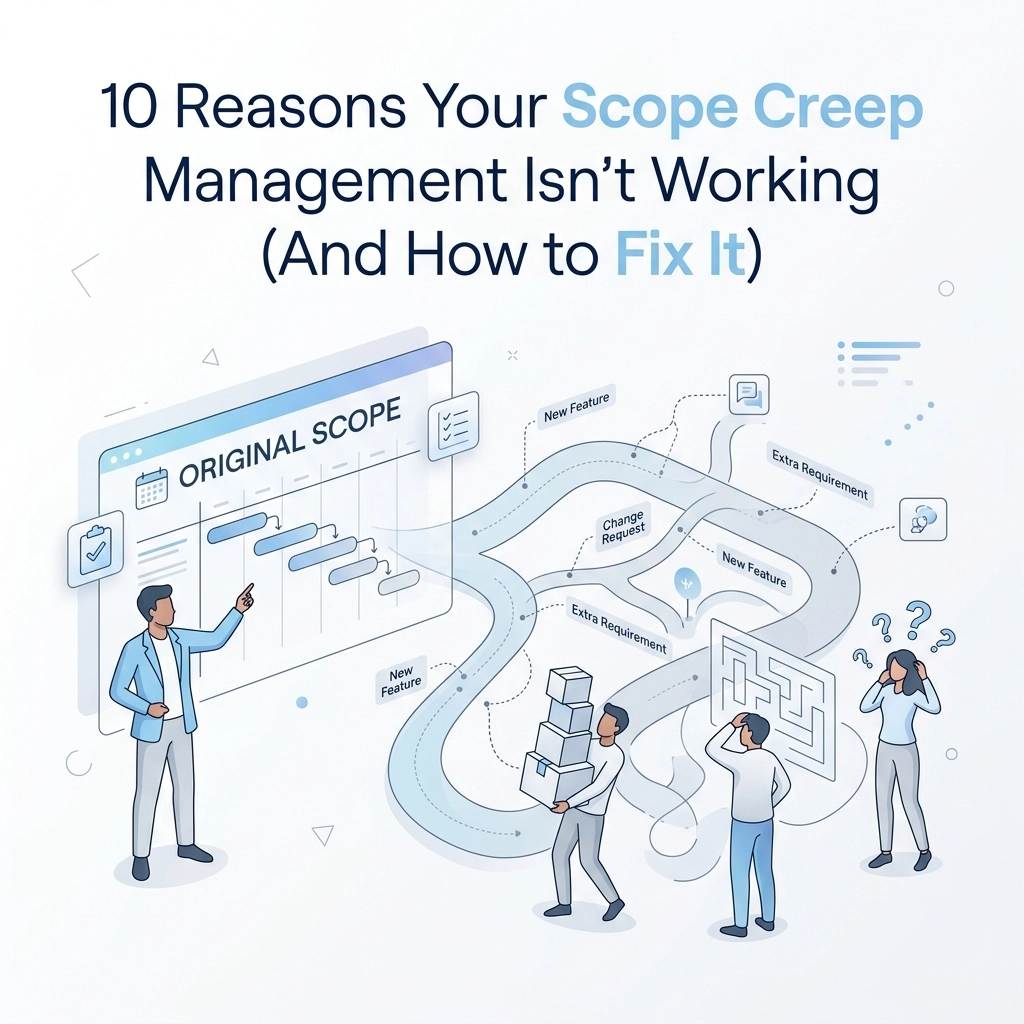

Scope Creep Management is the only thing standing between your project's profitability and a total collapse of your margins. If you’ve ever reached the end of a sprint only to realize you’ve done 40% more work for 0% more pay, you don’t have a "difficult client" problem. You have a structural failure in your workflow.
As a Digital Architect at GHW-Digital, I see this every day. Projects don't fail because of a lack of talent. They fail because the boundaries were made of sand. We treat software development like construction, yet we often forget to sign off on the blueprints before we start pouring the concrete. If you want to protect your time and your sanity, you need to stop reacting and start architecting your defense.
1. Ambiguity is the Silent Margin Killer
The most common reason for failure in Scope Creep Management is a lack of precision. Vague terms like "user-friendly," "fast," or "modern" are traps. They are subjective. When a client says "fast," they might mean a 100ms load time. You might think 2 seconds is fine.
Without a technical baseline, you are essentially giving the client a blank check to define "done" however they feel on a Tuesday morning. You need a Work Breakdown Structure (WBS) that translates "vibes" into "variables." If it isn't documented with a specific metric, it doesn't exist. This is where most Independent Contractor Agreements fail; they cover the money, but they don't cover the technical definition of success.
2. Your Independent Contractor Agreements Are Too Soft
A contract isn't just a legal formality; it is your shield. If your Independent Contractor Agreements don't explicitly define what constitutes a "change request" versus a "bug fix," you are asking for trouble.
Many freelancers use generic templates that are too broad. To fix this, your agreements must include a "Scope Freeze" clause. This locks the requirements at a specific date. Anything added after that date isn't a "small tweak", it's a new invoice. We leverage tools like Vow Guard Elite to ensure these boundaries are legally and operationally clear from day one.

3. The "Just One Quick Thing" Trap
Scope creep doesn't usually happen in a massive explosion. It happens in whispers. A quick color change here, an extra button there. These micro-requests are the termites of the development world. Individually, they seem harmless. Collectively, they bring the house down.
Effective Scope Creep Management requires a "No Free Lunch" policy. Even a five-minute task has an administrative cost. It breaks developer flow and pushes back testing. If you don't track these "quick things," you lose visibility on the project's true velocity. Check out our thoughts on velocity and ideas to see how we handle these shifts.
4. Lack of Formal Change Control
If a client can request a feature over a casual Slack message, your process is broken. Verbal or informal requests are the primary drivers of project drift.
You need a formal Change Request Form. It should include:
- The description of the change.
- The impact on the timeline.
- The impact on the budget.
- A signature (digital or physical).
By forcing a formal process, you introduce "friction" for the client. This friction isn't bad; it forces the client to evaluate if the change is actually worth the cost. According to the Project Management Institute, uncontrolled changes are the leading cause of project failure.
5. You Haven't Defined What Is Out of Scope
Standard Scope Creep Management focuses on what you will do. Expert management focuses on what you won't do.
Every proposal should have a "Not Included" section.
- "We will build the API, but we will NOT handle third-party integration maintenance."
- "We will design the UI, but we will NOT provide custom photography."
By explicitly stating the exclusions, you eliminate the "I thought that was included" conversation before it starts. This clarity is essential for any robust Independent Contractor Agreements that aim to protect the service provider.
6. Ignoring the Monitoring Phase
You cannot manage what you do not measure. If you aren't comparing your actual progress against your initial baseline every single week, you aren't managing scope; you're just hoping for the best.
Variance analysis is your best friend. If you planned for 40 hours and you've spent 60 on a feature that is "almost done," you have a leak. Tools like Scope Sentry help you visualize these deviations before they become catastrophic.

7. Fear of Saying "No"
Freelancers and small agencies often suffer from a fear of conflict. They worry that saying "no" to a request will damage the relationship or lead to a bad review.
In reality, saying "yes" to everything is what ruins relationships. When the project is two months late and you're asking for more money because you're exhausted, the client won't remember the 50 "small favors" you did. They will only remember that you missed the deadline. Professionalism is about setting boundaries. A "no" today is a "thank you" on launch day.
8. Requirements Gathering is Too Shallow
If your requirements gathering process takes less than 10% of the total project time, it’s too shallow. Most Scope Creep Management fails because the foundation was built on assumptions.
You need to act like a detective. Ask the "dumb" questions.
- "What happens if the user loses internet connection here?"
- "Who approves the content for this section?"
- "Where does this data actually come from?"
Uncovering these details during the discovery phase is cheap. Uncovering them during the coding phase is expensive. We dive deep into this on our app development philosophy page.
9. Stakeholder Fragmentation
Who is the "Captain" of the project? If you are taking orders from three different people at the client's company, you are doomed. Stakeholder A wants more data; Stakeholder B wants a cleaner UI; Stakeholder C wants it done yesterday.
Your Independent Contractor Agreements should specify a single Point of Contact (POC). This person is the only one authorized to approve scope changes. This prevents "scope by committee," where features are added to satisfy internal office politics rather than project goals.

10. You Aren't Using the Right Tools
Managing scope in a spreadsheet is like trying to build a skyscraper with a hand-saw. It might work for a tiny shed, but it won't scale.
Modern Scope Creep Management requires integrated tools that link your contracts, your tasks, and your time tracking. This is why we developed Scope Guard Elite. It creates a digital perimeter around your project, ensuring that every shift is documented, priced, and approved.
The Fix: Moving Goalposts into Locked Gates
The solution to scope creep isn't to work harder; it's to work with better governance. You need to transition from a "service provider" mindset to a "Digital Architect" mindset.
- Re-Baseline Regularly: If a major change is approved, reset your baseline. Don't try to cram new work into an old timeline.
- Educate the Client: Most clients don't want to ruin your life; they just don't understand the technical implications of their requests. Explain the "Trade-off Triangle": Quality, Time, or Cost. If one moves, at least one other must change.
- Audit Your Agreements: Ensure your Independent Contractor Agreements are updated to reflect the realities of modern dev cycles.
As noted by Harvard Business Review, the most successful projects are those where expectations are managed as rigorously as the code itself.

The Bottom Line
Scope creep is a choice. You either choose to manage it, or you choose to let it manage you. By implementing a strict change control process, hardening your legal agreements, and using precision tools, you can reclaim your margins and deliver better products.
Stop leaking revenue. Start building with a shield.
Marblism Legal Shield & Privacy Commitment
At GHW-Digital, we believe in radical transparency. All project data and contract architectures managed through our platforms are encrypted and handled with zero-party data principles. We do not sell your project metrics or client lists. Our goal is to protect your intellectual property and your profits through blunt, honest, and ethical software solutions. Your boundaries are our business.
Ready to lock down your next project? Explore our Ideas and Solutions to see how we can help you stop the creep.
Leave a Reply